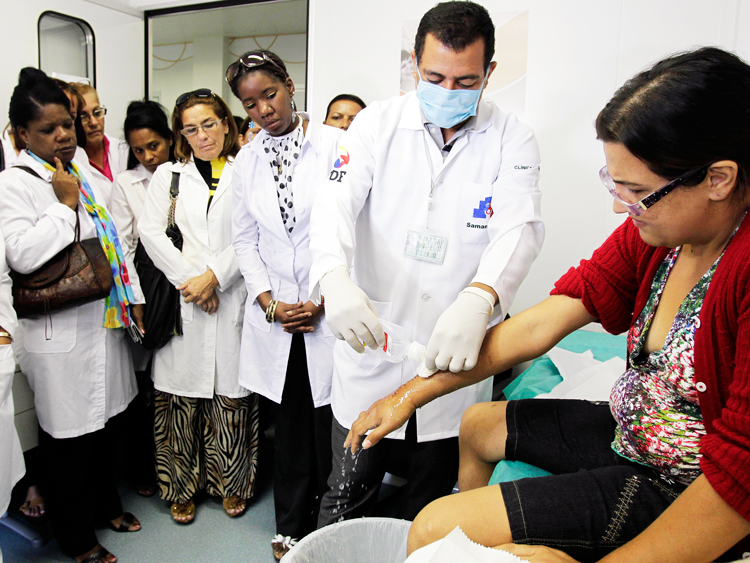
In the latest move by Washington to tighten its brutal economic war against Cuba, the U.S. government revoked visas from officials in Brazil who had helped expand Cuba’s international medical missions there. Since 1963 Cuba’s revolutionary government has organized doctors and nurses to answer the requests of governments around the world, bringing vital treatment to people in the most remote rural regions or worst-off urban neighborhoods.
They’ve helped establish medical schools in Africa, Latin America and the Middle East. The missions are voluntary, and Cuban medical workers receive their full salaries and pensions, contrary to Washington’s repeated slander that the program is “human trafficking.”
The State Department revoked the visas of several Brazilian government and former Pan American Health Organization officials Aug. 13. They include Mozart Julio Tabosa Sales and Alberto Kleinman, who served in Brazil’s Ministry of Health when the government there established the Mais Medicos (More Doctors) program in 2013 with Cuban assistance. Washington revoked the visas of their family members as well.
“These officials were responsible for or involved in abetting the Cuban regime’s coercive labor export scheme, which exploits Cuban medical workers through forced labor,” Secretary of State Marco Rubio claimed. “This scheme enriches the corrupt Cuban regime and deprives the Cuban people of essential medical care.”
Brazilian Health Minister Alexandre Padilha responded to Washington’s attack, saying, “We will not bow to those who persecute vaccines, researchers, science — and now two of the key people behind Mais Medicos.”
Cuban doctors have treated millions of patients in over 3,600 municipalities across Brazil.
“Cuba will not abandon its health care programs in dozens of countries,” Cuban Deputy Foreign Minister Carlos Fernández de Cossío said. “These are absolutely legitimate and, more importantly, they save lives and bring relief to communities.”
The State Department says it intends to revoke or restrict the visas of officials in Cuba, in Grenada and other Caribbean countries, and in African nations that were involved with Cuba’s overseas medical missions.
The plan is an extension of moves by former Democratic President Joseph Biden, who signed a bill that included sanctions against officials from countries that contracted Cuba’s medical services.
Several Caribbean government heads responded to Washington’s attack, saying they will gladly waive their right to U.S. visas if that’s what’s needed to keep Cuban medical workers in their countries.
Barbados Prime Minister Mia Mottley called Washington’s actions “unfair and unjustified.” She said, “We could not get through the pandemic without the Cuban nurses and the Cuban doctors.”
Grenada Foreign Minister Joseph Andall called the Cuban internationalist program “indispensable.”
“A significant percentage” of the country’s doctors are trained in Cuba at no cost to Grenada, he said. “Without the input of the Cuban Medical Brigade there is no question that our health system will collapse.” He praised the “generous intervention of Cuba and for that we must always take a principled stand.”
According to the U.S. State Department’s own figures, Cuba currently has more than 26,000 doctors and nurses volunteering in 55 countries worldwide. In addition to providing primary care and specialists, the Cuban missions have led the response to regional disasters, such as hurricanes, earthquakes and public health emergencies.
Cuban doctors played decisive roles combating the cholera outbreak in Haiti following a devastating earthquake there in 2010, and assisting Caribbean nations and elsewhere, including Italy, during the COVID-19 pandemic.
Through Operation Miracle, Cuba organized 3 million ophthalmic surgeries to treat eye diseases across Latin America and nations in the Caribbean. During the deadly Ebola virus outbreak in West Africa in 2014, Cuba chose 256 out of a total of 12,000 volunteers to join the “army of white coats,” as Fidel Castro, the revolution’s central leader, called them.
In 2019 Cuban doctor Enmanuel Vigil Fonseca told BBC that some of the medical services provided by the missions are through agreements that include payment, others are provided at no cost. The payment terms are no secret to the participating volunteers, he said. The much-needed currency is used to maintain the social gains of the revolution, including in its own health care system. “Each participant knows that they get a part and the rest goes to the National Health System,” Fonseca said. “Not into someone’s pocket to enrich themselves.”
The Cuban government’s internationalism is a product of what working people accomplished when they made a socialist revolution, transforming their conditions of life and themselves in the process.