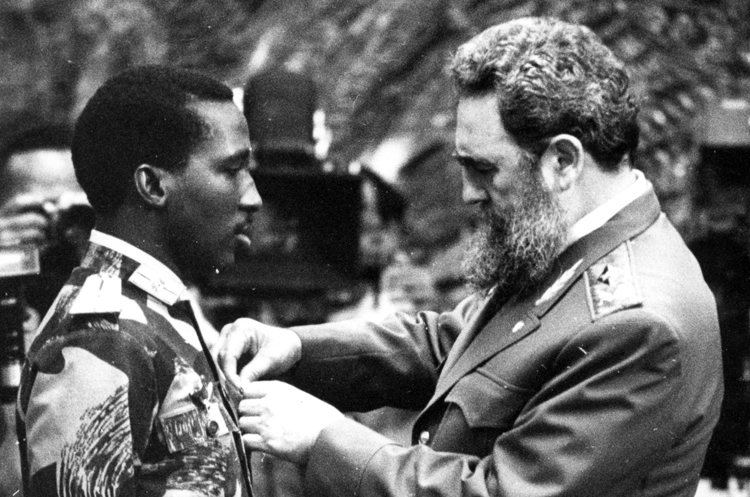
We Are Heirs of the World’s Revolutions: Speeches from the Burkina Faso revolution 1983-87 by Thomas Sankara is one of Pathfinder’s Books of the Month for August. Sankara led an uprising in the former French colony of Upper Volta in August 1983 that brought a popular revolutionary government to power. In one of the poorest countries in the world, workers, peasants, women and youth were organized to take control of their own destiny. An outstanding communist, he followed the example of Cuban revolutionary leaders Fidel Castro and Che Guevara. Below is an excerpt from his speech, “You cannot kill ideas: A tribute to Che Guevara,” given on Oct. 8, 1987, marking the 20th anniversary of Che’s death in combat in Bolivia. Sankara was assassinated a week later in a counterrevolutionary coup. Copyright © 2007 by Pathfinder Press. Reprinted by permission.
Dear friends, we join our voices with everyone in the world who remembers that one day a man called Che Guevara … his heart filled with faith, took up the struggle alongside other men and, in so doing, succeeded in creating a spark that powerfully disturbed the forces of occupation in the world.
We simply want to say that a new era in Burkina Faso has come, a new reality is on the march in our country. That’s how Che Guevara’s call to action must be understood — Che, who wanted to light fires of struggle throughout the world.
Che Guevara was cut down by bullets, imperialist bullets, under Bolivian skies. And we say that for us, Che Guevara is not dead.
One of the beautiful phrases often recalled by revolutionaries, by the great Cuban revolutionaries, is the one that Che’s friend, his companion in struggle, his comrade, his brother, Fidel Castro himself repeated. He heard it from the mouth of a man of the people one day during the struggle — one of Batista’s officers who, despite being part of that reactionary, repressive army, managed to connect with the forces fighting for the well-being of the Cuban people. Right after the assault on the Moncada garrison had failed, when those who had attempted it were about to be put to death by the guns of Batista’s army — they were going to be shot — the officer said simply, “Don’t shoot, you cannot kill ideas.”
It’s true, you cannot kill ideas. Ideas do not die. That’s why Che Guevara, an embodiment of revolutionary ideas and self-sacrifice, is not dead. You have come here today [from Cuba], and we draw inspiration from you.
Che Guevara, an Argentine according to his passport, became an adopted Cuban through the blood and sweat he shed for the Cuban people. He became, above all, a citizen of the free world — the free world that we’re building together. That’s why we say that Che Guevara is also African and Burkinabè.
Che Guevara [made] his beret … and its star known almost everywhere in Africa. From the north to the south, Africa remembers Che Guevara. …
Che is Burkinabè. He is Burkinabè because he participates in our struggle. He is Burkinabè because his ideas inspire us and are inscribed in our Political Orientation Speech. He is Burkinabè because his star is stamped on our banner. He is Burkinabè because some of his ideas live in each of us in the daily struggle we wage.
Che is a man, but a man who knew how to show us and teach us that we can dare to have confidence in ourselves and our abilities. Che is among us.
What is Che, I’d like to ask? Che, to us, is above all conviction, revolutionary conviction, revolutionary faith in what you’re doing, the conviction that victory belongs to us, and that struggle is our only recourse.
Che is also a sense of humanity. Humanity — this expression of generosity and self-sacrifice that made Che not only an Argentine, Cuban, and internationalist combatant, but also a man, with all the warmth of a man.
Che is also, and above all, demanding. The demanding character of one who had the good fortune to be born into a well-to-do family … Yet he was able to say no to those temptations, to turn his back on the easy road in order, on the contrary, to assert himself as a man of the people, a man who makes common cause with the people, a man who makes common cause with the suffering of others. Che’s demanding character is what should inspire us the most.
Conviction, humanity, a demanding character — all this makes him Che. Those who are capable of mustering these virtues within themselves, those who are capable of mustering these qualities within themselves — this conviction, this humanity, and this demanding character — they can say that they are like Che — men among men, but, above all, revolutionaries among revolutionaries.
We have just looked at these pictures that trace part of Che’s life as best they can. Despite their forceful expression, these images remain silent on the most crucial part of the man, the very part against which imperialism took aim. The bullets were aimed much more at Che’s spirit than at his image. His picture is found the world over. His photo is in everyone’s mind, and his silhouette is one of the best-known. So let’s see to it that we’re able to get to know Che better.
Let’s draw closer to Che. Let’s draw closer to him, not as we would a god, not as we would an idea — an image placed above men — but rather … that revolutionaries draw inspiration from Che’s spirit, that they too become internationalists, that they too, together with other men, learn how to build faith — faith in the struggle for change, in the struggle against imperialism and against capitalism.