

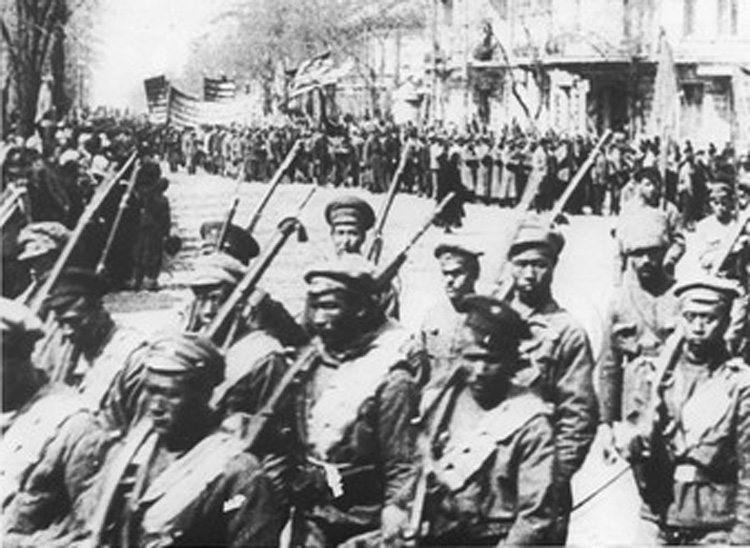
In the Russian Revolution and its defense against imperialist attack and capitalist-led civil war afterward, the V.I. Lenin-led Bolshevik Party put the fight against Jew-hatred at the center of its proletarian internationalist course.
Today, reactionary leaders in the Ukraine government’s “decommunization” drive and other opponents of the Russian Revolution contest this, claiming “Bolshevik pogroms” were widespread during the civil war that raged after working people took political power in October 1917.
Pogroms were the stock-in-trade of the “White” army and other allied counterrevolutionary forces in Ukraine and elsewhere, as they drove to overturn soviet power. They massacred Jews on a scale surpassed only in the Nazi Holocaust itself. More than 100,000 Jews were slaughtered. Complicit were the U.K., French, U.S. and 13 other capitalist governments that intervened, backing the Whites with 180,000 troops, war materiel and funds.
Lenin wrote in 1918 that the weapon of Jew-hatred had “slipped from the hands of the tsar” to those of the bourgeois counterrevolution. He called for “uncompromising measures to tear the antisemitic movement out by the roots. Pogromists and pogrom-agitators are to be placed outside the law.”
“When the accursed tsarist monarchy was living its last days it tried to incite ignorant workers and peasants against the Jews. The tsarist police, in alliance with the landowners and the capitalists … tried to divert the hatred of the workers and peasants who were tortured by want against the Jews,” Lenin said in a gramophone recording he made in March 1919, shortly after the revolution conquered. It was played all across the country.
“It is not the Jews who are the enemies of the working people. The enemies of the workers are the capitalists of all countries,” he explained. “Shame on accursed tsarism which tortured and persecuted the Jews. Shame on those who foment hatred toward the Jews, who foment hatred toward other nations.”
The Bolsheviks pursued this course so vigorously that their enemies referred to communists as the “Yid Party.” They circulated vile posters depicting Red Army leader Leon Trotsky as a Jewish devil. Thousands of Jews flocked to the party and joined the Red Army.
The “Bolshevik pogrom” slander gets traction because some attacks on Jews were carried out under what Trotsky called a “fraudulent red flag” — as White army spies and warlords took advantage of civil war chaos to enter the Red Army for military or personal advantage. Some penetrated the party itself. Revolutionary warriors must face such “cruel truth,” Trotsky wrote.
The Bolshevik leadership took measures to expose and crush the offenders militarily. “Not a single crime committed in the army is to be left unpunished,” Trotsky insisted.
Working-class political course
More broadly, the Bolsheviks moved to implement their program. They explained pogroms are a class question in the imperialist epoch, for which the kulaks — wealthy capitalist farmers — were principally responsible in rural Ukraine and the North Caucasus. “There are a large number of corrupt kulak elements” who seek to “incite the Red Army men to engage in pogroms and banditry,” Trotsky said.
Kulaks grouped around White army leader Gen. Anton Denikin and his Anglo-French backers and reactionary bourgeois nationalists of various stripes, like Symon Petlyura. Others flocked to self-seeking warlords, who set out, Trotsky said, to “plunder the peasants, commit pogroms in the towns … slaughter hundreds of thousands of absolutely innocent people.”
Petlyura, who claimed to be the leader of the fight for Ukrainian independence, allied with reactionary Polish army forces to assault the Red Army. He was notorious for leading his troops in pogroms against Jews. He was assassinated in 1926 by Shalom Schwartzbard, a Jew and former Red Army combatant who had lost 14 relatives to Petlyura’s murderers.
Bolshevik leaders also paid special attention to Nikifor Grigoriev, aligned with the Social Revolutionary Party, and anarchist Nestor Makhno, each of whom built private armies numbering thousands after being exposed and purged from the Red Army.
Such elements found fertile ground for their antisemitic poison among the thousands of former officers of the czarist army who the Bolsheviks recruited into the Red Army to take advantage of their military experience. The Bolsheviks countered the threat of Jew-hatred by assigning communist commissars to give political supervision and leadership while working alongside them.
‘War communism’
As the civil war and imperialist attacks ground on, the Bolsheviks were compelled to organize “war communism,” a regime of austerity, including requisitions of grain from the peasants. This put great strain on the bedrock of the revolution — the worker-peasant alliance.
Richer capitalist-minded kulaks sowed peasant disaffection by denouncing the Bolsheviks, especially in western Ukraine. Though forced into “war communism” by the necessity to feed workers in the towns and Red Army forces during the long and draining war, these measures were never what the Bolsheviks had intended, Lenin said.
The Bolshevik leaders sought to win peasants away from the kulaks. They divided the estates and encouraged land seizures; provided seeds, machinery and training; aided the formation of peasant soviets; and boosted the weight of workers and poor peasants in Red Army regiments. They organized specially equipped trains loaded with books and communist literature to go out into the countryside in an effort to raise the educational and cultural level.
They insisted on the humane treatment of prisoners taken in battle, many of whom were peasants who had misguidedly fallen under the clutches of the kulaks. And they defended the national rights of the Ukrainians against “Great Russian chauvinism.”
Under these conditions, Lenin and Trotsky collaborated closely with fellow Bolshevik Christian Rakovsky, head of the Ukrainian soviet government and Communist Party. Rakovsky led a political campaign of public meetings and articles in the party and soviet press echoing Lenin’s writing and speeches against Jew-hatred, explaining the stakes for the Russian toilers.
This was part of a broader Bolshevik-led nationwide propaganda and educational campaign in which countless numbers of leaflets and pamphlets were distributed, including by the Evsektsiia (Jewish section of the Bolshevik Party) and nonparty Jewish fighters.
Under Bolshevik leadership, workers and peasants prevailed, defeating the White Army, Petlyura’s forces allied with the reactionary Polish army, and other opponents of the revolution. Pogroms became a thing of the past — until Stalin’s murderous counterrevolution revived antisemitism as a weapon against the legacy of Lenin.
The Bolshevik’s course is an example to be emulated.