

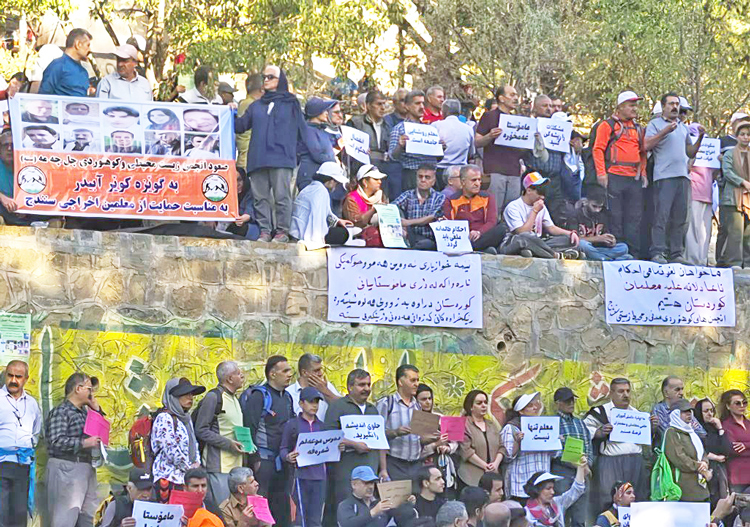
Opposition to the firing, forced retirement or suspension by the government of at least 17 teachers in Iran’s Kurdish region is winning broad support among toilers in Iran and strengthening the fight against the regime’s crackdown on political rights.
The regime arrested more than 21,000 people during and in the wake of Israel’s 12-day defensive war aimed at preventing Tehran from acquiring nuclear weapons. The charges range from criminal offenses to opposing the government. Tehran has executed at least 841 people since the start of the year. It’s on course to go well over the 975 in all of 2024, already one of the highest in the world.
But the regime’s attempt to push back widespread opposition to its rule is failing as protests continue to spread. The teachers’ battle is just one example.
Hundreds of people joined an Aug. 29 walk to the slopes of Abidar Mountain outside Sanandaj to protest the firings and suspensions.
Many of the teachers punished by the Education Department’s Administrative Violations Board had been elected to the leadership of the Kurdistan-Sanandaj Teachers Union or had been candidates in the most recent union election.
The charges against them include organizing “unlawful sit-ins to foment unrest and disrupt the education process,” “participating in illegal teachers’ union channels” and “spreading false information against the Islamic Republic.”
Hundreds of teachers have been suspended or fired since 2022 when “Women, Life, Freedom” protests began after the death of Zhina Amini, a young Kurdish woman who was arrested in Tehran by the hated “morality” police for allegedly violating the women’s dress code.
Oppressed nationalities in Iran include some 10 million to 12 million Kurds — as much as 17% of the population — and 5 million Baluchis, along with millions of Azerbaijanis, Arabs and others who are treated as second-class citizens by the regime. Some of the largest protests against the regime over the last several years have taken place in Kurdistan and Baluchistan. They set an example for working people across the country.
“What has taken place in Kurdistan is not an exception, but a clear mirror of a widespread policy, from north to south and from east to west, that has targeted independent teachers and union activists,” said the Coordinating Council of Iranian Teachers Unions.
A joint statement by the secretary generals of the Islamic Association of Iranian Teachers, the Islamic Educators’ Assembly and the Iranian Teachers’ Organization also condemned the repressive moves. The victimized teachers only crime, they said, “has been pursuing union demands, striving to improve the quality of education, and defending the rights of teachers and students.”
They noted that President Masoud Pezeshkian won the election last year “with the slogan of change,” but instead the crackdown on “teachers and trade union activists” has “intensified.”
The Truckers and Drivers Association of Iran, which led a widely supported 11-day strike at the end of May for higher pay and better conditions, issued a statement Aug. 25 demanding “the immediate annulment of these oppressive verdicts and the reinstatement of the honorable teachers of Kurdistan.”
“Just as truckers and drivers fight on the roads for the right to a decent livelihood and a fair life, teachers too strive in classrooms for the future of this land’s children,” the union said. “Our pain and the teachers’ pain are one — injustice, discrimination and disregard for labor rights.”
Along with repression, the reactionary regime in Tehran is appealing to patriotism and “national unity” after the war with Israel to try and tamp down the protests. But those calls more and more are falling on deaf ears.
More than a year of weekly protests by retirees and oil workers that were interrupted by the war have resumed and are picking up steam.
Frequent power outages as well as water shortages have provoked large protests. Hundreds joined protests in Shiraz Aug. 21, chanting “People are thirsty and in darkness, officials are in comfort and light” and “freedom, freedom, freedom.” They also chanted “Not Gaza, not Lebanon. My life for Iran,” a reflection of the mounting opposition among working people to being used as cannon fodder for the regime’s expansionist course centered on destroying Israel.
The Tehran and Suburbs Bus Drivers union sent a message of solidarity to 4,000 workers at the Arak Aluminum Company in Markazi province who have been holding protests, including hunger strikes, since the beginning of August. “Your struggle is the struggle of all of us workers,” it said.
“We thank you, and we believe that the joining of workers’ hands across the country will, sooner or later, bear fruit,” responded a group of Arak workers.