

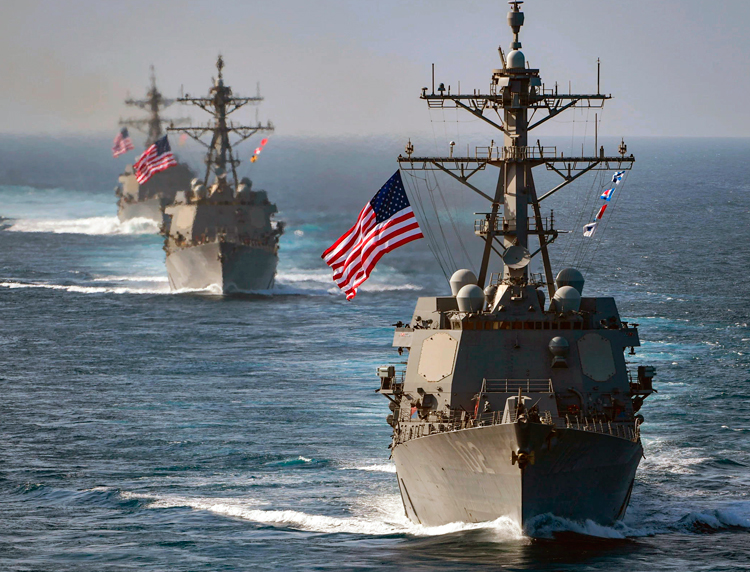
Washington is deploying a significant naval and military armada, the U.S. rulers’ latest move in its longstanding efforts to violate the sovereignty of Venezuela and overthrow its president, Nicolás Maduro. It is also a show of force aimed at intimidating the U.S. rulers’ rivals, including Beijing.
President Donald Trump authorized the deployment of several guided-missile destroyers and the Iwo Jima Amphibious Ready Group, carrying 4,500 troops, including a 2,200-strong Marine unit equipped for landing and invasion.
It is the biggest movement of military assets to the U.S. Southern Military Command jurisdiction in years and part of the government’s moves to reassert Washington’s dominance in Latin America and the Caribbean. Since February, Trump has designated nine Latin American cartels as “foreign terrorist organizations,” laying the basis for U.S. intervention. Two of these are Venezuelan. Without presenting any evidence, Washington has accused Maduro of being the head of the Cartel de los Soles and linked him to the Tren de Aragua gang.
Behind the banner of fighting “narco-terrorism” and defending “national security,” the U.S. government has also moved to extend its use of the military and National Guard forces for law enforcement operations at home. The administration has deployed hundreds of National Guard, first to Los Angeles, then Washington, D.C., saying they are needed to fight crime and get around local officials’ interference with ICE arrests and deportations.
As part of these efforts, the CIA has stepped up surveillance flights along the U.S.-Mexico border, and inside Mexican air space, authorities say, to gather information on drug cartels. Current and former U.S. officials have hinted at the possibility of direct strikes against cartel leaders and drug labs in Mexico.
“Mexico is a free, independent, and sovereign country,” countered Mexico President Claudia Sheinbaum Aug. 22. “No foreign government would dare to violate our sovereignty.”
At the same time, Sheinbaum’s government has steadily increased U.S.-Mexico drug enforcement collaboration.
The Pentagon has established military zones along the border with Mexico where troops can apprehend and detain migrants attempting to cross over until they are transferred to immigration authorities. Military officials hope to intimidate other migrants from trying to cross.
U.S. seeks overthrow of Maduro
Media pundits have drawn parallels between the current U.S. military deployment off Venezuela and the 1989 U.S. invasion of Panama, which overthrew the government of Gen. Manuel Noriega and kidnapped him under the cover of U.S. federal indictments for racketeering and drug trafficking. The invasion by some 26,000 U.S. troops dealt a blow to the sovereignty of Panama, and to the country’s control of the Panama Canal. The area where the canal now stands was seized by Washington in 1904 and returned to Panama in a 1977 treaty after a long and hard fight for national dignity and self-determination.
“Maduro will not escape justice and he will be held accountable for his despicable crimes,” Attorney General Pam Bondi said Aug. 7 as she announced the U.S. government was doubling the bounty for the arrest of Maduro to $50 million. In 2020 the first Trump presidency offered a $15 million reward, which was raised by the Joseph Biden administration to $25 million.
The drive to violate the sovereignty of Venezuela and bring down the Maduro government is bipartisan policy in Washington.
No court hearing or legal proceeding is required for the U.S. government to designate a foreign government or official as a terrorist or drug trafficker. Such a designation allows it “to use other elements of American power, intelligence agencies, the Department of Defense, whatever … to target these groups,” said Secretary of State Marco Rubio.
Washington is also moving to rally support from its allies in the region. “Just last week, Ecuador, Paraguay, Guyana, Trinidad and Tobago, today, Argentina,” Rubio said Aug. 26, are “joining us to help move this forward.”
By designating Maduro as head of a terrorist entity, the U.S. president can use executive orders and military and intelligence resources to attack that organization.
For nearly three decades, the U.S. rulers have tried to overthrow the Venezuelan government and impose one more subservient to Washington, and to take back control over the country’s vast oil reserves.
By painting a target on President Maduro’s back, Washington also seeks to magnify the effects of its crippling economic and financial sanctions against Venezuela.