The U.S. military cold-bloodedly killed 11 people on a speedboat in international waters off the coast of Venezuela Sept. 2, violating the sovereignty of Venezuela, other Caribbean nations and beyond. President Donald Trump claimed, without providing any evidence, the boat carried drugs destined for the United States, organized by “Tren de Aragua Narcoterrorists … operating under the control of [Venezuelan President] Nicolas Maduro.”
The attack was carried out without a warning shot and no effort to apprehend the crew. The administration says it’s planning to carry out further attacks.
The sinking of the boat took place just days after the Pentagon deployed eight warships, several navy surveillance planes and a nuclear submarine to the Caribbean — with some 4,500 troops, including 2,200 Marines — on top of other ships already operating there, aimed at threatening Venezuela.
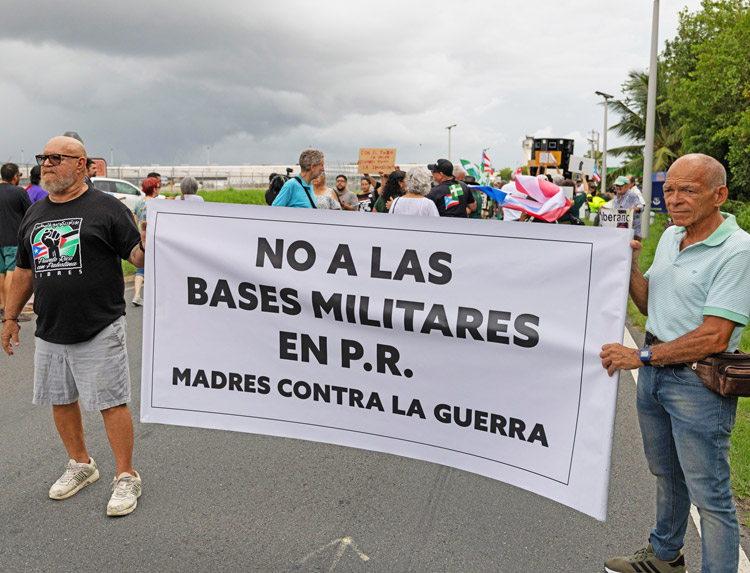
Marine and navy troops on Puerto Rico’s southern coast began practicing amphibious landings. The Pentagon also sent 10 stealth F-35 fighter jets to the former Roosevelt Roads Naval Station in Ceiba on the U.S. colony — now a civilian airport — putting them within striking distance of Venezuela. That base has been “closed” since 2004 after years of protests against the U.S. military presence on the island.
War Secretary Peter Hegseth, accompanied by Joint Chiefs of Staff Chairman Dan Caine, visited Puerto Rico Sept. 8. The Pentagon is weighing the possibility of using the island as a base for ongoing operations as Washington reasserts its power in the Caribbean and Latin America.
This was the first time the U.S. rulers have openly acted on their assertion they can kill anyone they accuse of being part of a criminal gang, denying those accused of due process and the opportunity to defend themselves at a trial. It’s also the U.S. military’s first publicly acknowledged airstrike in Latin America or the Caribbean since the invasion of Panama in 1989.
“Interdiction doesn’t work,” Secretary of State Marco Rubio claimed at a press conference in Mexico City Sept. 3, because the drug cartels “know they’re going to lose 2% of their cargo.”
‘We’ll keep blowing boats up’
“What will stop them is when you blow them up,” he said. “The point is the president of the United States is going to wage war on narco-terrorist organizations.” He pledged that blowing up boats would “happen again.” Trump said, “There’s more where that came from.”
But the prime target of the display of U.S. military might was not drug cartels, but Venezuela. Under both Democratic and Republican administrations, Washington has sought to force out President Nicolás Maduro and replace his regime with one that will better carry out the demands of the U.S. imperialist rulers.
In an Aug. 29 editorial the Wall Street Journal noted that the “serious firepower” the Pentagon has deployed to the Caribbean is meant “to pressure Mr. Maduro to abdicate, or perhaps oust him.” But the paper warned, “A halfhearted operation to remove Mr. Maduro that is unprepared for armed resistance is asking for trouble.”
On Sept. 3 the editors of the Journal applauded the sinking of the boat and death of those on board, saying, “It was a good move.”
In response to Washington’s military operations, the Maduro government called on the Venezuelan people to sign up to prepare to defend the country. The U.S. Defense Department says that Venezuelan F-16 fighter jets have flown over the guided missile destroyer USS Jason Dunham twice since the boat was destroyed. Trump has threatened to shoot them down next time.
Even before the boat was sunk, the Cuban government issued a statement Aug. 28, denouncing the stepped-up U.S. military operation in the Caribbean, calling it “a serious threat and an aggressive show of force against the sovereignty and self-determination of the peoples of Latin America and the Caribbean.”
No one can honestly believe that “the quantity of the troops, the combat matériel, naval forces, including nuclear submarines, and the firepower that the United States has sought to deploy in this peaceful area of the world is the appropriate manner to fight organized crime, illicit drug trafficking or irregular migration flows, nor that such deployment is truly pursuing its stated goals,” the Cuban Ministry of Foreign Affairs said.