Since Aug. 25 at least 10 protesters have been killed, dozens are missing and more than 3,000 arrested by government troops and police in Indonesia. In the midst of a deepening economic crisis, demonstrations erupted against President Prabowo Subianto after he granted federal legislators a pay raise, a special monthly housing allowance of 50 million rupiah ($3,000), and paid for their overseas trips and other perks.
As workers in Indonesia struggle with inflation and unemployment, the housing allowance alone is equivalent to 10 times the minimum monthly wage in the country.
The protests began on university campuses, but quickly spread to more than 110 cities, drawing in 64 trade unions and the Alliance of Indonesian Women. The government responded with a brutal crackdown as the military used rubber bullets, tear gas, water cannons and snipers against protesters.
Youth unemployment in Indonesia is 16%. “I don’t think there’s a fear to speak up, but there’s a fear that if you go to the street to do a demonstration there might be undercover police or military personnel to arrest people,” Cho Yong Gi, a 22-year-old university student told CNN.
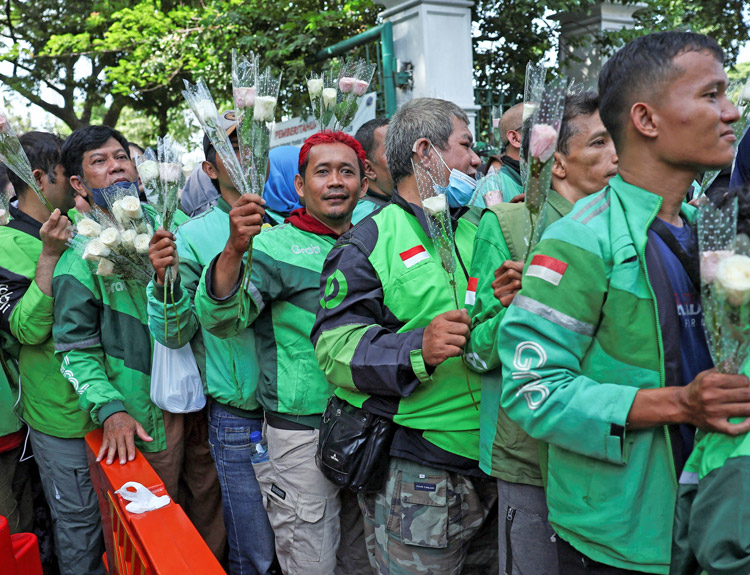
On Aug. 28 an armored vehicle from the National Police’s Mobile Brigade in Jakarta ran over and killed 21-year-old rideshare and food delivery motorbike driver Affan Kurniawan, and drove off without stopping. There are an estimated 1.5 million delivery drivers in Indonesia. When a news video of the killing was posted, street protests intensified.
The protests, which Subianto called “treason and terrorism,” have won widespread support throughout the region. After the killing of Kurniawan, workers in neighboring Malaysia, Singapore, Philippines and Thailand organized to order food on Indonesia delivery apps, telling the riders they could keep the food or distribute it to others.
Tara, a 34-year-old in the Philippines, told the BBC she was one of those who sent food orders. She said she’s encouraging others to do likewise. “Seeing you [Indonesian protesters] stand together against corrupt politicians is inspiring,” she said. “Our government is just as bad and corrupt.”
As protests have grown, they have forced Subianto to announce a reduction in the perks bestowed on legislators. Since he took office in October 2024 there have been three major protests against his cuts in social services. He responded by expanding the military.
Subianto rose to prominence in the Indonesian army’s Special Forces under the brutal dictatorship of Suharto, who had led the slaughter of tens of thousands of supporters of the Indonesian Communist Party in 1965. Subianto led the ruthless suppression of fighters for the independence of East Timor in the 1980s.
He was driven from the country by mass protests in 1998 that led to the downfall of Suharto. Subianto returned to Indonesia in 2001, joining his brother in building a powerful corporate empire.