Days before callously killing 11 people on a speedboat in international waters off the coast of Venezuela Sept. 2, Washington carried out a rapid military buildup in the Caribbean that so far has amassed eight warships, several Navy P-8 surveillance planes and one attack submarine in the region.
The Pentagon dispatched 10 F-35 stealth fighters to Puerto Rico — in position to carry out airstrikes in the Caribbean or inside Venezuela if ordered — and began amphibious landing training exercises involving 4,500 U.S. sailors and over 2,000 Marines Aug. 31.
The U.S. rulers’ use of its colony in Puerto Rico as a military base isn’t new. “I’m appalled at what is going down right now, the rapidity of it,” Myrna Pagán, a leader of Vieques Lives Matter, told the Militant in a phone interview from Vieques Sept. 12. “Suddenly we are to be used as a trampoline again, just as Vieques was used when the U.S. invaded Grenada and Panama.
“We have fought so long to get our land cleaned, to know peace on this island so our people can thrive,” she said. “And now we’re supposed to go back in history and become a tool the U.S. government will use again. It’s unacceptable.”
Washington seized Puerto Rico as part of its spoils in the so-called Spanish-American War in 1898. The U.S. Supreme Court defined the island as “belonging to” but “not part of” the U.S., saying it was occupied by “alien races.” The U.S. rulers imposed citizenship on Puerto Ricans in November 1917, days before entering World War I, to allow for drafting Puerto Ricans into the army and using the island as a military base. There is a long list of Puerto Ricans killed or wounded serving as cannon fodder in the interests of U.S. imperialism.
In 1941, as U.S. rulers prepared to enter World War II, Congress authorized setting up a Navy base on Vieques, a small island less than 10 miles from mainland Puerto Rico. U.S. troops evicted some 10,000 residents at gunpoint, driving them to a small strip in the center of the island.
They transformed Vieques into a giant target range, raining down live ordnance containing napalm, depleted uranium and other toxic chemicals for over 60 years.
The Pentagon took over nearly 70% of Vieques, opening a 60-year fight by generation after generation of working people there to get U.S. forces out. The military used Puerto Rico as a base of support in the bloody coup financed by the CIA in Guatemala in 1954. Planes launched from Puerto Rico carried thousands of U.S. Marines in the April 1965 invasion of the Dominican Republic. In May 1969, U.S. jets sprayed a chemical simulating nerve gas over the land and waters of Vieques to test protective gear for U.S. troops fighting in Vietnam.
A base for U.S. aggression
As early as 1981, Maurice Bishop, prime minister and central leader of Grenada’s revolution, warned that “Ocean Venture 1981,” a 14-nation NATO exercise in Vieques that year was “a practice run for direct invasion of Grenada by U.S. troops.” The 10-week exercise included 250 ships, 1,000 aircraft and 120,000 troops. Months before U.S. troops invaded Grenada in October 1983, following a Stalinist coup that overthrew Bishop, maneuvers called Universal Trek ’83 were held in Vieques to work out the final details. Puerto Rico served as a staging ground for half of the invading troops.
Vieques residents, and other Puerto Ricans and allies abroad, fought tenaciously against the use of their land for bombing practice and as a training ground for launching Washington’s 1989 invasion of Panama. Over 20,000 U.S. troops invaded, seizing Gen. Manuel Noriega, Panama’s head of state, after the U.S. indicted him on drug trafficking charges.
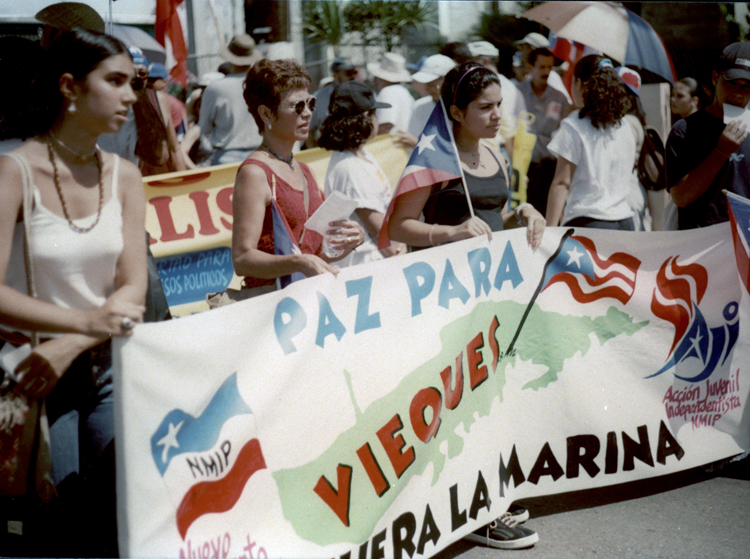
The struggle against the U.S. military base exploded in 1999 after a 500-pound bomb, dropped by a U.S. Navy plane during a training exercise, killed local civilian guard David Sanes. Groups of fishermen, teachers and other protesters carried out civil disobedience actions, setting up encampments, some of them in the area of the bombing range.
Some 50,000 people marched in Ceiba, Puerto Rico, demanding the U.S. Navy get out of Vieques. The Navy was forced to suspend its bombing for a year.
In 2000, a huge crowd of some 85,000 working people marched in San Juan, Puerto Rico, when Washington announced plans to resume bombing.
Under the unrelenting pressure from the people of Puerto Rico, the U.S. Navy shut down operations in Vieques in 2003. President George W. Bush admitted defeat, saying, “They don’t want us there.” The decades of bombing left behind enormous destruction and caches of toxic chemicals. Studies showed that residents of the island were significantly more likely to get cancers, heart and liver diseases and diabetes than other Puerto Ricans. U.S. troops are still collecting unexploded bombs and various contaminants.
“We were not so naive to think the Navy was leaving forever,” Pagán told the Militant.
“It pains us greatly that they come to Puerto Rico to use our land, our air, and our sea for their military exercises. We know the pollution these exercises left behind in Culebra and Vieques,” Sonia Santiago, a founder of Mothers Against War, told the press Sept. 7 at a protest action in front of the Muñiz Air Base in Carolina, Puerto Rico.
“There is a whole new generation appalled by this,” Pagán said, explaining that more protests are planned. “We don’t want any military actions here. We will not accept that, and will do whatever is necessary to prevent it.”