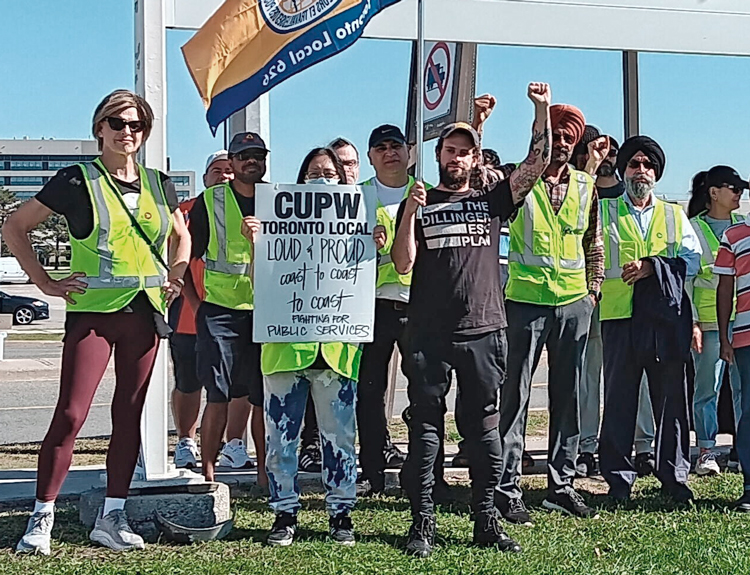
MONTREAL — The Canadian government announced Sept. 26 it was further slashing door-to-door mail delivery and closing many of the country’s rural post offices to save money in an “existential” crisis. “In response to the Government’s attack on our postal service and workers,” Jan Simpson, president of the Canadian Union of Postal Workers, answered, “all CUPW members at Canada Post are on a nationwide strike.”
At a Parliament Hill rally called by the union Oct. 1, Canadian Labour Congress Executive Vice Presidents Siobhan Vipond and Larry Rousseau stood with postal workers, supporters and other labor leaders to demand job security, respect for Canada’s striking postal workers and an end to the cuts.
In November 2024, more than 55,000 CUPW workers went on strike across the country against plans by Canada Post to introduce part-time weekend jobs at lower pay and second-rate benefits. Bosses offered a paltry 11.5% wage increase over four years, while the union was demanding double so workers could catch up with inflation.
Acting on orders from Ottawa, the Canada Industrial Relations Board issued a mandatory return-to-work order Dec. 15, extending the current contract through May 2025, allegedly to provide more time for negotiations. CUPW denounced “this assault on our constitutionally protected right to collectively bargain and to strike.”
But Canada Post stalled rather than negotiate, sticking to its concession demands. Ottawa then ordered the Industrial Relations Board to force the union to make workers vote again on the bosses’ final offer they had already rejected. The union denounced this blow to their rights, saying it could set a dangerous precedent.
Unionists reject concessions again
When the results of the revote were announced Aug. 1, nearly 70% of the union’s 55,000 members rejected the proposal again. Then negotiations went nowhere, as the bosses looked to the government to end the standoff.
On Sept. 25, Joel Lightbound, minister of government transformation, public works and procurement, who is responsible for Canada Post, announced the sweeping cuts in postal service and rollbacks in workers’ jobs, wages and benefits.
Claiming Canada Post is losing $10 million a day, Lightbound gave management 45 days to outline a plan to implement his order.
“CUPW is outraged and appalled by the minister’s announcement today,” the union responded in a statement. “Our singular objective over the last two years has been to negotiate new collective agreements that meet the needs of workers and the public. Throughout this time, Canada Post has done everything in its power to avoid real bargaining and has repeatedly relied on government intervention.”
After the strike began, Prime Minister Mark Carney repeated Lightbound’s demand that Canada Post make the changes.
Over the past year the Canadian government has used anti-labor laws to order striking workers back to work — port workers in both Quebec and British Columbia; members of the Canadian Union of Public Employees; International Longshore and Warehouse Union members; and Teamster union rail workers at both Canadian National and Canadian Pacific Kansas City — and has imposed compulsory arbitration.
In August more than 10,000 Air Canada flight attendants in CUPE Local 4092 broke the mold, refusing to comply with a similar back-to-work order, striking for three days and winning a new contract.
In Manitoba, reaction against the government-ordered cuts has been swift. The province has the largest rural population and greatest proportion of Native population among Canada’s provinces. Assembly of Manitoba Chiefs Grand Chief Kyra Wilson said that any loss of postal delivery will be an additional serious hurdle for First Nations, who already face barriers to accessing essential services. Prescriptions “are being shipped through Canada Post to our First Nations communities,” along with legal documents and other essential materials, she said.
“There doesn’t seem to be any end to the attacks, so there’s no choice but to fight,” Canada Post worker Shirley Kroot told this Militant worker-correspondent on the picket line Sept. 29. Kroot, like many of her co-workers at Canada Post in Brockville, a small town 130 miles west of Montreal, drives on rural roads.
Three days earlier I had discussed with CUPW members on the picket line the importance of building solidarity. “It’s not just us that needs solidarity,” Nathan McGregor, a letter carrier for almost eight years, said. “It’s also the port workers and the Montreal transit maintenance workers who are on strike now. It seems like it’s everyone lately!”
“We’re tired of all this,” Pierre-Luc, a letter carrier and shop steward for CUPW Local 350 who wished to use only his first name for fear of boss reprisal, told the Militant. Reflecting both frustration with the ongoing government attacks and determination to fight against them, he said, “We’ve been in negotiations for two years. We went on strike for a month last year and the government ordered us back to work. Canada Post has dragged out negotiations because they know the federal government will side with them, and now this!”
“The unions need to build support for the postal workers and their right to strike, as part of fighting Ottawa’s ongoing assault on the union movement,” said Katy LeRougetel, a member of the Bakery, Confectionery, Tobacco Workers and Grain Millers union and the Communist League’s candidate for mayor of Montreal.