MANILA, Philippines — “Women are objectified and commodified. It is a culture that capitalists profit from,” said Virginia Suarez, a lawyer who specializes in women’s and workers’ rights. “When I read this book, I was enriched. Women have to break free.”
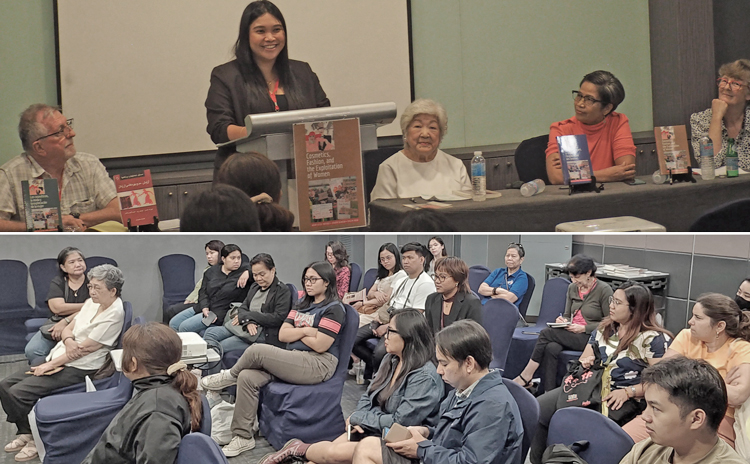
Suarez was the first speaker on a panel at the Manila International Book Fair presentation of the new edition of Cosmetics, Fashion, and the Exploitation of Women, by Mary-Alice Waters, Joseph Hansen and Evelyn Reed. The other speakers on the Sept. 13 panel were Sheila Estrera, a young woman from Mindoro and volunteer at the Pathfinder booth; Ana Maria “Princess” Nemenzo, a fighter for political and women’s rights in the Philippines for over five decades; and Katy LeRougetel, the Communist League candidate for mayor of Montreal, from Canada. Some 30 people attended.
Ron Poulsen introduced the panel on behalf of Pathfinder Books, Sydney. He said interest in the book around the world meant that “it has become one of Pathfinder’s most popular titles.” It has already been translated into Farsi, Spanish and French. The new edition was presented at book fairs this year in Havana, Cuba; in Erbil, in the Kurdish region of Iraq; and will be featured by Pathfinder at the Santo Domingo and Montreal book fairs this fall.
Suarez explained that she had previously worked in advertising. The main goal of the company where she worked was “to create a need from unnecessary wants.” However, she said, “I never realized the evil of advertising until I joined the women’s movement.” She pointed to the way some insidious advertising encouraged sexual exploitation and violence.
The “24/7 ads” in the Philippines foster “a desire to be white: that white is beautiful, creating a standard of beauty that is not ours,” Suarez said. Capitalist advertisers try to convince us “that as women we are never beautiful enough, while making millions in profits, using chemicals that destroy our bodies.” At the same time, they profit from exploiting their workers, she said.
“Joe Hansen’s 1954 article is still relevant today, and even more obvious now because of how much social media and marketing is everywhere,” Estrera told the audience. These platforms are used by the cosmetics and fashion industries to “create fake desires” to ensure consumption and profitability.
Today the cosmetics industry presents itself as “self-care and self-expression,” Estrera said. But “it infiltrates nearly every aspect of our lives.”
This book “is not intended as a tool for judgment of women,” she added. Rather, it sheds light on the place of women within the capitalist system and the “challenges women encounter in their daily lives.”
‘Book about capitalist exploitation’
“I have not read anything that analyzes the topic of beauty in the way this book has done,” Nemenzo said. “It’s not about cosmetics as such but about the exploitation rooted in the capitalist system.” To understand capitalism, she added, you have to have a historical perspective about the development of humankind that goes back millennia.
She described how as a young woman active in the student movement during the ferment in the 1960s around national liberation struggles in the Philippines and across Asia and beyond, women felt free and she became aware of the secondary status of women. “We believed,” she said, “women’s liberation should be fought for alongside struggles for national liberation.”
Today, “everything has become commodified, including health care,” she noted. She voiced the view of all the panelists in saying, “The advertising industry is so degrading to women.”
“Why is there inequality and poverty?” she asked. “Because, as Evelyn Reed explains, it began with the ownership of private property.” As the division of labor grew, “women were relegated to the home.”
“Is there no place for beauty?” Nemenzo asked. “Beauty is found in the way we treat each other, in social relations. We have to fight for both women’s liberation and class liberation.”
The articles by Hansen and Reed and the comments of those they were answering, LeRougetel explained, were written in the aftermath of World War II as U.S. capitalism emerged as the dominant imperialist power. The war against the Korean people was raging. “As we present this new edition of the book,” she said, “the capitalist rulers are driving humanity toward a third world war.”
Moscow continues to deny the right of the Ukrainian people to even exist, she said, while Israel is fighting to prevent another Holocaust. And here in the Pacific, the Philippines is right in the center of the deepening conflict between Washington and Beijing.
Brutal reality of women’s oppression
LeRougetel pointed to how Waters in the preface to the new edition says, “Daily news reports the world over bring to the fore the brutal reality of women’s oppression.” From rape and sexual enslavement as weapons of war to denial of safe and legal contraception and abortion services. “It’s a universal inequality that will never be eradicated under capitalism.” It’s inseparably part of profits and property.
“Women are an increasing component of the world working class,” said LeRougetel. She pointed to the example of women’s leadership seen in the strike by Air Canada flight attendants, who defied a government back-to-work order. “That fight continues today.”
The book is about capitalist social relations and how the fetishism of commodities obscures the fundamental role of labor, she explained. “The book points to the possibility to root out the oppression and exploitation of women by ending the capitalist system, by the working class organizing and leading a movement of millions to take political power away from the capitalists and build a world on socialist foundations.”
The panel was followed by 40 minutes of lively questions and discussion with the audience. Ashley Bjornerud voiced the frustration many women face with the overwhelming push to promote cosmetics for younger and younger children. She described how her 7-year-old goddaughter is being encouraged to wear lipstick. “Why do they start at such a young age?” she asked the panel. “Why do you need a professional make-up artist to make you look beautiful? How do you explain that looking natural is OK?”
Estrera responded that this book helps you understand where these pressures come from. Nemenzo added that it’s good to read the book to understand why women’s oppression is the way it is. But it’s important “to discuss it with others, to spread ideas through discussions, so we can introduce some change.”
LeRougetel pointed to two pictures in the book of women in industrial jobs that show how women can fight to change the reality of their economic position, and how this in turn changes how women see themselves.
Cosmetics, Fashion, and the Exploitation of Women was Pathfinder’s most popular title during the book fair, with 47 copies sold. Visitors to the stand bought a total of 518 Pathfinder books during the Sept. 10-14 fair. Additionally, owners of The Common Ground Bookstore, currently selling online but seeking a Manila store, saw the Pathfinder titles for the first time and purchased 110 books to add to their stock.
The discussion from the presentation continued afterward at Pathfinder’s booth nearby. Emaine Coronel, a young student who authored a children’s book, told LeRougetel how at a film production course she was told, “I wouldn’t be able to carry a camera. [So they] put me in marketing!” The CL candidate showed her Cosmetics, Fashion, and the Exploitation of Women, including pictures of women working in rail and other nontraditional jobs. “Hell, yes!” the young woman responded.