

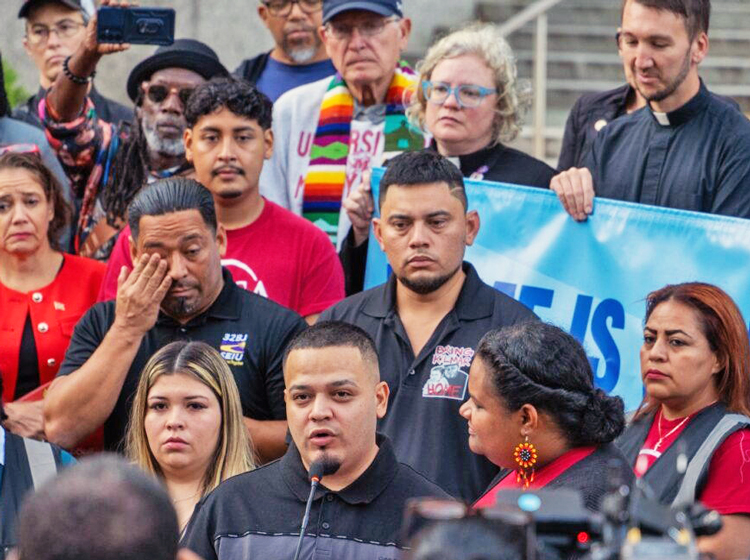
WASHINGTON — Supporters of Kilmar Abrego García and of the rights of immigrants in the U.S. will rally in Greenbelt, Maryland, before a U.S. District Court hearing on his fight for asylum Oct. 6. Abrego García, his family and supporters demand that Immigration and Customs Enforcement release him.
Abrego García has been jailed for 201 days — both in the U.S. and in the notorious CECOT ultra-high-security prison in El Salvador — since he was arrested by ICE after he picked up his son from his grandmother’s house after work March 12.
“We are back in court for Kilmar’s liberation,” Gustavo Torres, longtime leader of the immigrants’ rights group CASA, said in an appeal to the union members, immigrant workers, youth, church and synagogue members and political activists here who have rallied against Abrego García’s frame-up. Abrego García is an apprentice sheet metal worker and his union, the International Association of Sheet Metal, Air, Rail and Transportation Workers, has stood with him from the beginning.
In a gross violation of the constitutional right to due process, the 30-year-old worker from Beltsville, Maryland, was deported to El Salvador March 15, despite a court order barring the government from sending him there. Abrego García and his family had fled to the U.S. after they were threatened by gangs in El Salvador. He was flown to the CECOT prison where he was tortured.
Protests reflecting the widespread support he won succeeded in returning Abrego García to the U.S. in June, but he was immediately jailed on trumped-up charges of “human smuggling” — crimes he insists he is innocent of. A Homeland Security agent testified in court that authorities never considered bringing these charges, from a traffic stop in 2022, until this April, after the government had faced growing pressure to return Abrego García to the U.S.
Nashville Judge Waverly Crenshaw Jr. paroled him from jail while he was awaiting trial on those charges because the government had failed to show he is a danger or a flight risk. The judge said the government’s case was a “poor attempt to tie Abrego to MS-13,” the Salvadoran gang that ICE claims he was smuggling for.
After three days of freedom, when Abrego García reported Aug. 25 for a mandatory Baltimore ICE check-in, he was shackled and jailed again. Having been imprisoned for more than six months, Abrego García is yet to have been able to challenge the frame-up against him in court.
The Donald Trump administration is making its drive to deport him a centerpiece of their campaign against immigrant workers. Fearing the growing support he’s winning, the administration threatened to deport him to Uganda or elsewhere in Africa unless he agreed to plead guilty to the human smuggling charges.
Fight continues
In a new attempt to strip Abrego García of his right to due process, the Trump administration submitted a brief Sept. 23 arguing that Judge Paula Xinis, who will hear the case Oct. 6, cannot be allowed to do so. The Justice Department argues only an immigration judge, not a federal court, can hear his case.
This is just the latest instance of the government’s efforts to prevent courts from reviewing its broadside attack on the rights of working people. In a July hearing, Xinis described getting answers from the government “like nailing jello to a wall.”
On Sept. 26 Abrego García was transferred from the Farmville Detention Center in Virginia, near his family and attorneys, to a detention center in Pennsylvania. The government scandalously argued this would facilitate his ability to prepare his case. His lawyers said that while they had difficulty visiting him in Virginia, this move has made it “far more difficult.” Abrego García has been barred from getting visits from his wife, Jennifer Vásquez Sura, who lives in Maryland.
He faces harsh conditions at the privately owned Moshannon Valley Processing Center in Pennsylvania. Prisoners there report they’ve suffered assaults from guards, inadequate medical care, insufficient food, solitary confinement for small infractions and other abuses.
During a brief visit with his family in late August, Abrego García thanked his supporters from CASA and his union, SMART. He said it was only when he was returned from El Salvador that he learned about the publicity and support he was getting. “I am so grateful to them and I want them to know that we have made a step closer to justice but we still need more justice.”
The fight to defend Abrego García has helped win broader support in the labor movement for the fight for amnesty for all immigrants in the U.S., crucial to strengthen and unify the working class.
The rally to back Abrego García will be held Oct. 6 at 9 a.m. at U.S. District Court, 6500 Cherrywood Lane, Greenbelt, Maryland.