

The Jewish Question: A Marxist Interpretation by Abram Leon is one of Pathfinder’s Books of the Month for October. As the imperialist slaughter of World War II and of the Nazi Holocaust were unfolding, Leon wrote the book to explain the basis of Jew-hatred in the imperialist epoch, as well as the road to its abolition. It is important today as antisemitic attacks rise worldwide amid Israel’s war to defend a refuge for Jews and prevent another Holocaust. Won from Zionism by supporters of Leon Trotsky, Leon led the communist movement in Belgium until arrested by the Nazi occupiers and sent to his death in the Auschwitz gas chambers. The main excerpt is from the book’s first chapter, “The premises for a scientific study of Jewish history.” The second piece is from the introduction by Dave Prince. Copyright © 2020 by Pathfinder Press. Reprinted by permission.
Without a thorough study of Jewish history, it is difficult to understand the Jewish question in modern times. The plight of the Jews in the twentieth century is intimately bound up with their historical past. Every social formation represents a stage in the social process. Being is only a moment in the process of becoming. In order to undertake an analysis of the Jewish question in its present phase of development, it is indispensable to know its historical roots.
In the sphere of Jewish history, as in the sphere of universal history, Karl Marx’s brilliant thought points the road to follow. “Let us not look for the secret of the Jew in his religion, but let us look for the secret of his religion in the real Jew.”
Marx thus puts the Jewish question back on its feet. We must not start with religion in order to explain Jewish history. To the contrary, the preservation of the Jewish religion or nationality can be explained only by the real Jew, that is to say, by the Jew in his economic and social position. …
It was the continuous religious persecutions that forced them to entrench themselves increasingly in commerce and usury. The Crusades, by reason of the religious fanaticism they engendered, violently accelerated this evolution, which transformed the Jews into usurers and ended in their confinement in ghettos. Of course the hatred against the Jews was also fanned by the latter’s economic role. But the historians attribute only a secondary importance to this factor. This condition of Jews continued up to the French Revolution, which destroyed the barriers that religious oppression had raised against the Jews. …
If Judaism did not completely disappear in the West, it was owing to the mass influx of Jews from Eastern Europe. The Jewish question, which is now posed on a world scale, therefore results primarily from the situation of Eastern Jews. This situation is, in turn, a product of the lag in economic development of this part of the world. The special causes of Jewish emigration are thus linked with the general causes behind the emigration movement of the nineteenth century.
The general emigration of the nineteenth century was caused in large measure by the failure of capitalist development to keep pace with the crumbling of the feudal and artisan economy. …
While the imbalance between the crumbling of feudalism and the development of capitalism was disappearing in Western Europe, it was growing worse in the backward Eastern European countries. The destruction of feudal economy and primitive forms of capitalism proceeded there much more rapidly than the development of modern capitalism. Increasingly greater masses of peasants and artisans had to seek their road of salvation in emigration. …
Jewish masses streamed in ever larger numbers from Eastern Europe to the West and to America. The solution of the Jewish question, that is to say, the complete absorption of the Jews into economic life, thus became a world problem.
By socially differentiating Jews, by integrating the latter into economic life, and by emigration, capitalism has laid the bases for the solution of the Jewish problem. But capitalism has failed to solve it. On the contrary, the fearsome crisis of the capitalist regime in the twentieth century has aggravated the plight of the Jews to an unparalleled degree. The Jews, driven from their economic positions under feudalism, could not be integrated into a capitalist economy in utter decay. In its convulsions, capitalism casts out even those Jewish elements that it has not yet completely assimilated.
Multiplying everywhere is the savage anti-Semitism of the middle classes, who are being choked to death under the weight of capitalist contradictions. Big capital exploits this elemental anti-Semitism of the petty bourgeoisie in order to mobilize the masses around the banner of racism.
The Jews are being strangled between the jaws of two systems, feudalism and capitalism, each feeding the rottenness of the other.
In the imperialist epoch … Jew-hatred originates in the petty bourgeoisie and both the ultraright and the radical left wings of bourgeois and middle-class anticapitalist politics.
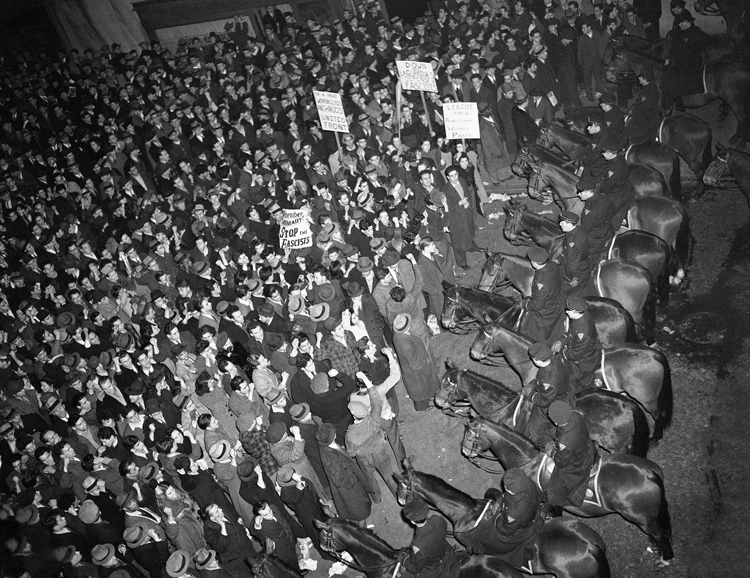
It is only when growing numbers among the ruling families no longer see another way to maintain their rule, however, that sections of them begin encouraging and financing initially small but violent fascist parties and their fighting units to attack workers’ picket lines, meetings, and social struggles. These layers of big business do so with the aim of smashing the trade unions and working-class political parties, in order to drown in blood every act of resistance to the disaster imposed on the toilers by capital. …
The prospects for revolutionary working-class victory presented in this book are best left to the words of its author, Abram Leon: “When the people of the factories and the fields have finally thrown off the yoke of the capitalists, when a future of unlimited development opens up before liberated humanity, the Jewish masses will be able to make a far from unimportant contribution toward the building of a new world.” A socialist world.