As a two-and-a-half-year bloody civil war ravages the toilers in Sudan, the reactionary Rapid Support Forces seized el-Fasher, the largest city in the Darfur region, Oct. 26, unleashing a massacre against the indigenous black population.
Two days later, RSF paramilitary soldiers systematically shooting unarmed civilians at point-blank range are shown on videos posted by the Sudan Doctors Network. Dead bodies are scattered alongside burned-out vehicles.
“Fifty or 60 people in a single street … they kill them bang, bang, bang. Then they would go to the next street, and again bang, bang, bang,” a witness named Mubarak who had escaped to the town of al-Dabba, told Reuters.
“Six health workers, four doctors, a nurse and a pharmacist were abducted from the city’s only functioning hospital,” the World Health Organization wrote, “and more than 460 patients and their companions were reportedly shot and killed.”
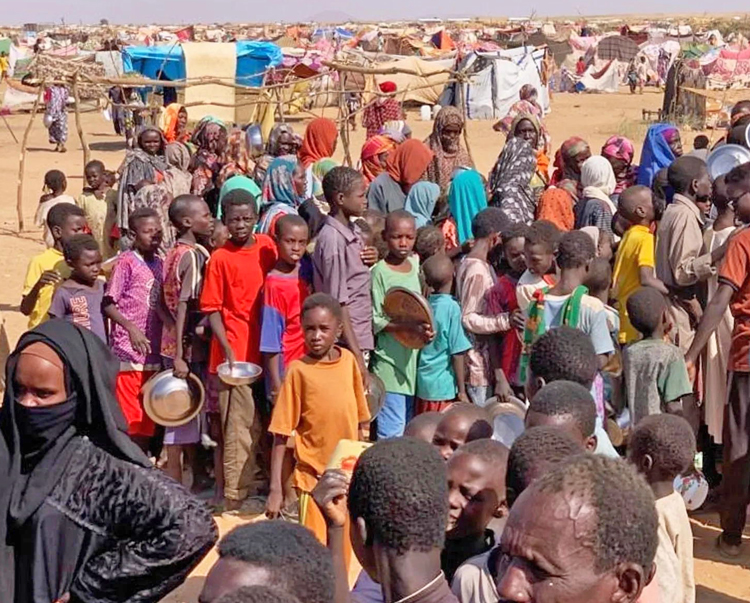
Tens of thousands of people tried to flee toward Tawila, 40 miles away. Everywhere “there were beatings, executions. Some people were taken away just because they were black,” Nasreldin, one of the few who made it to that town, told the Norwegian Refugee Council there.
With the takeover of el-Fasher, the Rapid Support Forces, which are largely comprised of Arabs, now control the entire Darfur region in western Sudan, an area the size of Spain. The civil war has devastated the lives of millions of working people throughout the country. Much of Khartoum, Sudan’s capital, has been destroyed, about a quarter of the country’s 45 million people have been forced from their homes and at least 150,000 civilians killed.
Rivals fight over control of resources
In 2019 months of anti-government protests and strikes toppled the three-decade-long dictatorship of Omar al-Bashir. A military-led transitional government, with backing from Washington, was then put together by Sudan’s Gen. Abdel Fattah al-Burhan and the RSF’s Lt. Gen. Mohamed Hamdan Dagalo. It promised a return to civilian rule, but instead maintained military rule.
The U.S. government pressured Sudan’s competing army and paramilitary to combine their forces into a single army. Instead, fighting erupted in April 2023 with each group seeking to grab control over the country’s rich natural resources, which include oil, gold, copper, iron ore and natural gas.
Successive Sudanese governments had maintained their rule by wielding national divisions cultivated by the former British colonial rulers based on tribal origin and religion.
The Rapid Support Forces emerged from what had been the Janjaweed militias, which were utilized in the early 2000s by the al-Bashir regime to brutally suppress a rebellion by black African groups in Darfur. They killed tens of thousands of civilians and hundreds of thousands more perished from hunger and disease.
The Rapid Support Forces began its siege of el-Fasher in April. They constructed a 35-mile earthen berm around the city in an attempt to encircle its 1 million residents. Facing daily shelling and starvation conditions, more than 70% of the city’s population fled.
Foreign powers intervene in war
Heightened competition among capitalist powers for resources and political and military influence in Africa is driving intervention in the conflict.
RSF fighters are armed with bomb-carrying Wing Loong II and FeiHong-95 drones, made in China and supplied to them by the United Arab Emirates. “The UAE has been accelerating the flow of materiel to the RSF in recent months and enabling it to launch fresh offensives,” the Wall Street Journal reported Oct. 31.
Rapid Support Forces fighters “have been conducting door-to-door searches, picking out non-Arab men and boys before executing them,” the Journal reports. “Residents say militia members swept through the city, raping black women, detaining aid workers and forcing the last remaining residents to leave.”
Sudan is one of the poorest and least-developed countries in the world, a legacy of imperialist exploitation and oppression. Located in the Horn of Africa, it’s the third-largest country on the continent, with 500 miles of coastline on the Red Sea, a strategically important commercial transit area.
The rulers in both Tehran and Moscow are seeking to establish military bases there. Moscow supplies the Sudanese Armed Forces, led by al-Burhan, with weapons, military equipment and oil.
After seizing el-Fasher, Dagalo’s RSF announced Nov. 6 that it agreed to a truce promoted by Washington, with backing from the governments of Saudi Arabia, Egypt and the UAE.
However, the following day the paramilitary force launched drone attacks on Khartoum and the city of Atbara. Both the RSF and the Sudanese army have agreed to various ceasefire proposals during the civil war. None have succeeded.