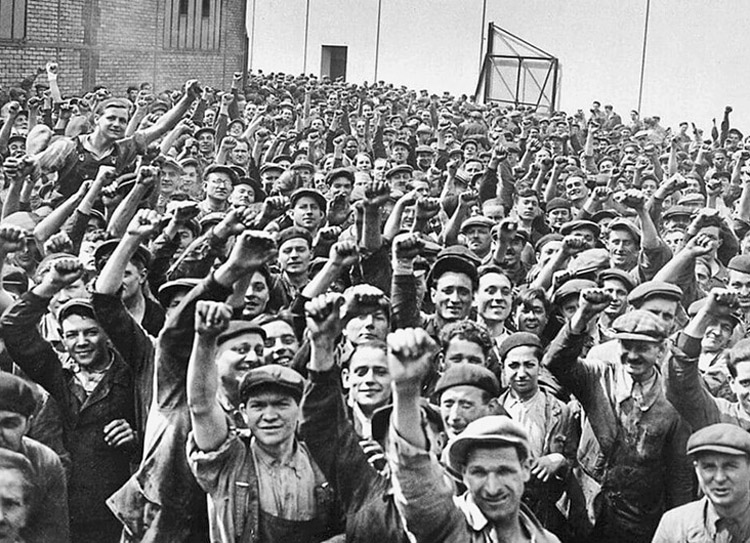
One of Pathfinder’s Books of the Month for November is The Crisis of the French Section (1935-36) by Leon Trotsky. Growing class battles across Europe, from rising proletarian struggles in France to the Spanish Revolution, posed the need for workers to take power to stop imperialism’s march toward another world war. Adolf Hitler had come to power in 1933 after the sectarian course of the German Communist Party, on orders from Joseph Stalin, had blocked united working-class resistance to the Nazis’ rise. Moscow then did a U-turn, ordering all CPs to ally with liberal capitalists in a “Popular Front.” This class-collaborationist course was used to block workers from fighting to take power to defeat growing fascist forces. The excerpt is from Trotsky’s Nov. 26, 1935, call, “For committees of action not the People’s Front!” Copyright © 1977 by Pathfinder Press. Reprinted by permission.
The “People’s Front” represents the coalition of the proletariat with the imperialist bourgeoisie, in the shape of the Radical Party and smaller tripe of the same sort. The coalition extends both to the parliamentary and to the extraparliamentary spheres. In both spheres the Radical Party, preserving for itself complete freedom of action, savagely imposes restrictions upon the freedom of action of the proletariat.
The Radical Party itself is undergoing decay. Each new election gives added proof of the passage of supporters away from it to the right and to the left. On the other hand, the Socialist and Communist parties — because of the absence of a genuinely revolutionary party — are growing stronger. The general trend of the toiling masses, including the petty bourgeoisie, is quite clearly to the left. The orientation of the leaders of the workers’ parties is no less self-evident: to the right. At a time when the masses by their votes and their struggle seek to cast off the party of the Radicals, the leaders of the united front, on the contrary, seek to save it. After obtaining the confidence of the masses of workers on the basis of a “socialist” program, the leaders of the workers’ parties then proceeded to voluntarily concede a lion’s share of this confidence to the Radicals, in whom the masses of workers have absolutely no confidence.
The “People’s Front” in its present guise shamelessly tramples not only upon workers’ democracy but also upon formal, i.e., bourgeois, democracy. The majority of the Radical voters do not participate in the struggle of the toilers and consequently in the People’s Front. Yet the Radical Party occupies in this front not only an equal but a privileged position; the workers’ parties are compelled to restrict their activity to the program of the Radical Party. This idea is most outspokenly advanced by the cynics of l’Humanité. …
The proletariat does not deny anyone the right to struggle side by side with it against fascism, the Bonapartist regime of Laval, the war plot of the imperialists, and all other forms of oppression and violence. The sole demand that class-conscious workers put to their actual or potential allies is that they struggle in action. Every group of the population really participating in the struggle at a given stage and ready to submit to common discipline must have the equal right to exert influence on the leadership of the People’s Front.
Each two hundred, five hundred, or one thousand citizens adhering to the People’s Front in a given city, district, factory, barrack, and village should in time of fighting actions elect their representative to the local committee of action. All the participants in the struggle are bound by its discipline.
The last congress of the Communist International, in its resolution on the Dimitrov report, expressed itself in favor of elected committees of action as the mass support for the People’s Front. This is perhaps the only progressive idea in the entire resolution. But precisely for this reason the Stalinists do nothing to realize it. They dare not do anything for fear of breaking off collaboration with the bourgeoisie.
To be sure, in the election of committees not only workers will be able to participate but also civil service employees, functionaries, war veterans, artisans, small merchants, and small peasants. Thus the committees of action are in the closest harmony with the tasks of the proletariat’s struggle for influence over the petty bourgeoisie. But they complicate to the extreme the collaboration between the workers’ bureaucracy and the bourgeoisie. In the meantime the People’s Front in its present form is nothing else than the organization of class collaboration between the political exploiters of the proletariat (the reformists and the Stalinists) and the political exploiters of the petty bourgeoisie (the Radicals). Real mass elections of committees of action would automatically eject the bourgeois middlemen (the Radicals) from the ranks of the People’s Front and thus smash to smithereens the criminal policy dictated by Moscow.
However, it would be a mistake to think that it is possible at a set day and hour to call the proletarian and petty-bourgeois masses to elect committees of action on the basis of a given statute. Such an approach would be purely bureaucratic and consequently barren. The workers will be able to elect a committee of action only in those cases in which they themselves participate in some sort of action and feel the need for revolutionary leadership. In question here is not the formal democratic representation of all and any masses but the revolutionary representation of the struggling masses. The committee of action is an apparatus of struggle. …
The greatest danger in France is that the revolutionary energy of the masses will be dissipated in spurts, in isolated explosions like Toulon, Brest, and Limoges, and give way to apathy. Only conscious traitors or hopeless muddleheads are capable of thinking that in the present situation it is possible to keep the masses immobilized up to the moment when they will be blessed from above by the government of the People’s Front. Strikes, protests, street clashes, direct uprisings, are absolutely inevitable in the present situation. The task of the proletarian party consists not in checking and paralyzing these movements but in unifying them and investing them with the greatest possible force.