

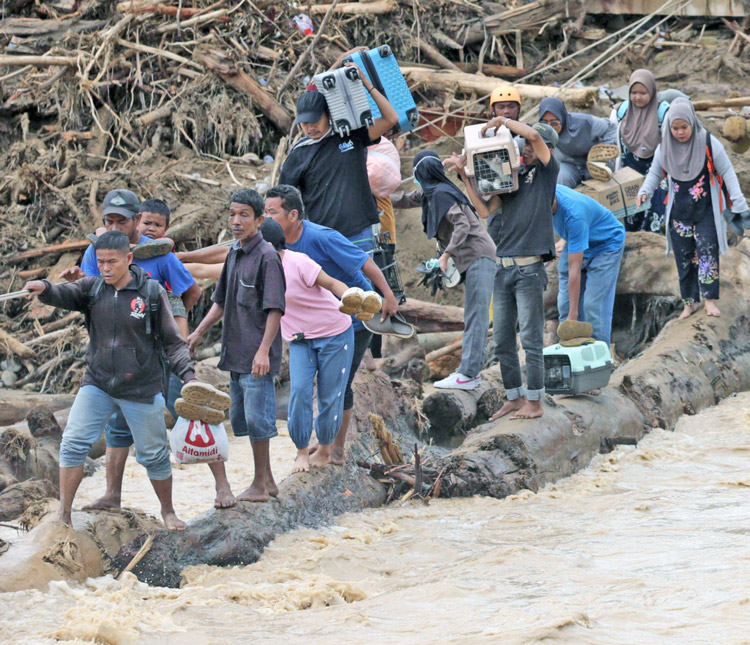
SYDNEY — Monsoon rains and tropical storms caused massive floods and landslides, which devastated much of Southeast Asia since late November, leaving some 2,000 dead and over 1 million displaced. Buildings and farmland, including whole towns, have been destroyed, and roads, rail lines and other infrastructure torn up. While capitalist politicians and the media were quick to blame “climate change,” many working people have pointed to actions by governments and capital that turned this weather event into a social disaster.
“The government is to blame for the rising death toll due to the lack of response,” Sydney warehouse worker Amrullah Arazak, who comes from the province of Aceh on Indonesia’s island of Sumatra, told the Militant. “So many people are still missing and nothing has been organized to find them.” Aceh is one of the hardest hit regions. “They say the situation is under control, but people are still dying.”
Annual monsoon floods are a normal part of life in Indonesia and other Southeast Asian countries. They’re usually a boon for agricultural production, but floods from this year’s heavy rains were turned into a disaster by the impact of unbridled capitalist expansion.
“The impacts are different today because of excessive deforestation with illegal logging and mining,” Hegel Terome, a leader of Kalyanamitra, a Jakarta-based women’s organization, told the Militant.
Over 11 million acres of forest have been harvested on Sumatra over the past two decades. This not only reduces the ability of the soil to absorb rainfall, but as the storms hit, massive piles of logs were swept downstream slamming into dwellings and bridges with immense destructive force. Even after floodwaters subsided, many places remain covered in thick mud and piles of debris.
There has been widespread anger at the refusal of Indonesian President Prabowo Subianto to declare a national disaster, which would allow greater national and international aid. Instead Prabowo urged local governments to do more “to confront climate change effectively.”
With whole villages washed away and others inaccessible, many working people lack necessities and face starvation. There are outbreaks of disease, while medical facilities and equipment have been severely damaged. Local governments say they lack the resources to cope. The Indonesian government slashed aid to local governments and to the nation’s disaster management body earlier this year as part of budget cutbacks.
In the 2004 Indian Ocean tsunami, some 200,000 people died in Sumatra, mainly in Aceh. But residents say the impact on infrastructure of the latest flooding is more severe.
In southern Thailand, the city of Hat Yai was submerged by heavy rain, with 400,000 trapped in their homes. It took the Thai government a week to respond. Pom Johnson told the Militant from New Zealand that former colleagues in Thailand said they had been left to fend for themselves without food or water. The help that did come was largely from volunteers.
Recent poorly designed infrastructure fed the disaster, she explained. Many new highways have been built on embankments higher than the surrounding houses, without adequate drainage. These blocked floodwaters then engulfed the houses.
Similar highway construction swelled floodwaters in Hulu Langat, in Malaysia, Baskaran Appu told the Militant. He had just returned to Sydney after visiting his family there as the floods hit.
The effects of Beijing’s profit-driven Belt and Road program deepened the crisis in many areas. In Sri Lanka, an elevated highway built by the Chinese government is being blamed for turning villages and towns into lakes near the capital, Colombo. The expressway, which connects the city to the airport, was built across wetlands and acts like a dam, leaving rainwater nowhere to go. A network of highways funded by Chinese loans has caused similar problems across the island.
All 25 provinces of Sri Lanka were hard hit by the floods. Hundreds of dams and canals have been damaged along with two-thirds of the country’s rail tracks. Estimates say the damage to infrastructure could be 10 times that caused by the 2004 tsunami, which killed 40,000 people living along the coastline.
The death toll has also been high in the country’s mountain plantations around Kandy, where capitalist expansion has meant a third of the population now lives in landslide-prone areas. As elsewhere, communities affected by the floods have been left to fend for themselves. Bodies remain buried amid the landslides, threatening to contaminate drinking water. Sri Lanka’s government is mired in economic crisis, with mountainous debts to Beijing.
In the Philippines, hit by the same storms, thousands marched in Manila Nov. 30 for the third time in three months. They protested the embezzlement of billions of dollars of government funds that had been approved for flood-control projects that have never been built.
Baskaran Appu contributed to this article.