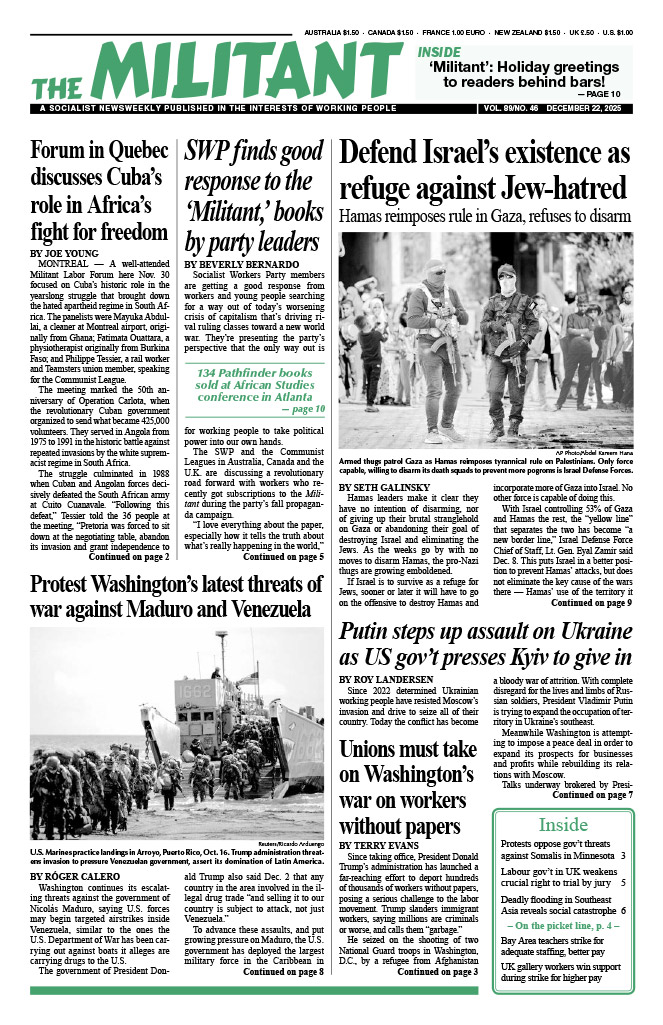
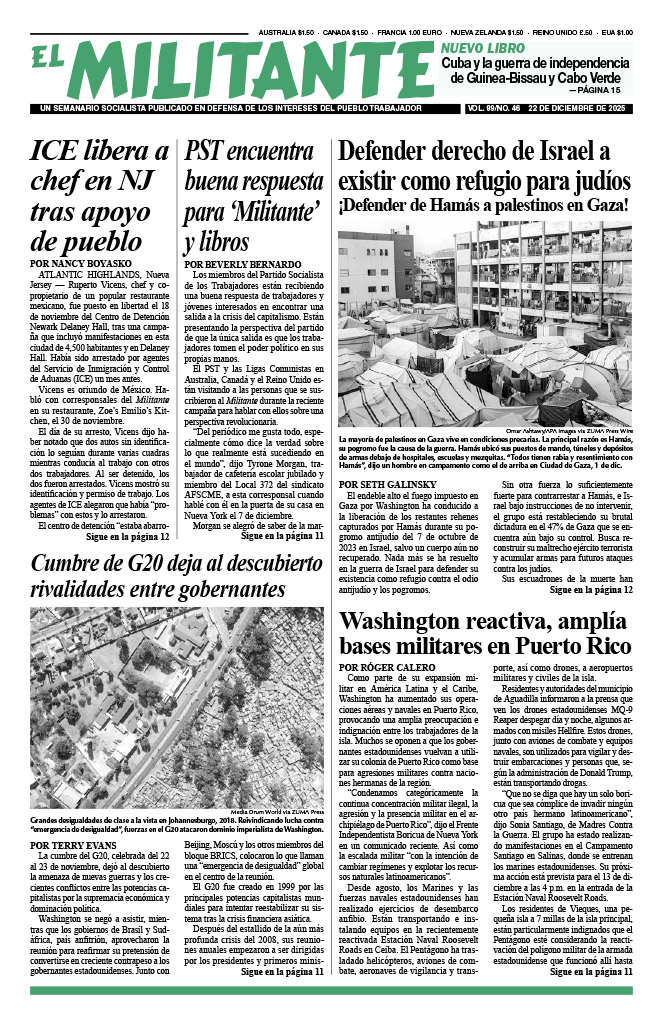
Washington continues its escalating threats against the government of Nicolás Maduro, saying U.S. forces may begin targeted airstrikes inside Venezuela, similar to the ones the U.S. Department of War has been carrying out against boats it alleges are carrying drugs to the U.S.
The government of President Donald Trump also said Dec. 2 that any country in the area involved in the illegal drug trade “and selling it to our country is subject to attack, not just Venezuela.”
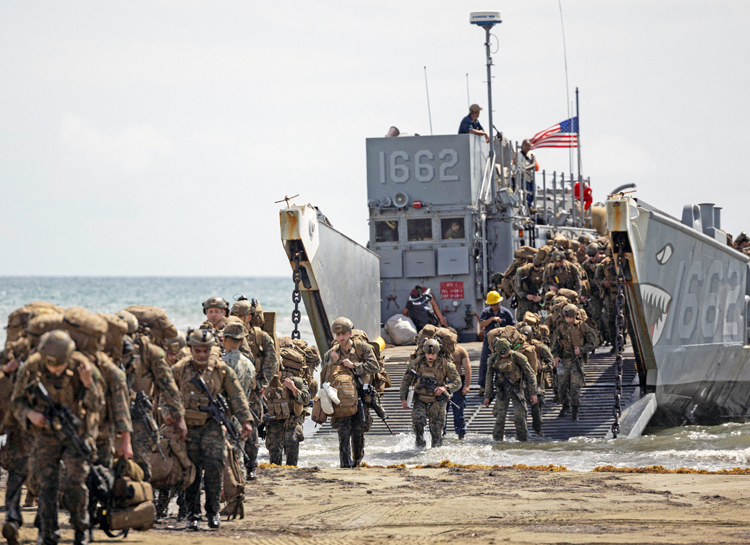
To advance these assaults, and put growing pressure on Maduro, the U.S. government has deployed the largest military force in the Caribbean in decades, including aircraft, naval attack ships and ground troops. It has authorized the CIA to conduct covert operations, including trying to get high-ranking military officers to flip on Maduro, arrest him, or kill him.
In another violation of Venezuela’s sovereignty, President Trump unilaterally declared Venezuela’s airspace “to be closed in its entirety” Nov. 29. Commercial airlines suspended flights, increasing the economic hardship of working people there on top of the effects of long-standing U.S. sanctions.
Trump to Maduro: leave or else
Trump and Maduro talked by phone Nov. 21 where the U.S, president, according to the Miami Herald, told Maduro he had to leave the country, and that he could go to the destination of his choice along with those closest to him. The paper says this discussion was facilitated by the governments of Brazil, Qatar and Turkey.
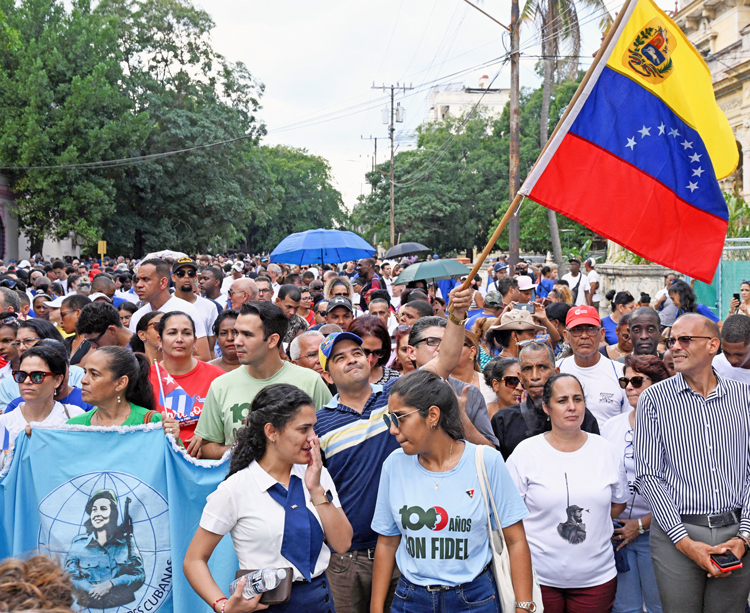
For over two decades, the U.S. capitalist rulers — under both Democratic and Republican administrations — have tried to topple the Venezuelan government and replace it with one more subservient to their interests. In this latest attack the Trump administration is accusing the Maduro government of being “narco-bandits,” without presenting any evidence.
At the same time, the U.S. president and Secretary of War Pete Hegseth are seeking to distance themselves from a Sept. 2 missile strike ordered on a boat that had already been hit, with survivors clinging to the smoldering wreckage and waving for help.
Democratic Party forces in Congress are pushing for public hearings to make political points against Trump by looking “more closely” at the “possibility” of a war crime being committed. Anyone who watches even a portion of the video that has been made public will see a gruesome attack on helpless shipwrecked sailors.
While seeking to tamp down the issue, Trump and Hegseth have both said the decision for the second strike was made by Adm. Frank Bradley and defended it. The administration says the decision was entirely legal and within his authority.
Republican lawmakers have pushed back on Democrats’ grandstanding, pointing to the long bloody record of extrajudicial killings carried out by the Barack Obama administration during the so-called war on terror.
“It is not an unprecedented thing,” said Republican Speaker of the House Mike Johnson Dec. 2, noting both Democratic and Republican administrations had used similar killings.
Under Obama, “I think there were 550 drone strikes on people who were targeted as enemies of the country,” he pointed out, “and nobody ever questioned it. Secondary strikes are not unusual.”
The U.S. military carried out another deadly strike Dec. 4, destroying an alleged drug boat in the Eastern Pacific. Four people were killed, the U.S. Southern Command said. At least 87 people have now been killed in 23 strikes.
Trump frees drug kingpin
On Nov. 16, the State Department designated the Cartel de los Soles, or Cartel of the Suns, as a “foreign terrorist organization.” Washington alleges the “cartel” is overseen by Maduro himself. But even U.S. intelligence agencies had previously questioned whether such a cartel exists.
On Dec. 1, Trump pardoned Juan Orlando Hernández, the ex-president of Honduras. He had been convicted in the U.S. of conspiring with drug traffickers to transport some 400 tons of cocaine into the United States. Hernández was convicted in 2024 based on the testimony of Alexander Ardón, a fellow National Party official, who described bribes from the Sinaloa Cartel funneled to Hernández’s election campaign in exchange for protection for their cocaine shipments.
Bourgeois media pundits said they were “confounded” by the decision, given the administration’s insistence the fight against cartels is a top priority. But there is no inconsistency here, as the U.S. capitalist rulers will do whatever serves their economic and political interests. Trump’s decision coincided with presidential elections taking place in Honduras, which he hoped to have an impact on.