The Tunisian General Labor Union (UGTT) has called a nationwide general strike Jan. 21 against the government of Tunisian President Kais Saied to protest his crackdown and arrests of political opponents, restrictions on basic rights, and to demand wage raises to offset the exorbitant prices working people face.
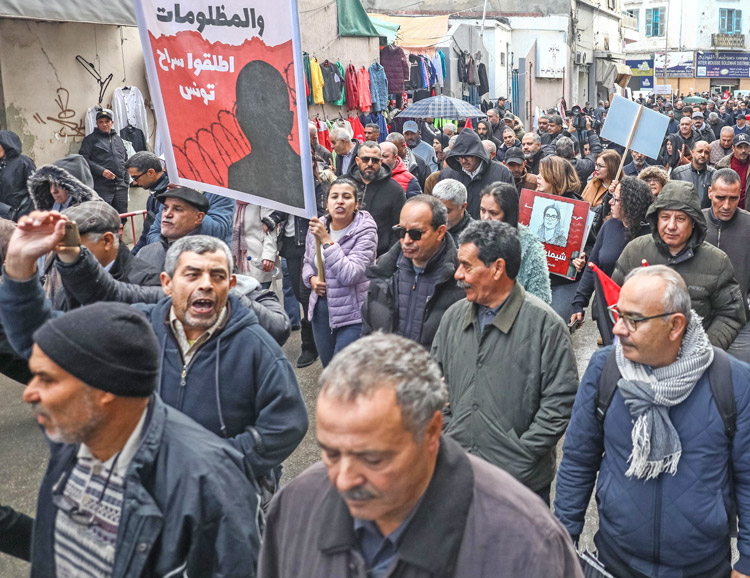
For the last three weeks, Tunisians have taken to the streets to demand the release of political prisoners. Carrying banners reading, “Opposition is not a crime” and “Free Tunisia,” protesters in Tunis, the capital, have held up pictures of detained political activists.
They also chanted, “The people want the fall of the regime!” the rallying cry of the 2011 mass uprising that overthrew the regime of President Zine El Abidine Ben Ali and led to a wave of protests throughout the region known as the Arab Spring.
Saied was first elected in 2019, promising to maintain liberties won through those struggles. But by 2021 he had disbanded parliament. He ruled by decree, claiming it was an “emergency measure” necessary during the COVID-19 pandemic. Despite protests against his attack on political freedoms, he rewrote the country’s constitution and clamped down harder.
“Since 2021 Saied has dismantled or sidelined opposition parties and civil society groups, including the UGTT,” Reuters reported Dec. 5, and “jailed top opposition politicians.”
Some 40 opponents of the government were given prison sentences from four to 45 years Nov. 28. They were convicted of “conspiring” to oust Saied, who branded them as “terrorists.” Human Rights Watch said several “had done little more than engage in basic political acts, including holding meetings with foreign diplomats or international organizations.”
Among those imprisoned are civil rights activist and lawyer Ayachi Hammami and Ahmed Nejib Chebbi, co-founder of the opposition National Salvation Front coalition. Hammami said he would launch a hunger strike. “Just as I fought outside prison for democracy, human rights, freedoms and social justice, I will turn the cell in which Kais Saied imprisons me into a space of struggle as well,” he told the media.
Twenty of those charged fled abroad and were sentenced in absentia, including the well-known French-Jewish writer Bernard-Henri Levy.
“We are not intimidated by your threats or your prisons. We do not fear jail,” said UGTT General Secretary Nourredine Taboubi Dec. 4 following a union protest. The UGTT has 800,000 members.
There have been repeated demonstrations in Tunisia against the worsening economic conditions working people face. Tunisia has an overall unemployment rate of 16%, and up to 40% for youth. In western Tunisia, the poverty rate is 37%.
Food prices have doubled since 2021 and there are shortages of basic necessities, including coffee, rice, cooking oil and sugar. An increasing number of Tunisian farmers on the border with Algeria are trying to get jobs as seasonal laborers there.