In the wake of the killing of thousands of protesters by the Iranian regime, a two-week wave of demonstrations that began Dec. 28 and spread throughout the country has been pushed back — for the moment.
The scope of the protests, as well as the government’s response using mass repression and shutting down the internet and most cellphone service, shows the bourgeois clerical regime is weaker than ever. It is desperately trying to prevent working people in Iran and other opponents of its reactionary dictatorship from communicating with each other.
More than 18,000 people had been arrested and 2,400 killed as of Jan. 13, according to the Human Rights Activists News Agency. Government officials have given similar figures. A doctor in Tehran told the Guardian that in one hospital in Tehran alone more than 400 people were treated for gunshot injuries to their eyes.
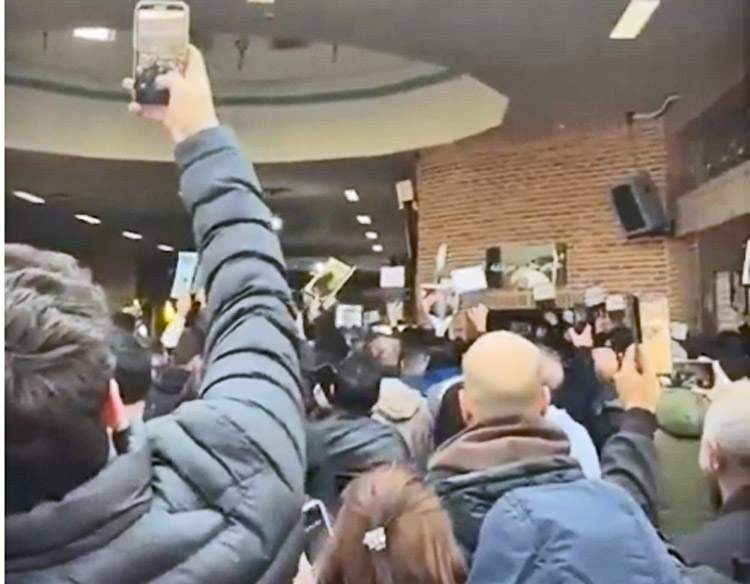
Some videos have made it through the blackout. One shows dozens of body bags and corpses on stretchers outside a morgue in Tehran. Another shows family members at the Behesht Zahra Cemetery in Tehran Jan. 12 chanting anti-government slogans at a ceremony for those killed.
The protests began when capitalist merchants at the bazaar in Tehran — previously allied with wings of the clerical regime — along with small shopkeepers, shut their doors and protested their mounting losses from the devaluation of the currency and rising prices. The Iranian rial has lost at least 40% of its value against the dollar since the 12-day war with Israel in June.
Israel’s success in destroying Iranian air defenses and missile stores, along with its killing of many top leaders of the regime’s hated repressive apparatus, was popular among many working people in Iran.
The protests, some in the tens of thousands, soon spread to bazaars around the country, to universities and to small towns and large cities in every one of Iran’s 31 provinces. In many of the small towns these were the first significant anti-government protests by working people. These areas are often the hardest hit by unemployment and the deepening capitalist economic crisis, exacerbated by U.S. sanctions.
Workers oppose being cannon fodder
Deep-rooted hatred for the regime and its trampling on democratic rights, and the attempts to expand its reactionary influence throughout the Middle East, broke into the open with demonstrators chanting “Freedom, freedom, freedom,” “Death to the dictatorship,” and “Not for Lebanon, not for Gaza; I give my life for Iran.” The last slogan expresses the widespread opposition among working people toward the regime’s “axis of resistance,” which includes Hamas, Hezbollah and the Houthis. It aims to destroy Israel and eliminate the Jews there.
While some 60% of Iranians are from the Persian nationality, mostly Shia Muslims, 40% are from oppressed nationalities, largely Sunni Muslims. By the third or fourth day actions spread to northwestern Iran, home to Kurds, an oppressed nationality. Baluchis, who like the Kurds have a long history of fighting for their national rights, took to the streets in Sistan-Baluchistan province in southeastern Iran. There were also large actions in Khuzestan, with its large Arab population.
At first the police, along with operatives of the Islamic Revolutionary Guard Corps and thugs from the paramilitary Basij, tried to quell the protests by firing tear gas, water cannons and rubber bullets and beating people with clubs, but they were often overwhelmed by the large crowds.
Provocations by prince, Mujahadeen
At some protests there were provocative actions — including attacks on police stations, government offices or individual cops and pro-regime thugs — by supporters of the Mujahadeen, an armed anti-government group that seeks support from Washington and other imperialist powers, as well as by supporters of the exiled U.S.-based “Crown Prince” Reza Pahlavi. He is the son of the last Shah of Iran, whose hated U.S.-backed dictatorship was overthrown by a mass popular uprising in 1979.
Pahlavi touts himself as the leader of the protests and openly promotes violent provocations. While some calls were heard at actions in Tehran and other cities in favor of his return, other protesters, especially among Iran’s oppressed nationalities, have been chanting “Death to the oppressor, be it a Shah or Supreme Leader.”
Older workers know firsthand what life was like under the shah, with thousands of political prisoners, and torture of unionists and political opponents by the hated Savak, the shah’s secret police.
Kurds, Baluchis, Arabs, Azerbaijanis and other oppressed nationalities will never forget the discrimination, racism and state violence they faced under the shah, including his imposition of Farsi as the only official language. With the consolidation of the cleric-led counterrevolution by 1983, the Islamic Republic reinforced the national oppression fostered under the shah.
Khamenei slanders protesters
Supreme Leader Ayatollah Ali Khamenei used the provocative actions by the Mujahadeen and shah supporters to bolster his slander that the protesters were agents of U.S. imperialism and of Israel’s Mossad.
At first President Masoud Pezeshkian said the demands of the merchants were legitimate and offered to negotiate. But soon he shifted, echoing the same charges as Supreme Leader Khamenei, who represents the real power in the country.
The Islamic Revolutionary Guard Corps, the police and the Basij stepped up their deadly attacks Jan. 9 and 10, using semi-automatic weapons and machine guns, causing large numbers of deaths of peaceful protesters.
With the internet shut down the regime mobilized thousands of loyalists for rallies across the country Jan. 12, falsely charging the protesters with being Israel’s “hired terrorists.”
President Donald Trump, looking for stability in the Middle East to seek profits for the U.S. rulers, warned Khamenei that Washington could “start shooting soon” if the regime keeps killing protesters.
“Even if Trump authorizes attacks on Iran in the coming days, his goal will not be to change the Islamic Republic or to support the protesters. Rather, his priority is to change the behavior of Iran’s government in a way that serves U.S. interests,” Farsi-language internet site Tahkim-e Mellat noted. The Tehran and Suburbs Bus Company Union issued a statement Jan. 7 in solidarity with the anti-regime protests, noting that “these movements have emerged not to return to the past, but to build a future free from the domination of capital, founded on freedom, equality, social justice and human dignity.”
“Genuine liberation is possible only through the conscious and organized leadership and participation of the working class and oppressed people, not through reproducing outdated and authoritarian forms of power,” the bus workers union noted, “nor reliance on foreign powers or factions within the ruling establishment.”
What’s needed is “unity, solidarity and the creation of independent organizations in workplaces and neighborhoods and at the national level.”