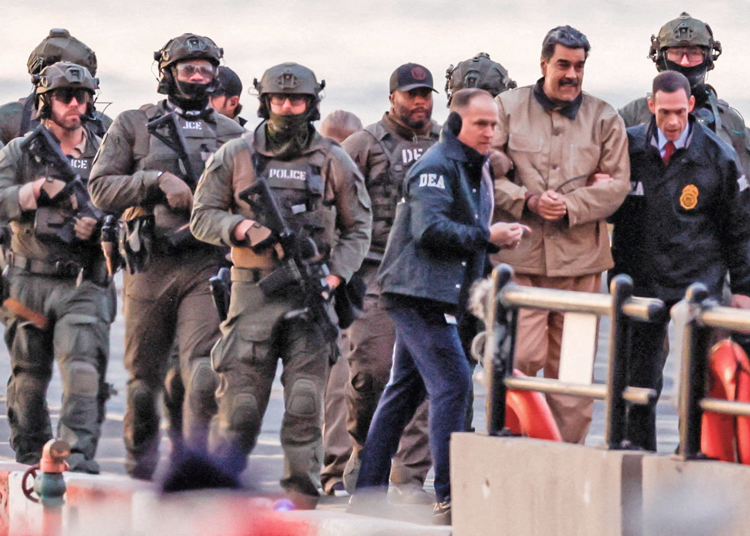
After launching a military assault on Venezuela and kidnapping Nicolás Maduro, the country’s president, Jan. 3, President Donald Trump’s administration has taken further steps to advance the U.S. rulers’ economic, political and military objectives in Venezuela and across the hemisphere. The assault on Venezuela was the opening salvo of stepped-up efforts by the U.S. ruling class to reinforce its domination and confront its global adversaries far more directly.
The U.S. rulers are maintaining a naval blockade in Caribbean waters and seizing tankers to try to bend Caracas to its will, further secure control over Venezuela’s vast oil resources and deal blows to Beijing and other rival powers. With imperial arrogance, the White House announced it would “run” Venezuela, imposing U.S. control on oil operations and marketing.
“I am pleased to announce that the interim authorities in Venezuela will be turning over between 30 and 50 million barrels” of “sanctioned” oil to the U.S. government, Trump said Jan. 6. Revenue from the sale of the oil “will be controlled by me.”
This is equivalent to one to two months of Venezuelan oil production. The value to the U.S. government would be as much as $2.8 billion.
Meanwhile, U.S. forces continue to unilaterally seize oil tankers carrying Venezuelan “sanctioned oil,” including some linked to a “shadow fleet” run by Tehran and Moscow.
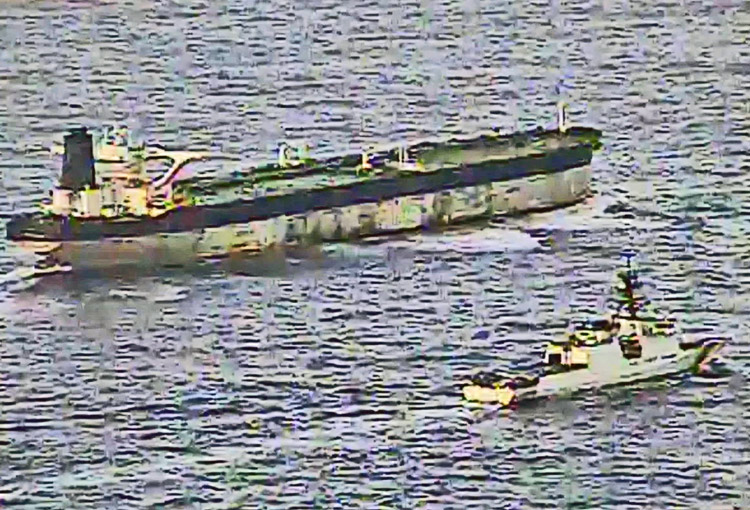
They seized the Marinera Jan. 7 as it approached Iceland, ending an 18-day pursuit. The tanker had swapped its false flag for a Russian flag, hoping to provide some deterrence. Moscow requested Washington stop its pursuit and sent a submarine and a destroyer to the area, before U.S. special operations forces commandeered the ship. The Pentagon had deployed aircraft and other assets to the U.K. ahead of the operation.
Following the ouster of Maduro, the Trump administration said it was canceling a “second wave of attacks, which looks like it will not be needed.” Trump said Washington and Caracas, now headed by former Vice President Delcy Rodríguez, “are working well together.”
Rodríguez was sworn in as president Jan. 5, the same day Maduro and his wife, Cilia Flores, were indicted in a New York court on multiple conspiracy charges related to cocaine trafficking.
With an armada in front of Venezuela’s coast and thousands of troops, aircraft and ships in the region, the U.S. government says it is “working with” remaining leaders of the Venezuelan government, looking to maintain stability and manage a transition.
Imperialist heist
Meanwhile, Trump hosted a White House meeting Jan. 9 with top executives from Chevron, ExxonMobil, ConocoPhillips and other major oil companies to pitch a $100 billion investment plan in Venezuela’s oil industry. This was a graphic display of how big capital plunders underdeveloped countries.
Trump called on the oil executives to invest, pledging they would “get their money back as quickly as we can,” and then “we can divvy it all up.” To put a veil on the imperialist heist, White House officials interspersed their comments with assurances that this will also be “beneficial” for the people of Venezuela and the United States.
While open to the offer, the oil bosses demanded Washington do more to make Venezuela “investable.” It “has to be a win for the company and our shareholders,” Darren Woods, ExxonMobil CEO, said. “We’ve had our assets seized there twice and so you can imagine to re-enter a third time would require some pretty significant changes” in Venezuela’s laws.
The oil boss was referring first to the 1976 nationalization of Venezuela’s oil industry, through which Venezuela reclaimed sovereignty over its natural resources. And then some 25 years later, when the Venezuelan government sought to gain greater control over the industry, which was still largely dominated by U.S. corporations. In the early 2000s, the Hugo Chávez government changed the terms of operation for foreign companies, and redirected a larger portion of oil revenues to much-needed social spending. The measures were widely popular among working people in Venezuela, who felt pride in benefiting from the fruits of their country’s patrimony.
In response, every U.S. administration since then has imposed punishing sanctions on Venezuela’s oil and gas sectors, aggravating the industry’s decline and worsening the economic conditions confronting working people. To guarantee their returns, oil bosses are now demanding the people of Venezuela abandon sovereign rights they have fought for over decades, and accept the U.S. rulers’ imperial domination.
U.S. seeks to assert dominance
Control of production of Venezuelan heavy sour crude also has a strategic place in the U.S. capitalist rulers’ growing efforts to “reindustrialize” their economy. Ramping up production capacity and controlling strategic resources are a necessary preparation for future wars.
Washington is now pressing Caracas to cut ties with Moscow, Beijing and Tehran. Trump said Jan. 9 that if Beijing and Moscow want Venezuelan oil, they can buy it from the U.S.
With U.S. sanctions barring most countries from obtaining Venezuela’s oil, Beijing had become far and away its biggest buyer and its largest investor. Beijing has poured billions of dollars into Venezuela, with Caracas building up a debt that grew to $44 billion in 2017, which it has been paying down with oil. Moscow has also invested heavily.
“If we didn’t do this, China would have been there and Russia would have been there,” Trump said. “When you add Venezuela and the United States together, we have 55% of the oil in the world,” he added.
To feed refineries in the U.S. Gulf states — specifically engineered to process Venezuelan oil — U.S. companies were importing oil from Canada. Securing Venezuelan oil will now increase Washington’s leverage over Canadian capitalists in trade and other deals. Using tariffs and other threats, including threats of attacking drug cartels in Mexico, Washington is pressuring both governments prior to a July 2026 review of the United States-Mexico-Canada Agreement.
Blockade of Cuba
Tankers bound for Cuba are a special target of the U.S. naval blockade of Venezuela. Washington hopes to force the Cuban people and government into submission by cutting off its supply of oil and trade.
“There will be no more money or oil going to Cuba — Zero!” Trump said Jan. 11. “I strongly suggest they make a deal, before it is too late.”
The U.S. rulers are determined to erase the example set by the Cuban people and their socialist revolution, which brought working people to power, overthrew capitalist exploitation and showed toilers everywhere there is an alternative to fascism and world war.
The Cuban government sent a clear response to Washington: “Those who turn everything into a business, even human lives, have no moral authority to point fingers at Cuba for anything,” said Cuban President Miguel Díaz-Canel. “Those who blame the revolution for the severe economic hardships we suffer should be ashamed to speak. Because they know these hardships are the result of the draconian measures of extreme suffocation that the U.S. has been imposing on us for six decades and now threatens to intensify.
“Cuba is a free, independent, and sovereign nation. No one dictates what we do. Cuba does not attack. It has been attacked by the U.S. for 66 years,” said the Cuban president. “It does not threaten. It prepares itself, ready to defend the homeland to the last drop of blood.”