As we mark the 67th anniversary of the popular triumph in Cuba that opened the way to the first socialist revolution in the Americas, the Spanish edition of Cuba and the Coming American Revolution by Socialist Workers Party National Secretary Jack Barnes is one of Pathfinder’s Books of the Month for January. The excerpt is from the foreword by Mary-Alice Waters, an SWP leader and president of Pathfinder Press. It shows the power of Cuba’s revolution and why today Cuba is targeted by Washington as the U.S. rulers escalate war moves in Latin America, the Caribbean and around the world. Copyright © 2007 by Pathfinder Press. Reprinted by permission.
In less than seventy-two hours of combat in April 1961 along the southern coast of Cuba near the Bay of Pigs, Cuba’s Revolutionary Air Force, militias, police, and Rebel Army defeated an invasion by some 1,500 Cuban counterrevolutionaries financed, armed, trained, scripted, and deployed by Washington. The stunning victory, Yankee imperialism’s first military defeat in the Americas, had repercussions around the world — not least of all within the United States itself.
Jack Barnes takes that historic moment as the starting point for Cuba and the Coming American Revolution. It was the moment when Cuba no longer appeared as yet another potential Latin American victim of the most powerful empire in history, but emerged as its equal. “For us, what Cuban workers and peasants had accomplished,” Barnes writes, “was the example in our own political lifetime of the necessity and the possibility of revolution, of not only how to fight but how to fight to win, of the capacity of ordinary human beings to transform themselves as they confront challenges and take on responsibilities they would have previously deemed impossible.” …
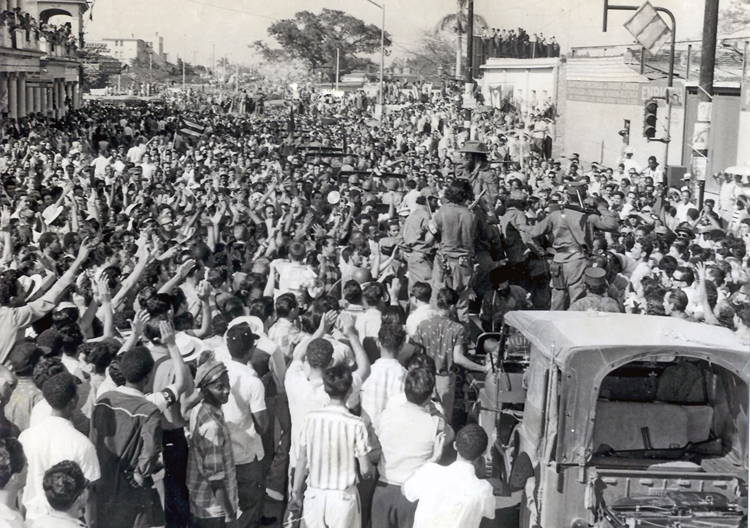
Nearly fifty years after the revolutionary victory that brought down the U.S.-backed military dictatorship of Fulgencio Batista on January 1, 1959, the U.S. rulers remain as committed to the necessity of overthrowing the Cuban Revolution as they were when the workers and farmers of Cuba, and the young people drawn to their struggles, led by the July 26 Movement and its Rebel Army, fought their way into history and began taking control of their own destiny. …
From the class perspective of the U.S. rulers, there was never anything irrational in their hatred for the radical land reform, mass campaign to wipe out illiteracy, nationalization of housing and slashing of rents, outlawing of racial discrimination, nationalization of basic industries, drawing of women into the workforce on a large scale, establishment of a popular militia, and other actions taken by the Cuban people and their revolutionary government. …
The course of Cuban working people was simply an unbearable challenge to the assumed property “rights” of the U.S. ruling families, who feared that the example set by the first socialist revolution in the Americas would be emulated elsewhere in our hemisphere. What drives Washington is “not fear of the Cuban Revolution” alone, as the Second Declaration of Havana proclaimed in February 1962, but fear of the Latin American revolution. “Fear that the plundered people of the continent will seize the arms from their oppressors and, like Cuba, declare themselves free peoples of the Americas.” …
This is the world in which the example set by the people of Cuba remains as important as it was the day they took power, demonstrating in practice what it takes to break the stranglehold of imperialist exploitation and defend those conquests. Explaining that truth to workers and farmers in the United States as they find themselves propelled into struggles that lead them to rethink many long-held prejudices in quite unexpected ways is not simply an act of working-class solidarity, however important that may be. It is a proletarian necessity, essential to the internationalist political education and transformation of the working class itself. As the Cuban people proudly say of their aid to the peoples of Africa, Latin America, the Caribbean, and elsewhere around the world, “Those who are not ready to fight for the freedom of others will never be ready to fight for their own.”
Shortly before Cuba and the Coming American Revolution came off the press in 2001, Colin Powell, the new secretary of state, explained Washington’s uncompromising stance toward Cuba’s revolutionary government. He did so more accurately than he perhaps intended. Testifying April 26, 2001, before a congressional committee, he responded to the question of why the U.S. government refuses to alter its decades-long policy toward Cuba. Powell replied that in China, Russia, and Vietnam “you can see leaders who the world is changing.” But in Cuba, he said, Castro “hasn’t changed his views in any way.”
The secretary of state got it only partially right, of course. As with each of his predecessors, his inability to fathom the human beings driving the Cuban Revolution was above all a class blindness. It is not only Fidel and the broad and deep revolutionary leadership of Cuba who have not changed their revolutionary convictions. It is the people of Cuba in their overwhelming majority who have never surrendered. Who refuse to subordinate the interests of working people to the prerogatives of capital. Who stand ready, as always, to aid revolutionary struggles wherever they may occur, by any means necessary. …
Cuba and the Coming American Revolution is not primarily a book about Cuba, however. Above all, it is about the struggles of class-conscious working people in the imperialist heartland, the youth who are attracted to them, and why the course of the class battles accelerating here today is and will continue to be inextricably intertwined with the defense of the conquests of the Cuban people. …
“What the workers and farmers of Cuba showed us is that with class solidarity, political consciousness, courage, focused and persistent efforts at education, and a revolutionary leadership of a caliber like that in Cuba — a leadership tested and forged in battle over years — it is possible to stand up to enormous might and seemingly insurmountable odds and win.