More information is coming out about the number of protesters slaughtered by the bourgeois-clerical regime in Iran Jan. 8-9. The Human Rights Activists News Agency has confirmed 5,459 deaths and is investigating 17,000 more. Two Iranian health ministry officials told Time magazine it could be as many as 30,000. Tens of thousands have been arrested over recent weeks.
But the reactionary regime is weaker than ever. Opposition to its rule continues from workers, unions, student groups, oppressed nationalities and political prisoners, who are speaking out and organizing new protests.
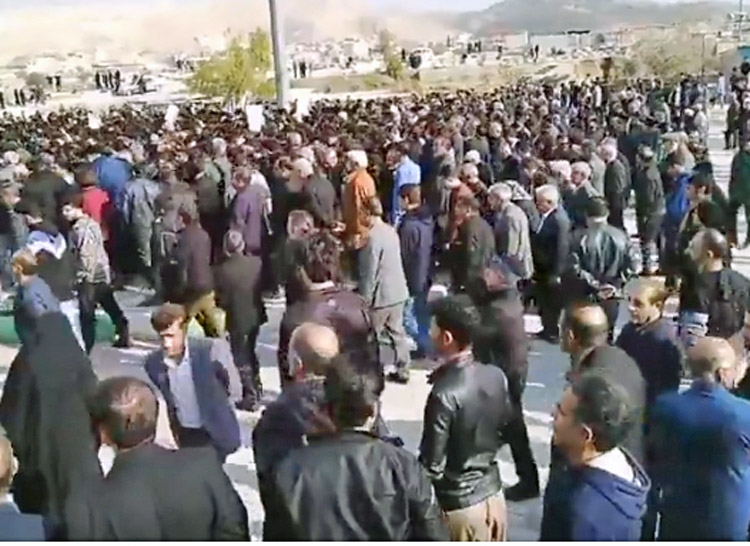
Even as the sound of bullets had barely quieted, family members turned some funerals into demonstrations. One of the largest took place Jan. 11 for teenager Alireza Seydi in Abdanan, a mostly Kurdish city, where 1,000 mourners chanted “Death to [Supreme Leader Ali] Khamenei.”
Hundreds of students at the Tehran University of Medical Sciences held a sit-in Jan. 26 to protest the administration’s cancellation of a memorial ceremony for fellow student Aida Heydari, killed during the protests. Then they marched through the campus.
“These days were not easy for us; days of hardship, anxiety, waiting and silence,” the Association of Truckers and Drivers Unions of Iran posted on its internet site Jan. 22, its first statement since the massacres and government-imposed internet blackout. “What was never cut off was our solidarity, and what was never silenced was our voice in defense of our rights.”
“Today we return with hope, with greater experience, and with a deeper faith that our strength lies in standing together.” Last year the association led an 11-day nationwide strike of independent owner-operators and other drivers.
Unionists: ‘We will not be silent’
“We demand the immediate and unconditional release of all innocent detainees — those whose only ‘crime’ was calling for a dignified life and exercising their right to protest,” the Coordinating Committee of Teachers Trade Unions said Jan. 22. “We will not remain silent until justice is won.”
The protests began Dec. 28 when small merchants and capitalist companies in Tehran’s bazaar shut their doors to demand an end to the devastating impact of the plummeting value of Iran’s national currency and rising prices. The protests rapidly spread to towns, small and large, and to oppressed nationalities, including the Kurds in the northwest and Baluchis in the southeast.
Fearing the growing movement, the regime unleashed its murderous assault. The police, Islamic Revolutionary Guard Corps operatives, snipers and paramilitary thugs fired semiautomatic weapons and shot guns — at times machine guns — into unarmed crowds across the country chanting “Death to the dictator,” “Freedom, freedom, freedom,” and “Not for Gaza, not for Lebanon; I give my life for Iran.” Some were shot at close range, stabbed or beaten to death.
These protests did not drop out of the sky. At the end of 2017 and into 2018, and again at the end of 2019, working people took to the streets and were met by the regime’s repression. A new protest wave began in September 2022, when Zhina Amini died after her arrest by the “morality” police for violating the regime’s dress code for women.
These protests are fueled by opposition to the anti-working-class actions of the regime, its trampling on democratic rights and the deadly consequences of its attempts to expand its reactionary military and political influence throughout the region, along with its goal of destroying Israel.
Since the early 1980s — when it consolidated its counterrevolution, stifling the 1979 popular revolution that overthrew the U.S.-backed shah of Iran — the regime has promoted Jew-hatred and hatred of Israel to try to maintain itself in power.
To justify its latest slaughter, it claims that the protests were “riots” organized by Israeli’s intelligence agency, the Mossad, and other “foreign terrorists.”
The thousands of women, men, children and teenagers killed have “left the people of Iran and the entire world astonished and stunned,” Sheik Abdul-Hamid told the Jan. 23 Friday prayer meeting at the mosque in Zahedan in Sisan-Baluchistan. “Those killed in the recent uprising are the people of Iran. They are not foreigners.”
Abdul-Hamid, a Sunni cleric and prominent leader of the oppressed Baluchi people, has spoken out frequently against Iran’s death penalty and for freeing all its political prisoners.
Some opponents of the regime — especially among Iranians in exile — hope Washington will intervene to overthrow Khamenei, and install in power Reza Pahlavi, son of the shah overthrown in 1979.
But a different course is presented by the Union of Workers of the Tehran and Suburbs Bus Company. In a Jan. 27 statement condemning the massacres it said it “continues to emphasize this fundamental and inviolable principle: That the true liberation of the people of Iran is possible only through collective leadership and the conscious, organized and independent participation of the working class as a whole and other oppressed strata within the country.”