MINNEAPOLIS — Recent protests and other events unfolding in Minneapolis over the last week show both the potential for building a powerful and disciplined union-led movement to fight and win amnesty for those in the working class without papers, as well as the deadly consequences of ultraleft tactics employed as an answer to the assaults and brutality of Immigration and Customs Enforcement agents operating here.
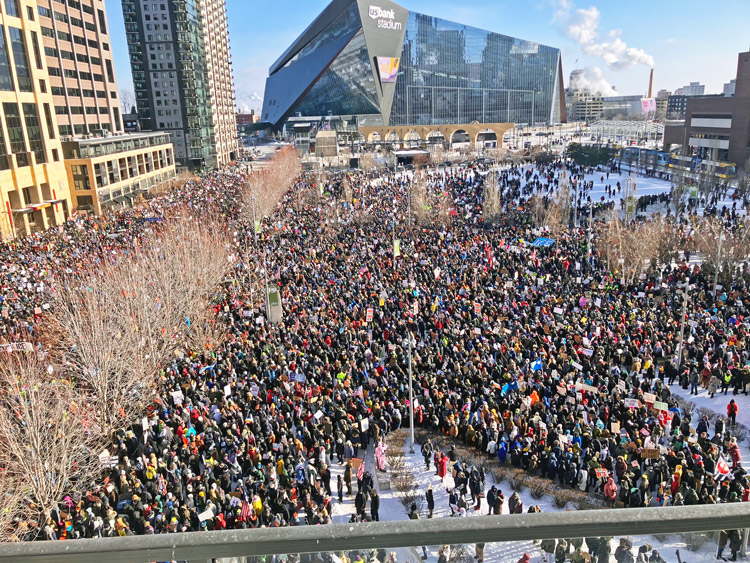
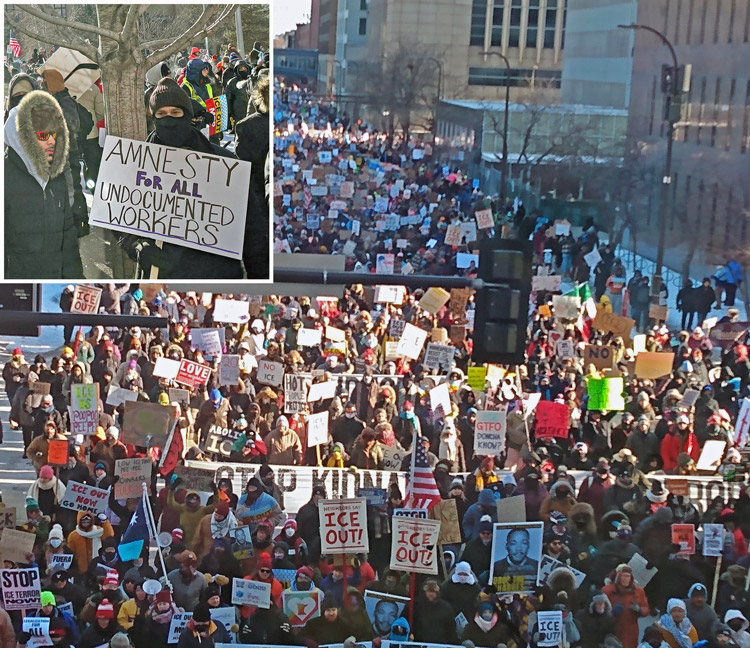
Thousands marched and rallied in subzero temperatures in downtown Minneapolis Jan. 23, protesting ICE’s continuing attacks on workers, with and without papers, and their families. It reflected the determination of many working people to stand up in defense of immigrant workers — their co-workers, neighbors, fellow unionists, church members and more. The Minnesota AFL-CIO Executive Board endorsed the action and urged its members to attend. Many did.
The union’s role in the march ensured its disciplined, peaceful character.
In contrast, a day later, U.S. Border Patrol officers were surrounded and confronted by some 50 people provocatively blowing whistles and shouting and filming them. Alex Pretti, a nurse and U.S. citizen who was part of the provocation, was shot and killed by federal agents.
Video shows Border Patrol agents try to push Pretti away. Then he moved to get between the agent and a woman they had pepper sprayed, and he was thrown to the ground and pummeled. As one agent appears to find and take a gun from Pretti, another shouts “gun,” and others start shooting. Pretti was shot 10 times and died at the scene.
The liberal media paints Pretti as a saint, and Trump officials immediately stuck a “domestic terrorist” label on him and accused him of being there to “massacre law enforcement.” Both sides prevent working people from drawing the necessary lessons in order to build an effective response. First, Pretti was not at a protest, but a confrontation organized to interfere with the Border Patrol agents.
Much has been said about Pretti’s Second Amendment right to bring a gun into a protest. But experienced, conscious working-class leaderships go out of their way to avoid giving the capitalist state and its agencies an excuse to victimize fighters in struggle. There is a perfect example that working people could draw from. That is, the example of the Minneapolis Teamsters struggles in the 1930s, where the leadership took away weapons from trade unionists going into combat with the cops.
These frequent confrontations, as well as peaceful vigils at makeshift memorials, are taking place in neighborhoods across the Twin Cities.
The same day the shooting occurred the Minnesota National guard was activated and is now on the streets.
And true to form, the following night antifa thugs, who have a continuity here dating back to the violent actions that ended up destroying the protest movement around the death of George Floyd in 2020, smashed up the front glass windows of a hotel where ICE agents are said to be housed, painting “F–k ICE” graffiti on the walls. This is a blow to efforts to build the kind of mass movement needed.
The ICE arrests and brutality are an attack on workers’ rights — documented and undocumented. But how workers and our unions can make progress needs to be debated out.
“We’re going to de-escalate a little bit,” President Donald Trump said Jan. 27. He ordered pugnacious Border Patrol chief Gregory Bovino out of Minneapolis, replacing him with Border Czar Tom Homan. Homan met with Democratic Minnesota Gov. Tim Walz, and they say they agreed on steps to improve the situation.
Trump promised a “very honorable and honest investigation” into the killing of Pretti. He called Pretti’s death “a very unfortunate incident.” And he noted, “You can’t walk in with guns” to a protest, “you can’t do that.”
Large protest, important discussion
Socialist Workers Party members set up a table at the Target Center where the Jan. 23 rally was held, featuring banners with party slogans and books by party leaders. They called for building a working-class movement to fight for amnesty for all undocumented workers in this country.
They explained to those they met that it is crucial to unite the working class against the divisive anti-immigrant propaganda of the bosses and their politicians. To boost their profits, the employers try to play native-born workers off against those without papers. In this way their goal is to weaken the labor movement, the better to lower the pay and working conditions of all workers.
Another key topic was the main slogan of the march, “ICE Out.” This slogan — backed by the governor and other Democratic politicians, the liberal press and antifa — fails to point a needed road forward. It’s similar to the slogan of Black Lives Matter agitating for “Abolish the police.” But neither is possible under capitalism, nor explains the source of the challenge confronting the working class.
Many who stopped at the party table were happy to learn about the demonstrations of millions that took place in 2006 and 2007, led by immigrants behind banners saying, “We are workers, not criminals.” These powerful actions succeeded in preventing passage of the Sensenbrenner bill, which would have made it a felony for an immigrant without papers simply to be in the country and a crime for anyone who extended “aid” to them in any way.
This powerful movement is in sharp contrast to the approach of many in Minneapolis today.
Layla, a fast-food worker who feared giving her last name because it could lead to victimization, picked up the book Is Socialist Revolution in the US Possible? which describes the mass marches in 2006 and 2007.
She responded to the SWP’s call for amnesty, noting a fight over this led by the AFL-CIO in 1986 forced Ronald Reagan to grant an amnesty to nearly 3 million immigrants. “That’s how my father got to stay in the U.S.,” she said. “That’s what we need.” A second amnesty was won under the George H.W. Bush administration in 1990.
Labor backs Minneapolis protest
Brian Bryant, president of the International Association of Machinists union, issued a statement calling on all IAM members to support the Jan. 23 action. “The IAM stands in solidarity with the people of Minnesota,” he said, “including union members and working families who are demanding accountability and an end to actions that violate basic civil and constitutional rights.”
The state AFL-CIO said, “As Minnesotans we stand together against ICE’s occupation of our communities and the unconstitutional detention of countless innocent Minnesotans, including a significant number of union members.”
Protest organizers had urged workers not to go to work Jan. 23 and for shop owners to close down. Hundreds of shops, museums and entertainment venues closed. Several restaurants stayed open, serving free food and hot chocolate.
The Karmel Mall, the largest Somali mall in the U.S., has been hard hit economically by the ICE actions, called “Operation Metro Surge” by the federal government. And there’s widespread fear by immigrant workers to go out in the absence of a strong enough popular movement to provide safety. Many of the more than 100 small shops in the mall have shuttered their doors.
The Minnesota Star Tribune reports, “Roughly 80% of immigrant-owned businesses along key corridors in Minneapolis and St. Paul have closed in the past week as employees and customers stay home.”
When this reporter returned to work Monday after the march, I learned that out of a workforce of some 100, 26 workers had called off work on Jan. 23. Production was cancelled in several departments. But most said they stayed at home, and didn’t attend the march. A widespread and ongoing discussion on what to do next continues to unfold.
Joanne Murphy and Mary Martin contributed to this article.