One of Pathfinder’s Books of the Month for January is 50 Years of Covert Operations in the US: Washington’s Political Police and the American Working Class by Larry Seigle, Farrell Dobbs and Steve Clark. It explains how the U.S. rulers use the FBI, their political police, to target fighting workers and communists to defend capitalist rule. As Washington today increases its war moves in Latin America and around the world, it is also stepping up deportations and demagogy against immigrant workers to try to divide and weaken the working class. This is part of the rulers’ assault on constitutional freedoms. The excerpt is from the introduction by Clark. Copyright © 2014 by Pathfinder Press. Reprinted by permission.
In August 1987 a federal district judge in New York City issued an injunction ordering that all documents obtained by the government in ways that violate the US Constitution and Bill of Rights cannot be “used, released, or disclosed” by the FBI or other federal police agencies.
The injunction came in connection with Judge Thomas Griesa’s decision a year earlier, in August 1986, on a suit filed by the Socialist Workers Party in 1973. The party’s aim was to bring into the open decades of covert spying and disruption against the SWP by the federal political police, and to mobilize opposition to these violations of the constitutional rights not only of members and supporters of the party and Young Socialist Alliance, but of other organizations and individuals targeted by covert government operations as well. …
The fifteen-year-long battle by the Socialist Workers Party, backed by thousands, resulting in that federal court ruling marked a victory for the working class. Moreover, that victory stands and has a direct effect to this day, more than four decades after the suit was filed. …
It was an unprecedented political initiative. A communist organization was filing a suit against the capitalist government, as opposed to being forced to defend itself and its members against a case trumped up by cops and prosecutors. Communist workers — along with fellow unionists, farmers, and supporters of civil rights — were plaintiffs, and government agencies and officials defendants. Not the other way around.
The broadly supported political campaign organized and led by the Socialist Workers Party provided an additional weapon that unionists, Black rights fighters, and others among the exploited and oppressed could use to better defend their own constitutional rights. Above all, it helped keep open political space for working people to speak, organize, and act outside the electoral and judicial arenas — to fight on our own terrain, in the factories, on the picket lines, and in the streets. …
[T]he SWP’s central leaders, from those in the oldest to newer generations, were convinced that attitudes were changing among workers and farmers in the United States as a result of the political conquests of the Black rights movement, anti-Vietnam War mobilizations, and other social struggles. The capitalist rulers and their government were on the defensive politically as a result of what was becoming known about cop spying, harassment, and disruption of working people and youth engaged in these fights. All this was compounded for the rulers in 1973 by the widely publicized “Watergate” revelations of rampant wiretapping and burglary by the Richard Nixon administration against its domestic rivals in capitalist politics.
SWP’s 1973-86 political, legal
battle against government
spying won a court victory
for working class, bolstered
constitutional protections
All in all, the communist leaders concluded, conditions were unusually good for such a political campaign. The Socialist Workers Party never lies to working people, in the US or anywhere else in the world. Its history and political record are an open book. It has nothing to hide. As these conclusions were confirmed in life over the next fifteen years, initial doubts and hesitations were transformed into respect and support for the SWP’s political course in this fight. …
The court’s sweeping 1986 decision in favor of the SWP’s suit found no evidence “that any FBI informant ever reported an instance of planned or actual espionage, violence, [or] terrorism” by the party or its members. …
Among the federal agencies who were defendants in the party’s suit was the US rulers’ immigration police. At the time it was called the Immigration and Naturalization Service (INS). Today it’s known as the Immigration and Customs Enforcement (ICE). Changing names notwithstanding, it is known and despised as la migra by working people who are its targets and by millions of others who know how the capitalists use it to divide and weaken the solidarity and fighting power of the working class, unions, and protests against discrimination of all kinds. …
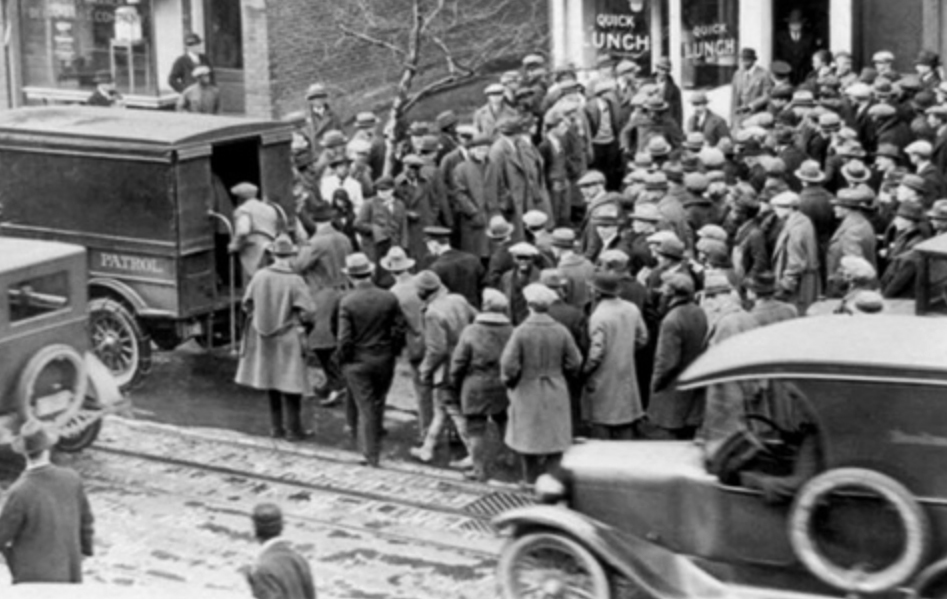
Deportations, in fact, were among the first and most brutal clubs wielded by bosses and their government in the repressive drive against the workers movement in the aftermath of World War I. In what became notorious as the Palmer Raids, named after the US attorney general at the time, more than 3,000 anarchists, communists, and other working-class militants were arrested and 750 deported in 1919 and 1920. …
For communist workers, defending ourselves is not primarily a question of legal arguments and courtroom tactics, although revolutionary-minded workers approach these matters with the utmost proletarian discipline and attention to detail.
Like everything else in the class struggle, how working people defend ourselves in face of frame-ups and other government assaults is above all a political question. It is part of the working class advancing along the revolutionary course toward replacing the state power of a tiny minority of propertied families — the dictatorship of capital — with that of the great majority, workers and farmers.