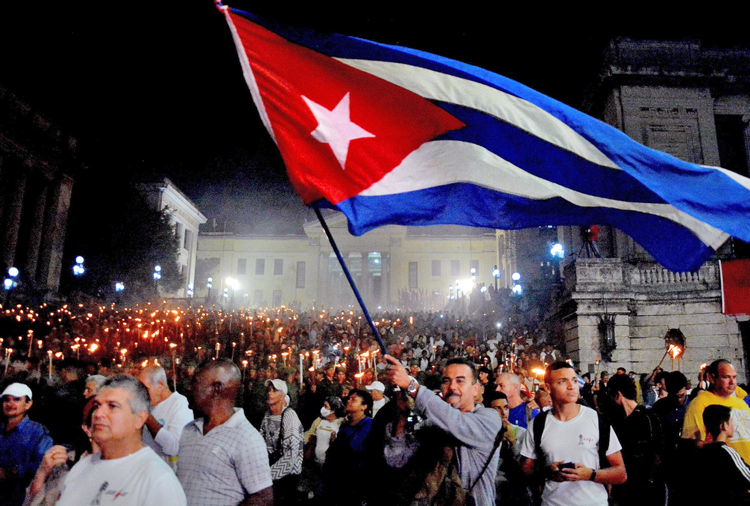
“This is not an act of nostalgia, it’s a call to action,” Litza González, national president of the Cuban Federation of University Students (FEU), told tens of thousands of students, young workers and soldiers as they marched from the steps of the University of Havana through the city’s streets Jan. 27.
The annual torchlight march honors the life of national hero José Martí, who led the 1895 Cuban war of independence against Spanish colonial rule. The march is a proud demonstration of Cuba’s heritage of revolutionary struggle against imperialist domination. This year, it was also a show of defiance to the U.S. rulers’ stepped-up threats against the Cuban people and their socialist revolution today.
Two days later, President Donald Trump signed an executive order authorizing new sanctions targeting any country that sells or provides oil to Cuba. The measure was preceded by Washington blocking oil supplies from Venezuela to Cuba a couple of weeks earlier and threats to the Cuban government “to make a deal, before it is too late.”
For more than 60 years, Cuba has been the target of a relentless economic and political war by the U.S. government that has no parallel. Enforced by both Democratic and Republican administrations, Washington has maintained sweeping measures that impose obstacles to Cuba’s ability to purchase fuel, foodstuffs, medical supplies and other essential items from the U.S. and elsewhere.
As a direct result of these measures, power outages are already a daily occurrence, with most people having electricity for only a few hours a day. By cutting off oil supplies, the Trump administration hopes to bring the Cuban people to their knees and force them to submit to its dictates.
To justify these latest assaults, the White House claims Cuba represents an “unusual and extraordinary threat” to U.S. national security.
“Under mendacious and empty arguments” President Trump wants to suffocate the Cuban economy, said Cuban President Miguel Díaz-Canel Jan. 30.
Cuba is “a country of peace, solidarity, and cooperation,” the Cuban government said Jan. 30. “It’s also a country of courageous fighting people. Imperialism is mistaken to feel confident that with economic pressure and inflicting suffering on millions of people, it will crush our determination to defend our national sovereignty.”
The march was one of several mass actions that have taken place across the island since Washington’s Jan. 3 bloody assault on Venezuela and kidnapping of President Nicolás Maduro, a blatant violation of that country’s sovereignty.
Half a million Cubans across the island marched Jan. 18 to pay tribute to the 32 Cuban combatants who died fighting against the U.S. assault on Venezuela. Regular army units and popular militias carried out military exercises in several provinces in late January. The trade unions and mass organizations are holding meetings to prepare for any possible military attack and to organize stepping up efforts to increase production of food and other essential items.
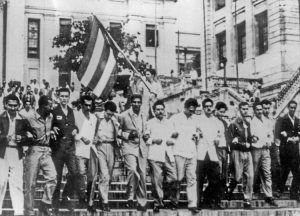
We “do not accept any shackles, new or old,” FEU President González said. Like the generation that staged the first torchlight march, led by Fidel Castro from the university 73 years ago, we “will not surrender, we will not sell out.”
On Jan. 27, 1953, that march was the first large street action opposing the U.S.-backed dictatorship of Fulgencio Batista, which had taken power through a military coup the year before. The Centennial Generation, as that generation of workers and students became known, refused to accept the tyranny and corruption that marked Cuba at the time. Under the leadership of Fidel Castro, the July 26 Movement and the Rebel Army, they went on to carry out a six-year revolutionary struggle that overthrew the dictatorship, and opened the road to a socialist revolution. Some 20,000 Cubans had paid with their lives by the time Batista and his henchmen fled the country Jan. 1, 1959.
The U.S. rulers seek to “return to a utopian and romanticized past that can only exist in their imagination, and to the power the revolution took away from them,” read a Jan. 31 column in Girón, the provincial newspaper in Matanzas.
Cuba’s socialist revolution targeted
Despite Washington’s threats, the U.S. rulers know any attempt to carry out a “surgical precision” military operation in Cuba, like they did in Venezuela Jan. 3, would not have the same results.
“If the Americans put a single foot on Cuban soil, it won’t be like their cowardly ambush of our combatants in Venezuela,” Cuban revolutionary leader Víctor Dreke told the BBC last month. “Over here, things would be different.” Dreke was a combatant in the revolutionary war that overthrew the Batista dictatorship. Since then he has shouldered central leadership responsibilities, including in Cuba’s internationalist missions that provided decisive aid to national liberation struggles in Africa.
“The U.S. is actively seeking regime change in Cuba by the end of the year” headlined a Jan. 22 Wall Street Journal article. It reported that U.S. officials, emboldened by their removal of Maduro, are “searching for Cuban government insiders who can help cut a deal” to push out the regime.
That approach would only be one more in a long line of attempts by the U.S. rulers who have underestimated the class consciousness of millions of Cuban workers and farmers.
“We have problems, and we know we have a lot problems,” Yadián Silva, a taxi driver, told The Associated Press. “But when things happen in Cuba, it’s because people truly feel they should happen. Not because someone from the outside says, ‘do this.’”
The Girón column also had an answer to U.S. officials quoted in the Journal: “Before they celebrate or fantasize about building casinos and McDonald’s in Havana, they should understand — that no matter how grandiose their rhetoric may sound to people worn down by material deprivation, no matter how attractive their promises for the future may seem to many victims of hopelessness, there is something that is much more deeply rooted than their hollow slogans.”