Unions help build Minneapolis protests to unite working class
MINNEAPOLIS — Across the country last week unionists, high school students and others marched to defend the rights of immigrants to live and work in the U.S. From Chester, New York, to Pocatello, Idaho, to Ames, Iowa, to Spokane, Washington, and other places, large and small, people gathered to protest Immigration and Customs Enforcement’s sweeping arrests and deportations in Minnesota.
Many working people who believed President Donald Trump when he said immigration raids were aimed at getting rid of violent criminals, the “worst of the worst,” now see ICE targeting their co-workers and neighbors.
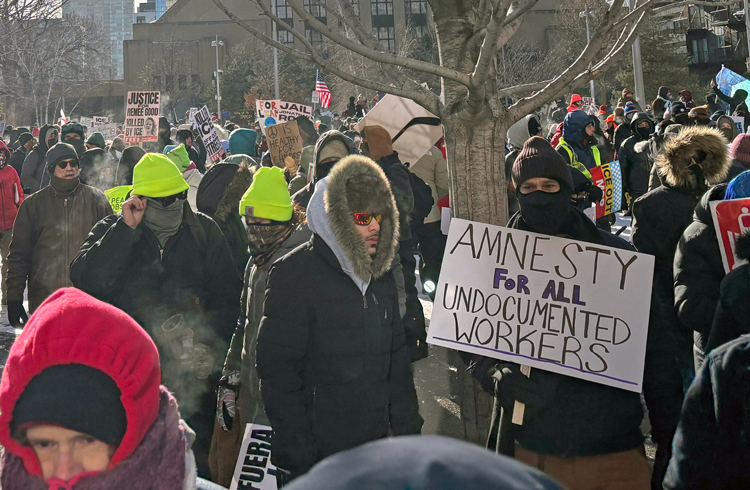
In Minneapolis, substantial demonstrations have called for the removal of ICE and Border Patrol agents from Minnesota. Thousands marched here Jan. 30 after government agents shot and killed nurse Alex Pretti, a regular participant in confrontations with them. The Minneapolis march was called by groups from the University of Minnesota and Stand With Minnesota. Across the country hundreds of demonstrations were organized in solidarity that day.
Seeing the spread of protests, Trump ordered the replacement of Border Patrol chief Gregory Bovino, an aggressive figure leading ICE’s “Operation Metro Surge,” with his boss, Tom Homan. The two ICE agents who shot Pretti have been relieved of duty and are under investigation. Trump promised to “de-escalate” the situation.
But government agents continue to roam the streets of the Twin Cities, as an ICE memo claims they have sweeping powers to forcibly enter people’s homes without needing a warrant. Co-workers of this Militant correspondent at an industrial bakery, including workers from Venezuela and Nicaragua, told me they go straight home after work every day fearing being detained if they go shopping. They depend on delivery services and neighbors to get groceries for them.
A labor-led fight for amnesty
At a Jan. 31 Militant Labor Forum, Helen Meyers, speaking for the Socialist Workers Party, discussed the road forward. “We always start with what advances the interests of the working class,” she said. “We oppose ICE’s Operation Metro Surge, but, more importantly, we advance a strategy to defend immigrant workers, unify the working class and strengthen the ability of the unions to take on the attacks of the bosses and their government. We fight to build a movement of millions to demand amnesty for all undocumented workers in the U.S.
“Along this road, we oppose the provocative actions of those seeking confrontation with armed federal agents,” said Meyers. “They only lead to two things — danger for all the participants and a serious obstacle to the participation of immigrant and other workers.”
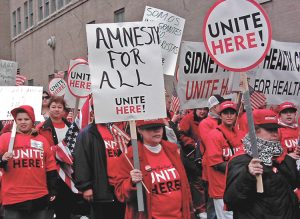
Meyers said that the fight for amnesty needs to be led by the labor movement. “It’s a life-and-death question for the unions. Actions like those the unions helped organize on Dec. 20 and Jan. 23, disciplined and peaceful, point the way forward to involving more and more working people, with and without papers,” she said.
Meyers pointed to the powerful example set by immigrant workers and their supporters in 2006 and 2007, as they led mass actions involving millions in cities, towns and villages all across the U.S. Their banner was, “We are workers, not criminals.” The size and breadth of the protests led to defeat of the Sensenbrenner bill, a reactionary law which would have made undocumented immigrants into felons and levied penalties on anyone aiding them.
The U.S. capitalist class doesn’t want to deport 11 million undocumented workers, she said. They need them in agriculture, health care, packinghouses, construction and more. The rulers’ goal is to instill fear to keep these workers working for lower wages, in worse conditions. Then they use this to drive down the wages of all workers, and to weaken our fighting capacity.
The only realistic road forward
Meyers said the fight for amnesty is not utopian. One amnesty was won in 1986 under the Ronald Reagan administration that led to nearly 3 million immigrants getting legal status.
A labor-led battle for amnesty for all immigrant workers in the U.S. would go much further today and greatly strengthen the whole working class.
Meyers concluded by saying the bosses will continue to attack the working class as long as capitalism rules. To end this, working people need to organize to take political power into their own hands. And that requires a revolutionary party — like the Socialist Workers Party is out to build.
A lively discussion ensued. Chris Pennock, a postal worker and member of the National Association of Letter Carriers, described how his union had sponsored a protest against ICE agents staging operations in post office parking lots. He said there is a discussion going on where he works on whether the union should take a position on social questions, like immigration, or just deal with workplace issues.
Meyers said one question she is asked about is the right of Alex Pretti to legally carry a gun at a protest. The SWP supports the constitutional right to bear arms, but that has nothing to do with what is wise to do at a demonstration. If you confront armed federal agents while carrying a weapon, you put your life and those of others around you in jeopardy.
She pointed to an example from the 1934 Minneapolis Teamster strikes. Farrell Dobbs, an SWP leader and one of the union leaders in those strikes, explains in Teamster Rebellion how after two Teamsters had been brutally murdered by Minneapolis cops, workers wanted to arm themselves for picket duty.
The union decided to disarm strikers before allowing them to picket. Not doing so, he said, could have led to a provocation where government officials could attack the strikers, including calling for federal troops to put them down.
The biggest problem in Minneapolis today is the lack of a broader leadership to advance these perspectives, Meyers said. Simply calling for “ICE out” or organizing confrontations won’t bring immigrant workers out of their homes or strengthen the labor movement. This will take a more decisive political fight — a popular, working-class-led fight for an amnesty.