FORT MORGAN, Colo. — Some 1,700 Teamsters union members who work at the giant Cargill meat processing plant here were locked out by the company May 20. The unionists had rejected the company’s so-called last and best contract offer by 85%. The proposal contained a miserly offer of a $2.15 an hour raise over the next five years.
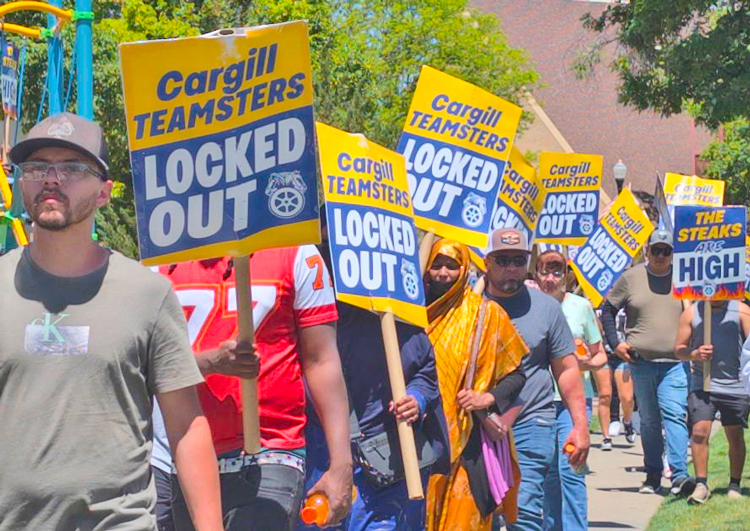
Lively picket lines are set up daily, either in front of the Cargill plant or in the public park in downtown Fort Morgan across from the Teamster hall. The city of Fort Morgan has refused to give the union a permit to set up portable toilets near the picket lines, in marked contrast to strong support for the workers shown by area residents and local businesses. The Cargill workforce is over 10% of the city’s population.
One of the Teamsters iconic black 18-wheeler trucks is on hand at the picket line outside the plant, serving ice water and fruit, using its sound system to play music from African, Latino and other artists. Under the intense sun at this high elevation, many workers carried colorful parasols and danced to the music, between chants of “We are Teamsters!”
“The union has made clear to the company that we wanted to continue negotiations before they locked us out and we still do,” Chris Suazo, a Teamsters Local 455 business agent, told the Militant. He said he heard negotiations will start up again May 27. “A central issue is wages. Their low hourly wage offer doesn’t touch inflation. Also, we don’t want a five-year-long contract like they proposed. And safety concerns are another big issue.”
Dean Modecker, secretary treasurer of Local 455, told the media that bathroom breaks is another important issue. “I’ve got grown men and women who can’t even go to the bathroom, their employer won’t let them go.”
Suazo explained the union also wants Cargill to pay for the mandatory company-issued safety boots. Currently the cost of the boots is taken out of workers’ paychecks.
Solidarity is coming from fellow packinghouse workers in UFCW Local 7 at JBS in nearby Greeley, who won a strike there earlier this year. Local 7 President Kim Cordova and other UFCW officers spent a day on the Teamsters picket line in solidarity with their fight May 21. The Teamsters posted videos of them standing up in support.
“Meatpacking workers have had enough of substandard wages,” Cordova told Colorado Public Radio. Regardless of whether you are a Teamster or a UFCW member, she said, “or a rancher trying to save a family farm, this fight is our fight.”
Immigrants and native-born united
Like the UFCW members who struck JBS, the workforce at Cargill is heavily immigrant. When asked about some anti-immigrant comments that have been posted on the Teamsters local’s public Facebook page, Suazo said, “I’ve seen those negative comments, which frankly are just based on ignorance about what these jobs are and who works them. We have a very diverse workforce with some 15 languages spoken in the plant. And I think it is very good to see everyone together in the union. In fact, community support for the union is strong.”
Short videos the union put up on its Facebook page show workers explaining in different languages why they are fighting for a wage increase.
One worker explains all the workers are united in the union’s conflict with Cargill. “We are all Americans here,” he says, reflecting how foreign-born workers are thrown into class-struggle battles here, rapidly becoming integrated into the U.S. working class.
Pointing to the constant honking of passing cars in support of the union, Suazo said community support has been strong. “We’re getting donations of food and water, and financial contributions as well. I think people in the community know how much these workers are a huge part of the local economy.”
Cargill bosses are driving to boost profits, including implementing a new artificial intelligence technology called CarVe, which uses computer imaging to record every speck of meat left on bones in a section of the fabrication department. Then workers are pushed to get it all. The system also tracks the supposed exact work station where the leftover meat came from and sends that to the supervisors.
A fight worth joining
Chris Bell, a 66-year-old union shop steward, has worked in maintenance at the plant for 33 years. He said the night the union vote rejecting the contract was announced, the company put concrete barriers across the plant entrances. When union officers headed to the union hall to meet, they were greeted by hundreds of workers already there, ready to respond to the lockout.
“The company says cattle herds are low and they’re not making enough profit, but why pinch pennies off our backs?” he said. “The community support is amazing. The small businesses know how important these 1,700 workers are in a town of 12,000. I’m going to retire soon, but this fight is for the next generation in the plant.”
Bell said he finds it challenging to picket in the heat for four hours, but he finds inspiration from the younger workers, especially those from Haiti and Africa, who often dance throughout their shifts.
As a child growing up in a small town in Colorado, Bell said he had never even met a Black person. When he saw TV images of Blacks marching for voting rights and getting attacked in Selma, Alabama, in 1965, he decided to take a stand for civil rights and human rights.
Johnny Carrillo said he has worked on the kill floor at Cargill for 12 years. “The company needs to be fair, and their offer of a $2.15 wage increase over five years is not that,” he said. “Everything is so expensive. You can pay $300 for a shopping cart of groceries at Walmart. My $1,000 mortgage went up by $200. We need the yearly $1-an-hour increases we’re asking for.”
When our reporting team showed Judy Burgess, a restaurant worker in Greeley, our photos of the Teamster picket lines, she called other workers to our table, saying “Look Cargill has locked out the workers. They deserve our support. All human beings need a living wage.”
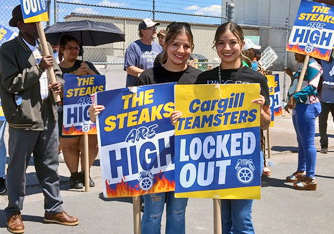
Several workers on the picket lines were glad to talk with members of the Socialist Workers Party and Communist League in Canada who had come to support them. Beverly Bernardo from Montreal spoke with Abby and Bella Pacheco, 22-year-old twin sisters who’ve worked at Cargill for two years on the kill floor. “We work our butts off; it’s very hot. I don’t feel we get the respect we deserve,” Abby, who opens hides, said. “So, we’re out in the heat today supporting our union.”
It’s well worth coming and offering support for the union. The pickets are generous and like discussing what working people face today. As locked-out worker Anabel Hurtado told the media, they just “want to be respected as employees, as Teamsters and like we’re human beings.”
To support the strike, contact Teamsters Local 455 at 423 Main Street, Fort Morgan, CO 80701; Fax: 970-542-9596.
Joel Britton contributed to this article.