Washington’s April 23 indictment of Cuban revolutionary leader Raúl Castro and five Cuban air force pilots for “conspiracy to kill U.S. nationals” in the shoot down of two planes that invaded Cuban airspace in 1996 replays the frame-up that became known as the case of the Cuban Five.
That frame-up began Sept. 12, 1998, when FBI agents launched “shock and awe” predawn raids in South Florida and arrested 10 people, accusing them of being part of a Cuban spy ring.
But they weren’t spies. They were carrying out undercover missions to protect the Cuban people from paramilitary and other counterrevolutionary Cuban American groups with a long history of carrying out bombings, assassinations and other violence against Cuba and against supporters of the Cuban Revolution inside the U.S. and Puerto Rico.
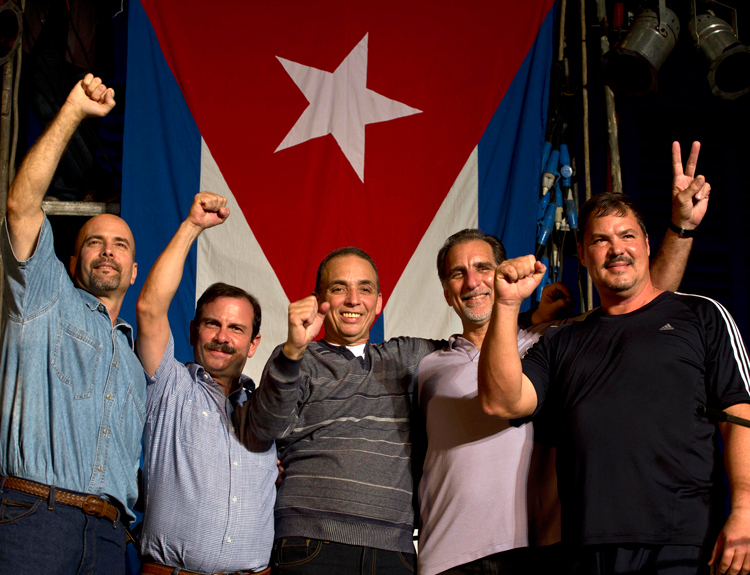
Five of those arrested took plea deals and disappeared from history, but Gerardo Hernández, René González, Ramón Labañino, Antonio Guerrero and Fernando González refused to turn traitor to themselves and the socialist revolution they were defending. They proudly fought the frame-up, slanders and lies, including in prison, winning support and respect inside the U.S. and around the world.
In this new indictment two of the Five — Hernández and René González — are mentioned numerous times, accused of being part of the “conspiracy” to shoot down the planes flown by the counterrevolutionary Brothers to the Rescue outfit.
The bourgeois press today — just like 30 years ago — falsely portrays Brothers to the Rescue as a peaceful group. But in the 20 months preceding the shoot down, planes from Brothers to the Rescue brazenly violated Cuban airspace 26 times. The main leader of the group, José Basulto, had a long history of violent attacks on Cuba.
Of the Cuban Five, Gerardo Hernández faced the most serious charge, conspiracy to commit murder — the same charge the U.S. government has resurrected against Raúl Castro and the Cuban pilots. Prosecutors claimed Hernández knew in advance that Cuba would shoot down the planes.
Given the intimidating influence in Miami of counterrevolutionary Cuban groups and politicians, the Five requested a change of venue. The court denied their request.
Leading up to their trial, the Five were held in solitary confinement for 17 months, in an attempt to break them and prevent them from being able to meet to prepare their defense.
Hernández was convicted, and given two life sentences. Labañino and Guerrero were given life sentences for “conspiracy” to gather and transmit “information related to national defense.” All five were convicted of “acting as an agent of a foreign government without registering with the Attorney General” and “conspiracy to act as an agent of a foreign government.” The government is considering using the same charges to frame up supporters of Cuba today.
But the U.S. rulers couldn’t break them. Instead, through their conduct in the frame-up trial and in prison, the five revolutionaries set an example for working people and youth in the U.S. and the world over. From inside prison they were on the frontlines of the class struggle in the United States.
They used the trial to explain how and why their actions were in the interests of the vast majority of the American people. The simple fact that the Five insisted on a trial and refused to “cop a plea” without a trial before a jury of their peers won them respect among fellow prisoners and helped them become known as people who could be trusted.
Three of the Five — Hernández, Fernando González and René González — had served in Angola as part of the Cuban mission there that helped defeat the South African apartheid regime and its invading army’s attempt to block independence from Portugal. This also gained them respect, especially among African American prisoners.
Their conduct during the trial and in prison strengthened the international campaign being organized by the people of Cuba and their government to win their freedom. Meetings were held to win support across the country and around the world. Pathfinder Press printed a number of books used to help get out the truth and advance the fight. After courts ruled that their punishment did not meet “federal guidelines” and their sentences were reduced, René González and Fernando González were released in May 2013 and February 2014.
The other three returned to Cuba in December 2014 in conjunction with the reestablishment of diplomatic relations with Cuba during the Obama administration.
Cubans poured into the streets across the island to celebrate their return, inspired by the firmness, dignity, courage and discipline of the Cuban Five. They are all serving in important positions in Cuba today.
That fight was something the U.S. rulers fear to this day.