HAIFA, Israel — The second international Contemporary Antisemitism conference took place here July 7-9, hosted by the Elizabeth and Tony Comper Center for the Study of Antisemitism and Racism at the University of Haifa. It was cosponsored by the Center for Holocaust Studies and Human Rights at Gratz College in Pennsylvania, Institute for the Study of Contemporary Antisemitism at Indiana University, and the London Centre for the Study of Contemporary Antisemitism, which hosted the first gathering last year in the United Kingdom. (See May 5, 2025, Militant.)
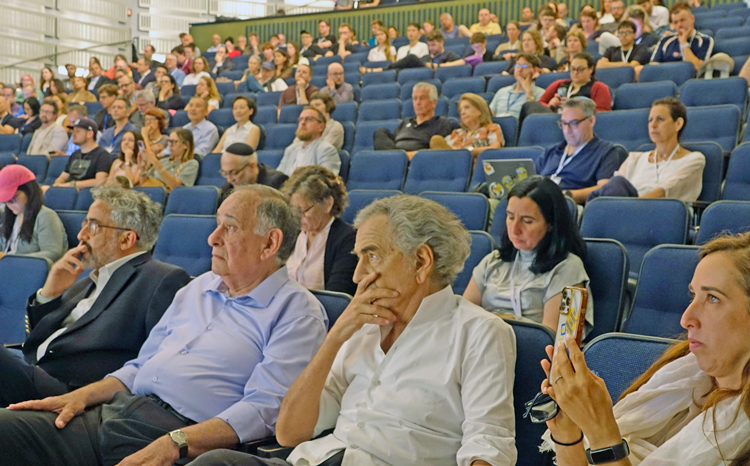
Dozens of panels over three days heard 220 people presenting papers in person, and more online. The largest delegations were from Israel, the U.S., U.K. and Germany. More than 550 participated in person and online, from 20 countries spanning the world. Featured speakers included writer and filmmaker Bernard-Henri Levy, from France; Deborah Lipstadt, Special Envoy to Monitor and Combat Antisemitism in the Joseph Biden administration; Dina Porat of the Yad Vashem Holocaust museum in Jerusalem; and Israeli political figure Natan Sharansky, a former imprisoned opponent of the Stalinist regime in the Soviet Union who today serves as chairman of the Institute for the Study of Global Antisemitism and Policy.
The conference announced the launching of the Contemporary Antisemitism Studies Association — CASA — initiated by the Comper Center’s David Barak-Gorodetsky; David Hirsh, academic director and CEO of the London Centre; and Ayal Feinberg, director of the Holocaust studies center at Gratz.
Those who spoke on conference panels often started from the inescapable fact that Hamas’ pogrom on Oct. 7, 2023, in which 1,200 Israeli Jews and others were slaughtered, thousands wounded and 251 taken as hostages, marked a watershed in world politics. Panelists recounted mounting personal experience since then of being “cancelled” as Jews, boycotted and in some cases fired from jobs. Many spoke about how today’s worldwide economic and social crises and instability are spurring an accelerating rise of Jew-hatred, and how this affects not only Jews.
Jew-hatred has been building for two decades, Hirsh has written, but since Oct. 7, “many Jews in the U.K. have experienced a cultural shift.” Hirsh himself has been a target of vile Jew-hatred at Goldsmiths, University of London, where he is a professor.
But many in the academic world dismiss the study of today’s reality as a “soft” field, or recoil because of the political sensitivities, said conference organizer and managing director of the Comper Center, Jacob Dallal.
‘Silenced No More’
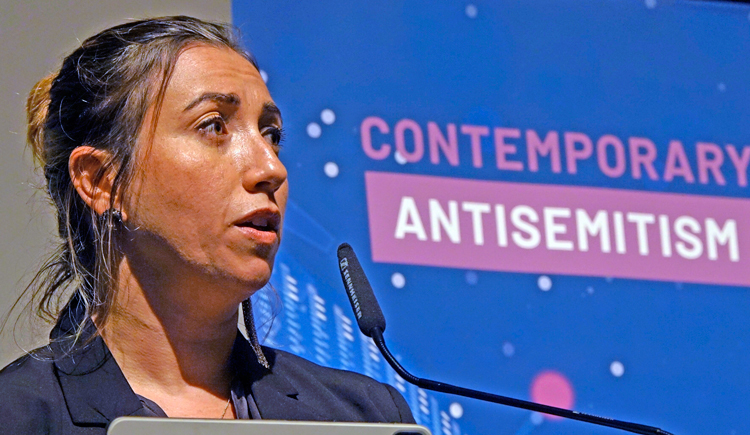
Cochav Elkayam-Levy, founder and chair of the Civil Commission on October 7th Crimes By Hamas Against Women and Children, spoke on the commission’s recently released “Silenced No More.” The 300-page report includes documented evidence of the crimes committed that day, including the “sexual hell experienced by the hostages.”
Oct. 7 was not only an atrocity, Elkayam-Levy said, “it was a crisis of truth. We had to invent new words, such as ‘kinocidal sexual violence’ to describe what they did to whole families. Hamas’ videos were a window to hell. We are making ‘Silenced No More’ available to everyone. Use it.”
Panels discussed Holocaust denial and the Protocols of the Elders of Zion — the notorious antisemitic forgery and hoax first published in 1903 in the czarist Russian Empire, purporting to detail a Jewish plot for world domination. In a panel addressing the shameful record of “genocide” libels against Israel, Gerald Steinberg from Israel’s Bar Ilan University pointed to how “the claim first appeared as part of Soviet antisemitism in the 1950s.”
Other panels took up what they described as “the insidious antisemitism” of the United Nations, of misnamed “human rights” organizations and nongovernmental organizations. There were panels on antisemitism and sports in the wake of numerous events, including the Amsterdam “Jew Hunt” in November 2024, as well as the October 2025 banning of Maccabi Tel Aviv soccer fans from watching their team play at a European match in Birmingham, England.
There were sessions on different countries, from North America to Europe, Asia and Latin America. These included one in which Yang Meng, who teaches a course in Hebrew civilization at Peking University, related a marked increase in antisemitism in China since Oct. 7. Yang said she had only been able to publish in English, not Chinese.
Jonathan Silberman, from Pathfinder Books in the United Kingdom and a leader of the Communist League there, spoke on “U.K. Policy in the Middle East: Defend British Interests, Not the Jews.”
Lively discussion took place at the Pathfinder book table, which was up throughout the conference. Many attracted by the table talked about how antisemitism has become a banner of both “the right” and “the left” — a recurring conference theme — and how pleased they were to see communists defending Israel’s existence. Some expressed concern about a “red, brown, and green alliance” — a convergence of radical left-wing (“red”), far-right or ultranationalist (“brown”), and allegedly “anti-imperialist,” radical Islamist and “green” political forces.
“I didn’t know that there were people like you,” Haifa University doctoral candidate Tomer Udi told the volunteers staffing the table. “That needs to be known in Israel.” It was a frequent comment to the volunteers, members of the Socialist Workers Party in the U.S. and the Communist Leagues in Australia and U.K. The volunteers explained the fight against Jew-hatred as an international question, a working-class question, as well as a national question in the Middle East and worldwide.
Thirty-nine copies were purchased of The Fight Against Jew-Hatred and Pogroms in the Imperialist Epoch: Stakes for the International Working Class, with articles by V.I. Lenin, Leon Trotsky, and SWP leaders James P. Cannon, Farrell Dobbs, Jack Barnes and Dave Prince. Twenty-five other books were sold, including Malcolm X, Black Liberation, and the Road to Workers Power by Barnes and books about the Cuban Revolution. Five participants subscribed to the Militant.
CASA leaders announced that these conferences would now be held yearly. David Hirsh told the Militant that next year’s conference will take place at Gratz College near Philadelphia, and the 2028 gathering in London.