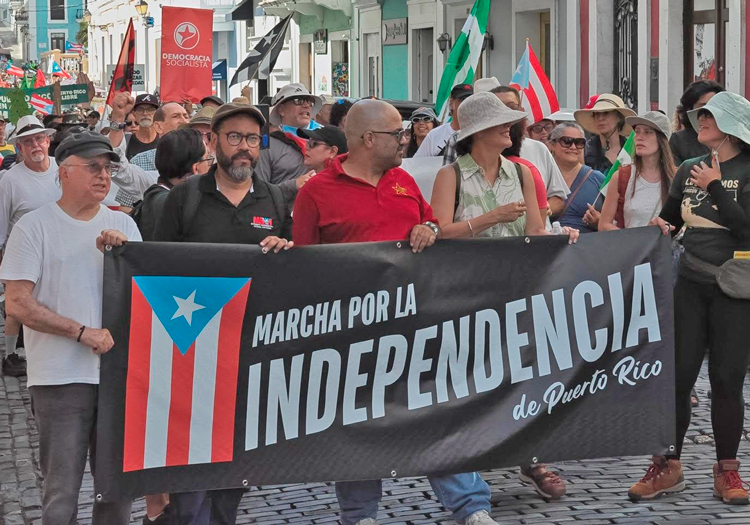
In Puerto Rico thousands marched over 5 miles from Old San Juan to the U.S. Federal Courthouse July 18 united in calling for Puerto Rican independence from U.S. colonial rule. Solidarity marches took place in Orlando, Florida; Minneapolis; and Worcester, Massachusetts.
The march has “two purposes,” a statement by the more than 20 organizations that called the protest said. “To assert our inalienable right to independence and to proclaim that only with the political power that independence provides will we be able to successfully confront the major problems caused by the colonial condition under which we live.
“We oppose the use of Puerto Rico as a military enclave for the U.S. armed forces and we repudiate the use of our soil for aggression against sovereign people,” they added. Washington reactivated its military bases on Puerto Rico to take part in its ongoing attacks on boats it accuses of running drugs, its military assault on Venezuelan sovereignty and to threaten military action against Cuba.
The statement denounced the “double colonization” of Puerto Rico. The first was its invasion 128 years ago when the U.S. Army wrested control of the island from the Spanish rulers, marking the emergence of the United States as an imperialist power. The second was Washington’s imposition of a Fiscal Oversight and Management Board in 2016 to take control over Puerto Rico’s budget, pushed through by President Barack Obama and a bipartisan U.S. Congress. The Junta, as it is popularly known, has dictatorial control over all the Puerto Rican government’s financial decisions.
Since seizing the island in 1898, Washington has plundered its natural resources and exploited its workers, generating superprofits for U.S. capitalists.
While Puerto Ricans became U.S. citizens in 1917, they can’t vote in presidential elections and have no voting representative in Congress. Federal court proceedings are conducted in English, even though Spanish is the country’s main language.
Originally created to ensure the payment of $70 billion in Puerto Rican government debt to wealthy bondholders, the Junta has made the crisis for working people worse. To meet its demands, the colonial regime laid off thousands of workers, closed schools, raised taxes and slashed pensions.
The U.S.-appointed Junta pushed for the privatization of the electrical grid. Puerto Rico’s water, electrical and healthcare systems are in crisis.
Under the impact of this U.S.-imposed crisis, over the last 20 years nearly 25% of the population of Puerto Rico has left. Today there are almost twice as many Puerto Ricans living on the mainland than on the island.
‘Take destiny into our own hands’
The colonial government of Puerto Rico is spending a million dollars to celebrate the 250 years of U.S. independence, María de Lourdes Santiago, a member of the Puerto Rican Senate from the Puerto Rican Independence Party, told protesters. “If it was good for [the American people] to take their destiny into their own hands, it should also be just as good for Puerto Ricans to do the same, especially in a moment when the colonial system has collapsed.”
“We are confronting severe poverty and social inequality because we do not have control over our own resources or a true democracy,” Nairobi Hernández, from the Combative Student Collective, told the crowd. “We lack the power to make our own decisions, while the interests of the bondholders, the empire and the Fiscal Oversight Board continue to make decisions for us.”
Fernando González Llort, president of the Cuban Institute for Friendship with the Peoples (ICAP), sent a message to the action, reaffirming the Cuban revolution’s longstanding solidarity with the fight for Puerto Rican independence. “We are united by the conviction that no empire, no matter how powerful it may seem,” he said, “can overcome peoples who recognize each other’s suffering and rise up together.”
“The march was a success,” Carlos Vega, a co-president of the National Hostosiano Independence Movement, told the Militant by phone from San Juan. “This was the first time in a while that so many organizations that support independence and sovereignty came together. And a large number of young people participated.”
“We have to step up our work to educate the people about what we can achieve when we are free,” he said.
Similar actions are planned in coming weeks in New York, Cleveland and Jersey City, New Jersey.