The struggles Robert F. Williams led “to desegregate public facilities in the Jim Crow South, and to organize self-defense in the Black community against Ku Klux Klan night riders, made Monroe, North Carolina, in those years an emblem of resistance to bigotry and social injustice,” Jack Barnes, Socialist Workers Party national secretary, wrote in a message to a meeting celebrating Williams’ life two weeks after he died from Hodgkin’s disease in 1996.
The example Williams set in the late 1950s and early ’60s came at a pivotal moment, as growing numbers of African Americans were joining fights to end segregation across the South. They were met by brutal assaults by the Klan and the abject refusal of cops and federal authorities to offer any protection or defend their constitutional rights.
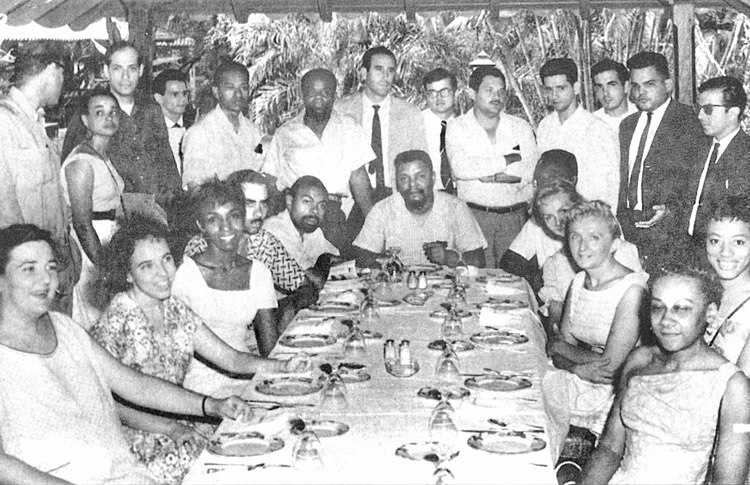
In addition to becoming a militant leader in the fight for Black rights, Williams spoke across the country in defense of Cuba’s socialist revolution, was a supporter of the labor movement and worked with Malcolm X, the Socialist Workers Party and others.
Williams, an ex-marine and former union fighter, became president of the Monroe chapter of the NAACP in the mid-1950s when he and Albert Perry were its only members. Williams rebuilt the organization, recruiting working people at pool halls, street corners and among tenant farmers and domestic workers.
“Most important, we had a strong representation of returned veterans who were very militant and didn’t scare easily,” Williams later wrote. They also got a charter to establish a branch of the National Rifle Association, “which encourages veterans to keep in shape.”
First victory over Jim Crow
The Monroe NAACP’s first victory was when Williams led its members to walk into the whites-only public library, choose some books and convince the librarian, who was unsure what to do, to let them check them out. Buoyed by that success, Williams led a yearslong fight for Blacks to use the city’s swimming pool.
The Klan retaliated, organizing rallies of thousands in a town of some 11,000. It began motorcades of hooded riders through the Black community, firing pistols. When the Klan discovered NAACP members were also armed, it promised to kill Perry.
Williams organized a defense guard by Perry’s house. After seeing off a Klan caravan, the guard fortified the house with sandbags and fox holes. A second Klan attempt on Perry’s house was met with gunfire. After that “the Klan didn’t have any more stomach for this type of fight,” Williams wrote, and its threats on Perry and its night-riding terror halted for a time.
Williams launched the Committee to Combat Racial Injustice in 1958 to win support for two framed-up Monroe Black boys, aged 7 and 9. They had been thrown into a reformatory after one of them was kissed by a 7-year-old white girl. Williams went on a nationwide speaking tour on what was called the “kissing case,” refuting the frame-up charges. The committee’s fight drew worldwide attention and broad support, eventually winning the boys’ release on Feb. 13, 1959. SWP members in New York and elsewhere played an important part in the campaign.
Williams became increasingly well-known across the country as an uncompromising defender of Black freedom. He met Malcolm X, who invited him to appear at the Nation of Islam temple in Harlem a number of times. Malcolm helped raise funds for the fights Williams led.
Monroe sit-ins faced ‘less violence’
In 1960 members of the Monroe NAACP joined in the spreading sit-in movement to desegregate lunch counters and department stores along with students all across the South. The Monroe sit-ins faced “less violence,” Williams noted, “because we had shown the willingness and readiness to fight and to defend ourselves.”
Williams launched The Crusader, a newsletter that condemned racial segregation along with the Democratic and Republican parties that upheld it. From late 1959, The Crusader described gains by Blacks in Cuba won as a result of the socialist revolution. Williams visited Cuba to learn more.
In 1961 the United Nations debated the failed attempt at an invasion of Cuba by U.S.-backed counterrevolutionaries in April of that year. Cuban Foreign Minister Raúl Roa read aloud to the General Assembly an ironic telegram Williams had sent to him. Williams demanded the U.S. government provide the same military support to the fight to overthrow Jim Crow that it had unleashed against Cuba. “Oppressed Negroes in South urgently request tanks, artillery,” Williams wrote, “to crush the racist tyrants who have betrayed the American Revolution and Civil War.”
In the summer of 1961 white supremacists made their first of several attempts to kill Williams. His home was reinforced and guarded.
In August a group of young Freedom Riders, who had been arrested were released from the notorious Parchman Prison in Mississippi, volunteered to go to Monroe and helped establish the Nonviolent Action Committee. They marched downtown for desegregation of the stores there and picketed the courthouse to demand the cops arrest the Klansman who had tried to kill Williams.
Though the Klan feared Williams and his leadership among Blacks, they were also aware that the leadership of the more established civil rights groups, including the NAACP and Martin Luther King’s Southern Christian Leadership Conference, turned their backs on the fights Williams led.
Over several days a pro-segregationist mob carried out bloody assaults on the pickets and then began driving through the Black neighborhood again, shooting at bystanders and leaders’ homes. Rather than arrest the thugs, cops jailed some 26 pickets for “incitement to riot.”
Williams mobilized the Black community, ordering the construction of barricades and issuing rifles. In the ensuing conflict he was framed up on kidnapping charges. He evaded both the racist cops and an FBI manhunt, making his way, along with his wife and lifelong political collaborator Mabel, to exile in Cuba.
Later he moved to China, returning to the U.S. in 1969. By 1976 all charges against him were dropped.
Far-reaching impact
The battles he led had a far-reaching impact. Rosa Parks, who had been one of the leaders of the Montgomery Bus Boycott in 1956, had known Williams both in Monroe and, much later, when they both lived in Detroit. She had come to sympathize more with his political outlook than that of Martin Luther King.
“I admired him so very much for his courage and for his commitment to freedom,” Parks said when she was invited to deliver the eulogy to Williams at his funeral in Monroe. “What he did should go down in history and never be forgotten.”
In his tribute to Williams, SWP leader Barnes recalled hearing him speak at Carleton College in Minnesota in 1961. He was on tour with Ed Shaw, a leader of the SWP, for the Fair Play for Cuba Committee. Shaw and Williams had stayed in touch since they worked together at an aircraft plant in Woodbridge, New Jersey, in the early 1950s.
“The meeting had an enormous political impact on all of us,” Barnes wrote. “Each of the speakers appeared equally comfortable in fielding questions about either the socialist revolution unfolding in Cuba or the battles for Black rights underway in this country, or both.”
Working people need to “relearn this history, so we can emulate these examples,” Barnes wrote. That remains true today.