The Battle of Birmingham in the spring of 1963 was the biggest and broadest action yet against decades of segregation enforced by racist violence. Millions across the country saw fearless fighters against Jim Crow — including thousands of youth — stand up to brutal repression on TV screens and the front page of daily papers.
The battle that unfolded in Birmingham, Alabama, aroused working people everywhere. It inspired other protests that dealt blows to the ability of the Republicans and Democrats — the dominant party in the segregated South — to uphold racial segregation.
Within weeks of the fight in Birmingham, some 150,000 marched for civil rights in Detroit in June, and on Aug. 28, about 250,000 came out for the historic March for Jobs and Freedom in Washington, D.C.
The actions in Birmingham were organized by a layer of battle-tested cadre led by Rev. Fred Shuttlesworth. They took place in a large center of heavy industry, where workers — Black and white — had been through deepgoing struggles led by the United Mine Workers in the 1930s.
The 1963 fight in Birmingham took place after students and other young African Americans across the South had acquired experience organizing sit-in fights to desegregate lunch counters and participating in Freedom Rides on Greyhound buses and other interstate transportation.
A new national group, the Student Nonviolent Coordinating Committee, was formed, with members fanning out across the South. Growing numbers of Blacks were insisting freedom be granted now, and were less and less willing to heed appeals from the John F. Kennedy White House to slow down and wait.
In 1956 segregationist forces passed laws to force the NAACP in Alabama to hand over the names of all its members in the state, which would have put targets on their backs. Rather than agree, the group dissolved.
In response, Shuttlesworth founded the Alabama Christian Movement for Human Rights to carry forward the fight, and began holding weekly mass meetings. Inspired by the victorious Montgomery bus boycott, Shuttlesworth launched a similar effort in Birmingham. He was jailed several times and his home was firebombed, leading him to urge supporters to keep their hunting weapons handy.
In April 1963 Shuttlesworth’s group issued a “Birmingham Manifesto” launching a campaign of sit-ins, marches and boycotts to end segregation, backed by Martin Luther King’s Southern Christian Leadership Conference. After the first week, the city got a court order to prevent marches, but the movement defied it. Several marchers, including King, were thrown in jail.
President Kennedy claimed he had no power to intervene, while the New York Times and other liberal papers heaped blame on what they called “poorly timed protests.”
The Children’s Crusade
King made bail on April 20, and Shuttlesworth, King and other leaders of the Alabama Christian Movement for Human Rights and SCLC decided to recruit high school students to march in large numbers on City Hall. The call was met with a wave of enthusiasm in the classrooms.
On May 2 hundreds of students quit school and marched downtown in disciplined groups of 50. When one group was arrested, another marched in its place. By the day’s end, some 1,000 students were jailed. An overflow mass meeting was held that evening to bolster support among parents.
“Daddy, I don’t want to disobey you, but I have made my pledge. If you try to keep me home, I will sneak off,” one boy told his father. “I want freedom for you and Mama, and I want it to come before you die.”
The following day 1,000 more students assembled to march. This time Public Safety Commissioner Eugene “Bull” Connor ordered the fire department to disperse them with fire hoses. When that failed, he ordered the use of high-powered nozzles, sending students tumbling. Outraged, onlookers threw bottles at cops and firemen.
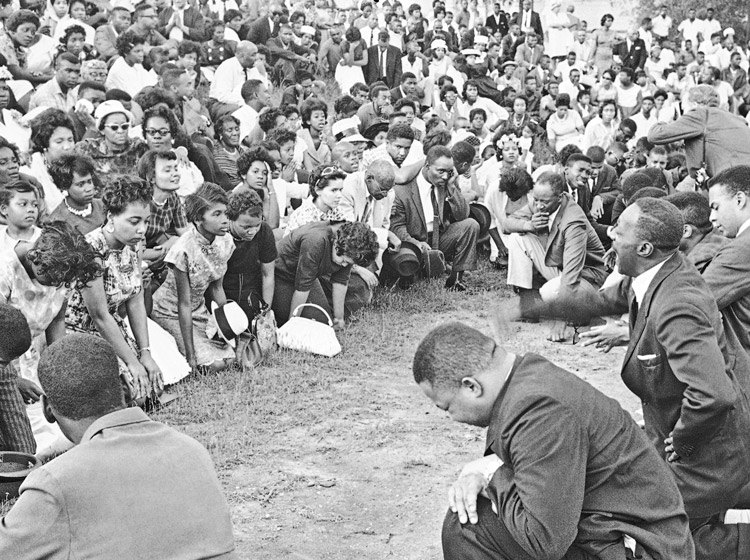
And the student marches continued. Connor ordered cops to set dogs on protesters. On May 5 cops arrested protesters on the steps of the New Pilgrim church. In response, the congregation and others marched toward the jail. When Connor ordered the use of fire hoses on them, for the first time some firemen hesitated. Connor had to retreat, letting marchers hold a prayer service at a nearby park.
James Foreman and other leaders of SNCC arrived in Birmingham to boost the fight. They led parents in making a mass delivery of blankets to the jailed students.
On May 7 Foreman and others organized a decoy march, confusing the cops, allowing carloads of some 600 student protesters from different directions to get driven downtown. They held sit-ins and picketed stores. Hundreds more of all ages joined them. With the jails full, cops made no arrests, and protesters marched proudly back to the 16th Street Baptist Church.
From there, another wave of protesters poured out of the church. Connor ordered cops to set hoses on them, seriously injuring Shuttlesworth, who was taken to a hospital. “I wish he’d been carried away in a hearse,” Connor sneered.
Kennedy tries to shut protests down
Kennedy intervened to try to get demonstrations halted, urging city authorities and protesters to cut a deal. King responded by proposing the suspension of protests. Shuttlesworth disagreed.
“When I see on TV that you have called it off, I will get up out of this, my sickbed, with what little ounce of strength I have, and lead them back into the street,” he told King and other SCLC leaders.
The United Steelworkers and other unions joined efforts to raise money to bail out detainees. After students streamed out of jail May 10, Shuttlesworth announced a deal had been made to begin the desegregation of Birmingham. The next night the home of King’s brother, A.D. King, was firebombed, along with the Gaston Motel where SCLC leaders were staying. No one was injured.
In the months that followed, Shuttlesworth repeatedly proposed more protests whenever authorities dragged their feet carrying out their promises. In July the “White” and “Colored” signs came down and lunch counters were integrated.
On Sept. 16, the 16th Street Baptist Church was firebombed, killing four young girls and wounding more than 20 others. The Sept. 23, 1963, Militant reported that Black residents in Birmingham began armed patrols to safeguard their neighborhoods.
The murder of the four girls devastated the community, but it also deepened the determination of millions to tear down Jim Crow.