MONTREAL — As the crisis of capitalism deepens and friction between the rulers in Canada and the U.S. grows, the Liberal government of Prime Minister Mark Carney has over the last two months stepped up its assaults on the political freedoms of working people in Canada. It pushed through the so-called Lawful Access Act, known as Bill C-22, after moving to limit debate in the House of Commons. It includes sweeping attacks on the right to privacy, strengthening the powers of the cops and other government agencies to spy on working people who protest government policies and on other political opponents of the government.
The bill, which now moves to the Senate for debate, has been condemned by supporters of political rights across the country since its introduction in March.
The Foreign Influence Transparency and Accountability Act, introduced in 2024 under Carney’s predecessor, Justin Trudeau, made it a crime — punishable by up to life in prison and fines of up to 1 million Canadian dollars ($700,000) — to engage in “surreptitious or deceptive conduct” at the direction of a foreign government with the goal of “harming Canadian interests.” The government announced Aug. 4 that it had established a registry where groups that come under the law’s sweep have to sign up.
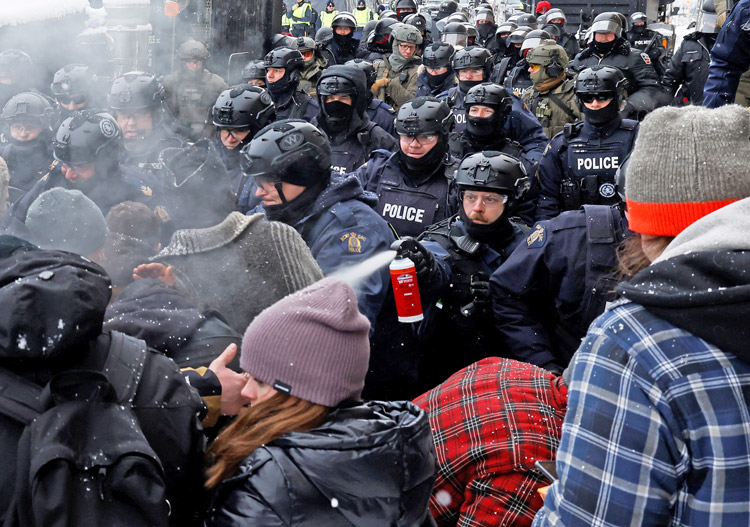
These attacks are the latest steps by Canada’s capitalist rulers to cut back the political space working people need to organize to defend ourselves as the bosses increasingly move to put the cost of their crisis on our backs. They follow Ottawa’s use of the draconian Emergencies Act in February 2022 to crush the truckers’ Freedom Convoy protest in the capital, and their repeated use of Section 107 of the Canadian Labour Code to attack the labor movement, ordering striking longshore, postal, rail and airline workers back to work.
Bill C-22 would require digital service providers to allow the cops, Royal Canadian Mounted Police and the Canadian Security Intelligence Service, Canada’s national spy agency, access to internet communications and data of anyone they target.
Threat to privacy rights
It would also enable cops and government spies to dig out precisely which phone company you are using and dramatically speed up using a warrant to access your communications. It would also allow them this information to track your location.
“This legislation presents one of the greatest threats to privacy in Canada of the past two decades,” Tim McSorley, national coordinator of the International Civil Liberties Monitoring Group, said. “Its provisions will weaken the rules governing police access to personal information, all while facilitating a vast expansion of government surveillance. This is another clear case of the decades-long trend of governments using national security as an excuse to erode civil liberties and human rights.”
Other groups protesting the bill include the Quebec League of Rights and Freedoms, Migrant Justice Clinic, British Columbia Civil Liberties Association, Canadian Muslim Public Access Council and the Canadian Civil Liberties Association.
For decades working-class fighters in the U.S. and other capitalist countries have faced government use of so-called foreign agent laws to attack their political rights. On the eve of World War II in 1938, the imperialist rulers in Washington passed the Foreign Agents Registration Act, using it to label labor and anti-war groups as agents of Germany, the Soviet Union or other foreign powers. Washington turned it on the Communist Party, the Socialist Workers Party and others in the 1950s. And they’re using it today to go after opponents of the U.S. rulers’ attacks on Cuban sovereignty.
The Canadian Civil Liberties Association pointed to a section of the new Foreign Influence Transparency and Accountability Act that makes it a crime for anyone to interfere with “essential infrastructures,” such as railroads, ports and highways. This could be used to “suppress protests” or labor actions, the association said.
The government has also stepped up use of Section 107 of the Canadian Labour Code as a strikebreaking tool, ordering tens of thousands of strikers back to work. But the refusal by 10,000 Air Canada flight attendants, members of the Canadian Union of Public Employees, to bend to a back-to-work order against them in August last year has set a powerful example.
“The courage of CUPE flight attendants to defy the government’s back-to-work order is an inspiration for all workers,” Dustin Saunders, chairperson of the Engineers division of Teamsters Canada Railway Conference Division 945, told the Militant in Vancouver. The Canadian Labour Congress also saluted the flight attendants’ victory, saying, “Any employer thinking of leaning on Section 107 in the future should think twice.”
Fight attacks on rights and freedoms
“The unions need to protect the political space we’ve won and badly need, to lead a fight by all supporters of political rights to fight against these anti-working-class laws and to prevent them from being used by both the federal and provincial governments against us,” Joe Young, Communist League candidate in October’s Quebec National Assembly elections, tells workers as he campaigns.
The CL is campaigning on the importance of opposing these escalating attacks on the rights of working people. “The CL joins with unionists and defenders of political rights fighting to make the government withdraw Bill C-22 and its foreign agents registry act and against its attacks on unions’ right to strike,” Young said.