Like battles against Jim Crow segregation across the South and elsewhere, the 1963-64 struggle in Cambridge, Maryland, was marked by the courage of its participants standing up to cops, racist mobs and the National Guard. It was also marked by the character of its central leader, Gloria Richardson, who drew thousands into action, including Blacks organized to defend themselves. She collaborated closely with Malcolm X and rejected backing either the Democratic or Republican parties.
Despite Blacks having exercised the right to vote there for decades, Cambridge was below the Mason-Dixon line separating what had been slave states from the North. In the 1960s, African Americans were denied access to the city’s hospital. Public schools and other facilities were segregated and housing for Blacks was dilapidated. While unemployment for Caucasians was over 7%, twice the national average, Black unemployment in Cambridge was a devastating 29%.
Members of the Student Nonviolent Coordinating Committee came to town to hold a march and sit-in Jan. 13, 1962. They were assaulted by a racist mob and several were arrested, but they got enthusiastic support from the town’s Black residents.
Scores of high school students walked out of class to support the marchers at their court hearings. Days later a mass meeting established the Cambridge Nonviolent Action Committee. Area unionists and Black World War II and Korean War veterans were among its members.
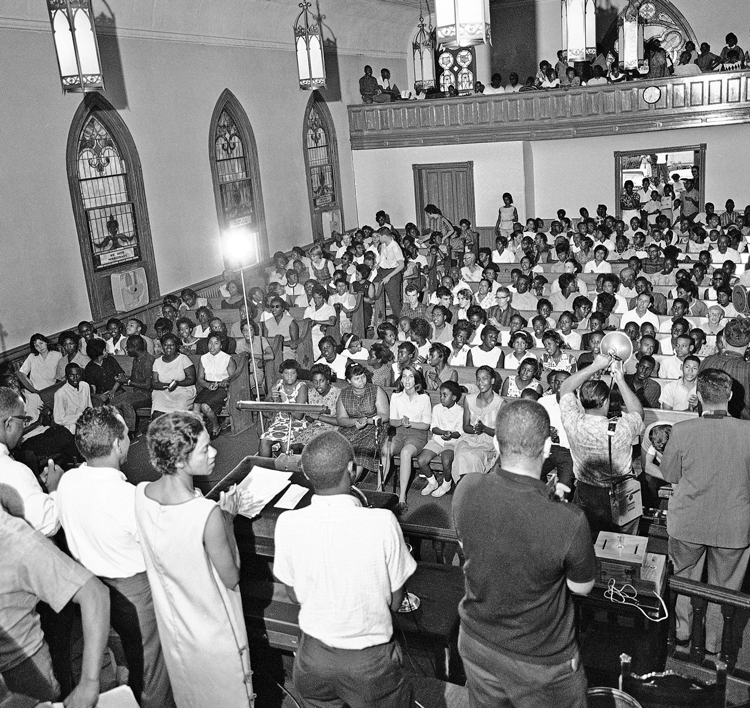
Soon after the group’s founding, Richardson became its central leader. She had been involved in battles for Black rights before, joining protests against segregation in the late 1930s when she was a student in Washington, D.C. She turned CNAC toward recruiting Black workers, integrating workers onto its executive committee and working closely with the unions.
When the city’s cinema owners moved to restrict Blacks to the back rows of the balcony, CNAC picketed the theaters March 29, 1963. Richardson and 16 others were arrested.
After further marches, two 15-year-old students, Dwight Cromwell and Dinez White, were arrested and sentenced to indefinite imprisonment at the state’s juvenile facility. Infuriated by the sentences, hundreds marched in downtown Cambridge June 11. As they headed back to the Black community they were assaulted by Klan-type thugs.
Self-defense, union involvement
The next night state troopers were mobilized to protect the racists as they carried out more assaults. The following night, June 13, some 500 protesters against Jim Crow marched downtown with several carrying arms to protect the demonstrators, as Black veterans organized an armed patrol to guard the perimeter of the Second Ward, the Black neighborhood.
“The men’s role was to protect the Second Ward as soon as night fell. There were exchanges of gunfire,” Richardson later recalled. “They knew what they were doing. They organized themselves, even down to having medical supplies.”
Maryland Gov. J. Millard Tawes called for the Cambridge Nonviolent Action Committee to halt protests for one year in exchange for promises he would speed up desegregation. Richardson said no. Tawes then called out the National Guard June 14 and imposed a curfew. The troops would remain in the city for almost a year.
Four days later, city officials insisted they should decide who represents the Black community in future negotiations. Again Richardson said no. “No Negro except those selected by us will act as an intermediary,” she said, the June 24 Militant reported.
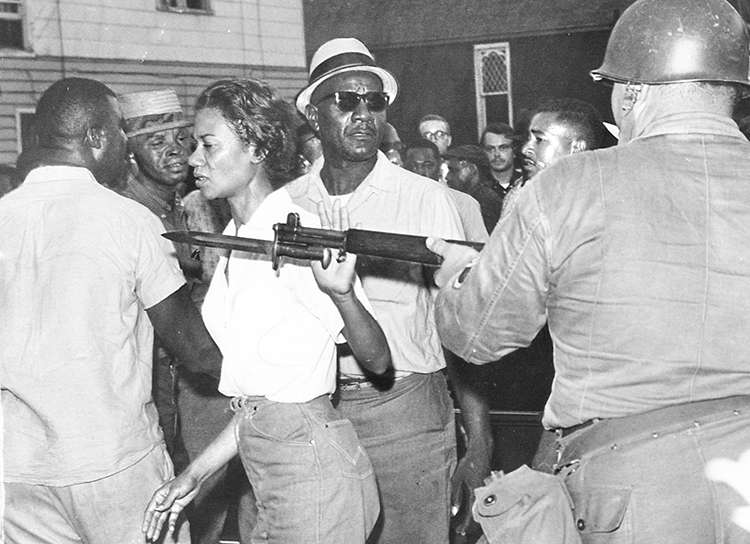
The most famous picture of Richardson protesting in Cambridge was taken one month later. When a National Guardsman approached her with his bayoneted rifle extended, she simply reached out and pushed it aside. The photo appeared in papers around the world. “I wasn’t afraid,” she said years later. “I was upset. And if I was upset enough, I didn’t have time to be afraid. And besides, we had guns too.”
The desegregation fight in Cambridge was tied to battles by the unions, especially ones with a substantial number of Black workers. CNAC members joined picket lines of the United Packinghouse Workers during a strike at a plant in Trappe, Maryland, helping to convince immigrant workers not to act as strikebreakers. Richardson was invited to speak at the union’s District 6 convention the following year.
International Ladies Garment Workers Union members at the Rob Roy factory in Cambridge invited Richardson to join a mass meeting to press union officials to fight to win the same pay that workers got at the company’s New York factory. Black and white workers asked Richardson to speak.
After she spoke, union officials tried to eject her from the meeting. “The local white ILGWU members,” Richardson recalled, “got up and said, ‘Oh no, if she goes, all of us go.’”
The White House feared the impact the deepening fight in Cambridge would have across the country. Attorney General Robert F. Kennedy met with Richardson and agreed to establish a public commission charged with desegregating all the city’s facilities. He also promised construction of public housing and a federal jobs program.
But segregationist forces filed for a referendum to overturn the deal. Before the vote, a Black church in Birmingham, Alabama, was firebombed and four children killed. CNAC called a memorial march, but it was banned by the National Guard.
Days later, on Sept. 27, Richardson urged Blacks to boycott the upcoming referendum. “Why would we agree to submit to have our civil rights granted by vote,” she told the media, “when they were ours already, according to the Constitution.”
Malcolm X: revolutionary leader
On Nov. 10, 1963, Richardson heard Malcolm X speak in Detroit at the Grass Roots conference. “The first time I heard him,” Richardson said, “I had the feeling wow!” Malcolm pointed to the example being set by the battle she was leading and she was invited to address the gathering. The conference voted to support the principle of self-defense and to back candidates of the newly formed Freedom Now Party.
Richardson and Malcolm both spoke at a conference hosted by the Freedom Now Committee in Chester, Pennsylvania, in March 1964, helping build support for Freedom Now candidates. In June of that year Richardson accepted Malcolm’s invitation to join the Organization of Afro-American Unity.
The fight in Cambridge unfolded as the Battle of Birmingham and the March on Washington took place, and the movement to end Jim Crow was drawing hundreds of thousands into the struggle and making gains. By July 1964 the Kennedy administration was compelled to sign the first national Civil Rights bill and segregation in Cambridge and other cities began to be dismantled.