Last week’s Militant featured part one of an article on the Socialist Workers Party’s June 11-14 international socialist conference, held in Oberlin, Ohio. It covered the opening report by National Secretary Jack Barnes, in which he told participants that the SWP today “is proletarian in our program, our class composition and our norms and habits of political conduct. Our communist program is stronger than ever.”
The SWP’s political activity and organizational methods, Barnes said, are aimed at building a revolutionary working-class party, based on Marxist foundations. A party that — in the course of class battles ahead — can become the cornerstone around which millions of working people are organized and led in a successful revolutionary struggle for workers power, as part of the battle for a socialist world.
“We don’t have to create that revolutionary party,” Barnes said. “It exists. Its name is the Socialist Workers Party. Our job is to build it.”
Below is the final part of the article.
Socialist Workers
Party 2026 Conference
The second day of the Socialist Workers Party International Conference opened with a talk by SWP National Committee member Mary-Alice Waters entitled, “Defending Cuba, Defending Cuba’s Socialist Revolution: Deeper into the Working Class.”
Waters placed the U.S. rulers’ aggressively stepped-up economic and military measures targeting Cuba within Washington’s broader imperialist course at home, abroad and, in particular, across the Americas.
The U.S. rulers are driving to dominate and exploit what they regard as “their” hemisphere. That extends from declaring that they must “own” Greenland and annex Canada as the 51st state; to declaring that the Panama Canal was stolen from the United States and the Gulf of Mexico is henceforth the Gulf of America; to staking a claim on the moon and outer space for U.S. military bases, nuclear reactors, commercial mining and other private business.
Barely three days into 2026, the Trump White House carried out its “shock and awe” assault on Venezuela, kidnapping and imprisoning President Nicolás Maduro and Cilia Flores, his wife. Washington is now preparing to place both of them on trial in U.S. courts.
These deepening attacks on Cuba’s national sovereignty come atop more than six decades of a bipartisan U.S. trade and financial embargo, brutally intensified by this year’s full naval oil blockade of Cuba. Washington’s aim is to punish the Cuban people for opening a socialist revolution at the beginning of the 1960s and to overturn that historic conquest.
This year’s savage new measures are aimed at denying the Cuban government every possible source of hard currency, as the U.S. rulers deprive the Cuban people of energy, food, water and life-sustaining medicines and equipment. In addition, the U.S. government is cranking up military threats and taking political measures designed to lay the groundwork for armed aggression. These include the frame-up indictment targeting the one living central leader of the 1959 revolution, Raúl Castro.
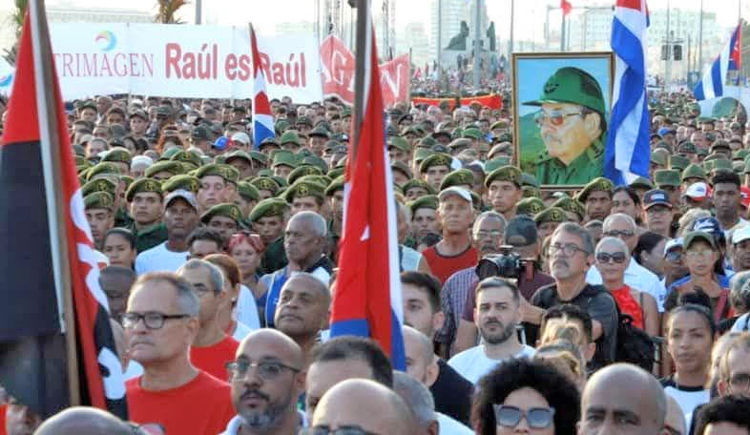
By imposing a humanitarian crisis in Cuba, Waters said, Washington is preparing the way to take any opportunity it might see to intervene with military force on the pretext of “saving the Cuban people.” That is, “saving” them from the government they have freely chosen for nearly seven decades.
The Cuban Revolution, Waters said, has been the target of “a nonstop propaganda offensive by the U.S. rulers and their mouthpieces in both imperialist parties. Their aim is to poison the minds of millions by slandering Cuba as ‘a ruthless dictatorship’ and a ‘failed state.’ They suppress knowledge about the gains of the revolution,” Waters said. “They heap lies and slanders on the proletarian internationalist example revolutionary Cuba has set from Latin America, to Vietnam, to Africa and beyond.”
It’s vital to counter these lies “by getting out the truth to workers and others wherever we can reach them across the United States and worldwide.” That’s the political importance, she emphasized, of the new book published by Pathfinder Press, Cuba and the Independence War in Guinea-Bissau and Cape Verde: The Fall of the Last Colonial Empire in Africa by longtime Cuban revolutionary leader Víctor Dreke.
“Party members and supporters have already been working with others to organize events to get this book into the hands of working people and students, encouraging them to read and use it. Along these lines, important meetings have already taken place — from Rhode Island and Massachusetts to Norway, from Havana and Paris to Sydney and Montreal,” Waters said.
“And we’re just barely out of the starting blocks.”
Branches of the SWP and Communist Leagues will be doing much more with this book over the months ahead. “Campaigning with it is a powerful new weapon right now in defense of the Cuban Revolution,” Waters said. “It tells the truth, in the words of those who fought and whose lives were shaped by the revolution. It leads us to reach people who are new to campaigning against assaults on the Cuban Revolution.”
In short, Waters said, this campaign helps the party advance along the proletarian course pointed out by the subtitle of her conference presentation, “Deeper into the working class.”
As the SWP has been doing for more than 65 years, Waters said, we are politically “in the trenches with the Cuban toilers, their mass organizations, and their government in the fight for national sovereignty and against U.S. imperialist economic and military assaults of any kind.”
That includes initiating and building protests in the streets, wherever we can and with the broadest possible forces, to demand U.S. hands off Cuba!
Our biggest challenge
The biggest political challenge for revolutionaries everywhere, Waters said, is that for the past 67 years, since the triumph in Cuba, there has “not been a single victorious socialist revolution anywhere in the world.”
There have been revolutionary struggles from Latin America and the Caribbean, to Africa and Asia. And there have been powerful social and political struggles in the imperialist countries as well, above all the proletarian-led movement that brought down Jim Crow segregation, Waters said.
“But for more than two-thirds of a century, there have been no new examples of what the working class and its allies are fully capable of achieving with decisive proletarian leadership, such as that of V.I. Lenin and Fidel Castro.”
Waters pointed to the deepening political class divide in the U.S. and beyond between the Socialist Workers Party and our sister parties, on the one hand, and, on the other, countless radical middle-class currents calling themselves “left” or “socialist.”
Most of the latter are Stalinist either in origin or evolution. In many cases today they look to the Maoist variant of that counterrevolutionary historical current, she said. Others claim social democratic or anarchist roots. “But as we’ve seen time and again since the birth of the communist movement almost 200 years ago,” Waters said, “the results of such anti-Marxist political misleadership are always the same.
“Not only do their ultraleft verbiage and actions push working people to the sidelines of the class struggle, as observers or even victims, not fighters and leaders,” Waters said. “Above all, their course channels working people into bourgeois electoral politics aimed at the self-defeating hope of ‘reforming’ capitalism.”
Today many such currents are coalescing around a shared political attraction to and glorification of the economic and military rise of capitalist Beijing and its counterfeit Chinese Communist Party. More than three decades after the fall of hated Stalinist regimes in the Soviet Union and Eastern Europe, these petty-bourgeois radical currents look to China as the principal alternative to what they see as U.S. imperialism’s “unipolar” world. Beijing is both the Stalinists’ new capital of “world socialism” and creditor-in-chief of “the Global South,” the wished-for capitalist counterweight to U.S. imperialist dominance.
Despite all this, Waters said, there is not some new worldwide resurgence of Maoism today, in any sense comparable to its heyday from the 1950s through the 1970s.
At the same time, these developments are tied to a spreading malignancy among meritocratic upper layers of the professional middle classes and campus-based students, Waters emphasized. “That is the Stalinist-style exaltation of thug violence against political opponents, whom they seek to ‘cancel.’”
What’s new today is the convergence of these currents with the sharp rise of reactionary, Islamist, Jew-hating organizations and actions around the world, which has accelerated since the Oct. 7, 2023, pogrom against Israel.
What’s mounting once again is the level of political thuggery and worse that seeks to prevent political discourse. “That violence is born of weakness and fear of the working class, not political strength,” Waters said. Such forces, she added, “are increasingly attracted to the example of Nazi-inspired Hamas and Hezbollah death squads cultivated by Tehran.”
In the United States, these class-collaborationist “radicals” operate under the illusion they are doing something “new” by channeling layers of privileged students and former students into the imperialist Democratic Party and its vote-catching left wing. In fact, they are treading in the footsteps of renegades from Marxism for well more than a century.

From elite neighborhoods of New York City’s Manhattan and Brooklyn’s Park Slope, to comfortable enclaves in big cities, suburbs, and university towns across the country, these insecure middle-class layers hold the working class in contempt. Under the impact of capitalism’s deepening economic and social crises, more and more of them are afraid that they themselves will be hurled down among the working classes.
Their celebration today of anti-materialist and anti-working-class identity politics, Waters said, feeds the capitalist rulers’ sought-after counterrevolution against gains won by the Black rights movement and women’s liberation struggles.
This “woke left” cult of victimhood, however, does not flourish widely in the working class, Waters underlined. SWP members, she added, “know this from their own work and experience on the job. We know it from discussions with our co-workers. We know it from campaigning door to door in working-class neighborhoods week in and week out, and from exchanges and experiences with working people of all skin colors, national backgrounds and both sexes.
“These attitudes, values, and conduct all have a class character,” Waters said. “The correct term for them is petty bourgeois. For the vast majority of working people, these are alien class attitudes.
“Here, too,” Waters said, “a rise in the class struggle and new victories of the socialist revolution will heighten both the political need for and opportunities to forge cadres of a working-class leadership, opportunities to build a proletarian revolutionary party, the Socialist Workers Party.”
Two Middle East wars
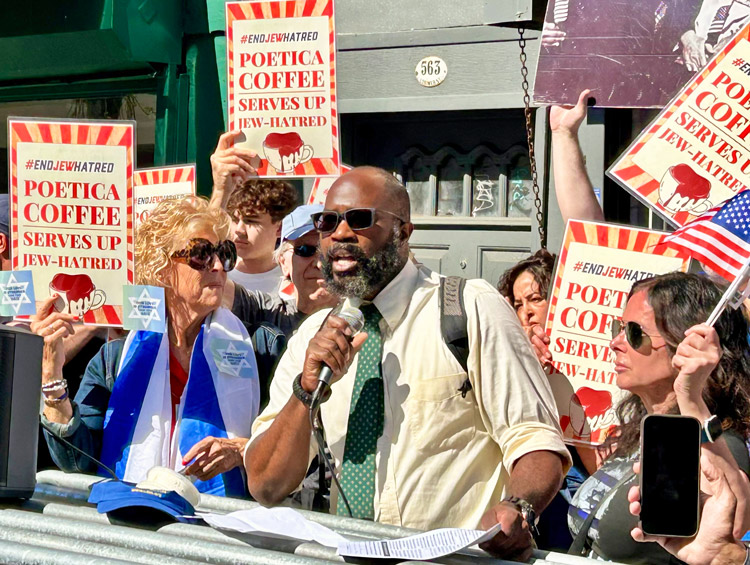
The third conference talk, presented by National Committee member Steve Clark, was entitled, “Iran, Israel, and the United States in the Imperialist Epoch: Two Wars in One.” Washington’s military, political, and diplomatic course since launching its assault on Iran in February 2026, Clark said, helps class-conscious workers clarify to other working people that there are two different wars being waged in the Middle East today.
One is the imperialist war launched by Washington against Iran in late February. Its widening aerial destruction of military targets, infrastructure, and civilian “collateral damage” in Iran has been mixed from the outset with on-again, off-again “peace talks” with that country’s reactionary bourgeois-clerical regime. The U.S. rulers’ goal, one they initially misjudged as a quick fix, is an economically and strategically advantageous live-and-let-live arrangement with Tehran, as well as with other capitalist governments in the Middle East.
Topmost for the U.S. ruling families are their own imperial interests in oil and gas resources, other lucrative markets, arms sales, and control over strategic sea routes and straits worldwide. Neither Washington’s war aims nor its “peace” blather, however, have as a central objective defense of Israel’s right to exist and prevention of another Holocaust. That fact, Clark said, is underlined by the overt rise of antisemitism and political hostility toward Israel in both the imperialist Democratic and Republican parties.
For the great majority of the more than 7.2 million Jews living in Israel, as well as many of its Arab citizens and others, Clark said, Israel has been waging a defensive war for close to three years. It’s a war on seven fronts, they often explain, pointing to Tehran’s heavily armed proxies across the Middle East.
The goal of this second war, Clark said, “is to prevent another Holocaust, such as that announced by the murderous pogrom of Oct. 7, 2023. That massacre was launched by Hamas, with full involvement by Tehran and its subordinate Jew-hating armies and militias in the region, from Hezbollah in Lebanon to those in Iraq, Yemen and elsewhere.
“Israel’s defensive war is impelled, above all, by recognition that Tehran’s drive to develop nuclear weapons and ballistic missile delivery systems,” Clark said, “is a threat to the very existence of Jews not only in Israel but elsewhere around the world.”
Tehran and its now battered proxies are also brutal class enemies of Arab, Iranian, Kurdish and other oppressed and exploited peoples across the Middle East, Clark added. “Politically conscious workers should never stop explaining that class reality,” Clark said.
These reactionary forces have sustained enormous blows from defensive operations by Israeli forces since the 2023 massacre of some 1,200 Jews and others, the wounding of thousands, and brutal abductions of 251. Today that phalanx of Jew-hating armies is weaker than ever, Clark said, citing a June 8 statement by Israeli Prime Minister Benjamin Netanyahu. “But our struggle against them is not yet over,” Netanyahu cautioned.
The Israeli government and people are determined not to have a prettied-up but perilous Pax Americana rammed down their throat by Washington or its “Board of Peace” — a body that includes governments that, far from being regional “peacemakers,” also have the goal of eliminating a viable Jewish state in the Middle East.
“Such an outcome would guarantee Hamas’ ability to stage new ‘October 7s,’” Clark said. “It would ensure ongoing deadly Hezbollah missile assaults on Jewish and other Israeli civilians. And it would bring closer and faster Tehran’s deployment of a nuclear arsenal with Israel as the bull’s-eye.”
That’s why Washington is making it increasingly clear that it views Israel as an obstacle to the U.S. rulers achieving their imperial goals. In April Trump, with all his trademark arrogance and bombast, announced that he was “prohibiting” Israel from bombing Hezbollah targets in Lebanon. Then in May the U.S. president said that Netanyahu will do “whatever I want him to do.” And in early June: “I call all the shots. Netanyahu doesn’t call the shots.”
But to no avail. “Jews refuse to surrender their very survival as a people,” Clark said.
The working classes, the oppressed, and the labor movement worldwide, he emphasized, must rally behind the fight against Jew-hatred and pogroms.
Clark reminded participants of the fact, underlined by Jack Barnes at the international socialist conference two years ago, that the political roots of Hamas lie in the reactionary drive by Hitler and the Nazis for a “Final Solution,” the extermination of two-thirds of Europe’s Jewish population — and well more than a third of the Jewish population of the entire world — during the closing years of World War II.
“The intention of the Jew-hating leaderships of the Tehran regime, Hamas, Hezbollah and others,” Clark said, “is to succeed where Hitler failed.” That and only that is the political content of, “From the river to the sea, Palestine will be free!” It has nothing to do with the aspirations for freedom of oppressed Palestinians.
As Leon Trotsky wrote in December 1938, “Now more than ever, the fate of the Jewish people — not only their political but also their physical fate — is indissolubly linked with the emancipating struggle of the international proletariat.” To this day, Clark said, the Socialist Workers Party works to educate and organize class-conscious workers and the labor movement the world over to act on that fact of history.
Struggles in Iran
The war on Iran unleashed this year by Washington also set back for a time the struggles by workers, oppressed nationalities, and students against the tyrannical regime there. Fights by these forces had been on the rise, despite stepped-up executions and murderous repression by the Iranian government’s Islamic Revolutionary Guard Corps and its paramilitary gangs of thugs, the Basij.
For sure strikes and protests have been curbed for now by war-fueled fears, opposition to imperialism’s assault on Iran’s sovereignty, and ongoing government terror, Clark said. “But resistance continues.”
Oil workers, garment workers, truckers, retirees and many other working people confront unpaid wages for months on end, job losses, and shortages of water, electricity and other basic necessities. Iran’s many oppressed nationalities and immigrant workers continue to face not only superexploitation but denial of language rights and simple human dignity.
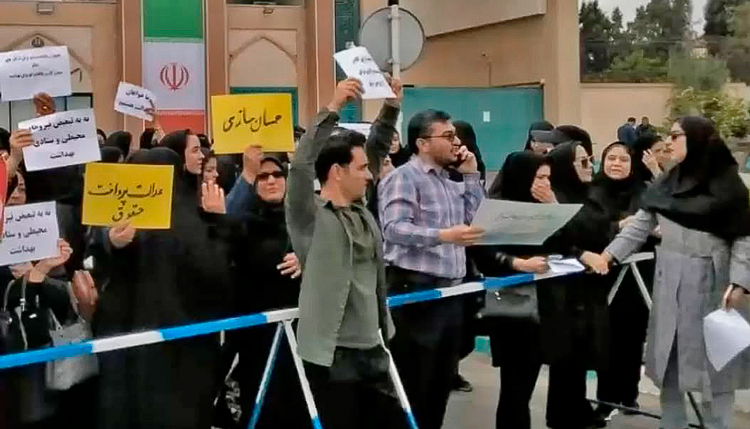
Clark pointed to a June 9 statement issued by an association of oil contract workers in Iran calling for safe job conditions and other demands. “We seek justice,” the oil workers declared. “We press our demands. Hear our footsteps approaching.”
The unresolved class and national conflicts in the Middle East — in Iran, in Israel, Palestine, Kurdistan and across the region — will inevitably sharpen, as new imperialist wars, civil wars, and social convulsions spread, Clark said. As in the U.S. and worldwide, workers of all national and religious origins, languages and skin colors need to forge strength and revolutionary confidence through solidarity in action. They need to build communist parties to overturn the class dictatorship of capital and establish workers power around the globe.
As workers and the oppressed take steps forward in overcoming seemingly age-old divisions that benefit only the exploiting classes, Clark said, then the property-holding rulers — from New York, London, Paris and Sydney, to those across the Middle East and beyond — will truly begin to “hear our footsteps approaching.”
On the road to the SWP
In his summary remarks the last day of the socialist conference, Barnes returned to one of the foundations of Marxism he had singled out in his opening presentation: building a party of professional revolutionaries. He described what led him and several other young people he knew in the early 1960s to decide what was worth devoting their lives and energies to.
Barnes recalled their trip to Cuba in the summer of 1960 to see for themselves the revolution unfolding there.
“I was a young person like many others then who knew little or nothing about Marxist politics or its materialist foundations,” he said.
“I wanted to visit Cuba for one reason. Because a revolution, the first one I knew about in my lifetime, was going on there.” He described the political impact of getting to know and spending time with some of the workers, farmers and militia members in Cuba who were making and defending that revolution.
Barnes also took a few minutes to talk about what he had learned politically from an article he read while in Cuba. It was published in the spring issue of the International Socialist Review, a quarterly magazine edited and published by the SWP leadership. The headline was, “Case History of an Experiment.” It was written by Murry Weiss, a longtime SWP leader.
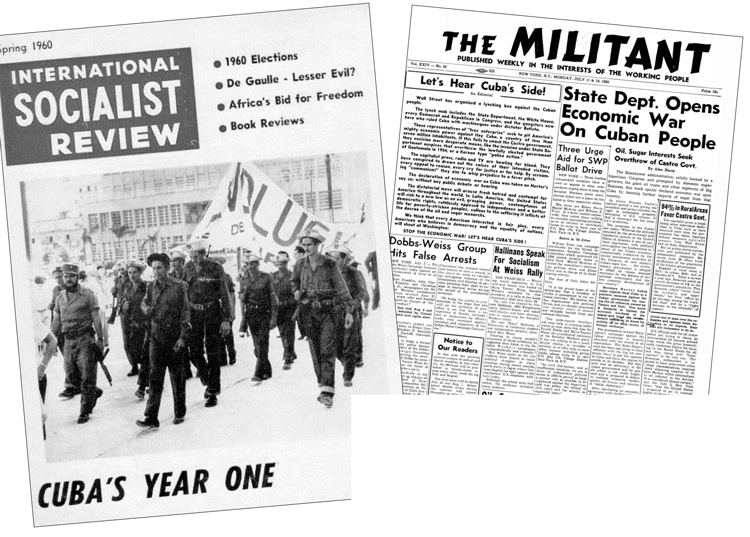
Barnes said he knew nothing at the time about the Socialist Workers Party and had never met a party member. He bought the magazine because its front cover featured a large photo of a Cuban militia unit, above the headline, “Cuba’s Year One.” It caught his eye on a newsstand he stopped at in front of the New York Public Library during a flight layover en route to Havana.
Many of the students who visited Cuba in the summer of 1960, Barnes said, knew that a U.S. invasion of some kind was coming, as it did just a few months later in April 1961 at the Bay of Pigs. “So we were reading anything we could get our hands on to understand more clearly what was happening in Cuba and why the U.S. government was so determined to destroy the example of the Cuban people and their leadership.”
During the 10 weeks Barnes was in Cuba, a Latin American Youth Congress was held in Havana in late July. It drew some 900 young people from across the Americas and elsewhere around the world. Che Guevara, a central leader of the revolution, presented the opening speech, in which he addressed a question on the minds of many, “Is this revolution communist?”
The answer was still being hotly debated during the first couple of years of the revolution, Barnes said, including among its supporters. Leaders of Moscow-oriented Communist parties across the Americas — many of whose young members attended the youth congress — were answering, “no,” Barnes explained. The Cuban Revolution, these CPers said, was anti-imperialist and anti-feudal in class character, not socialist. And Fidel Castro and other central leaders were revolutionaries, but not communists.
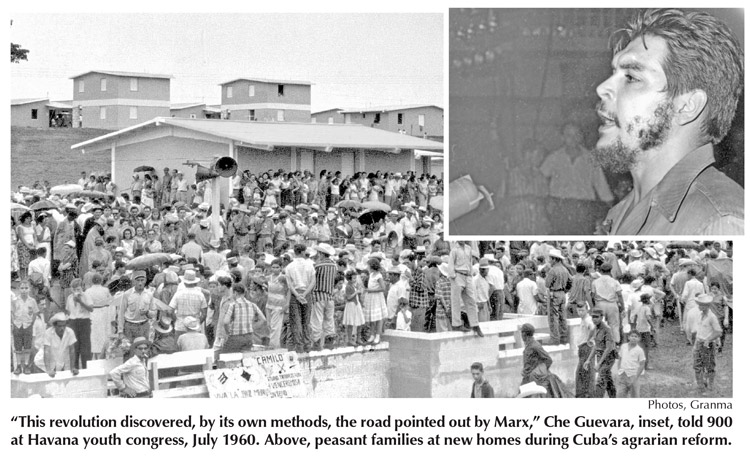
Guevara’s answer was strikingly different, Barnes said. After frankly posing the controversial question in his talk, Che emphasized: “I would answer that if this revolution is Marxist — and listen well that I say ‘Marxist’ — it is because it discovered, by its own methods, the road pointed out by Marx.”
Che’s statement rang true to what Barnes himself had seen and was thinking, he said. What’s more, it resonated with the very first lessons he was learning about proletarian politics from the magazine article he had begun reading.
The author of that article told the story of the collapse of a monthly magazine that had been launched in 1954 by several former SWP leaders who had broken from the party. They had left under pressures of the post-World War II anti-communist witch hunt, a conjunctural upswing in capitalist “prosperity,” and the related political retreat of the union movement from its high point in the late 1930s.
Initially the new monthly had “made a considerable impression in radical and student circles,” the article said. But the founders’ hopes for “a radical upsurge” in middle-class milieus hadn’t borne fruit, bringing to a close their magazine “experiment” after just a few years.
Even the name they had chosen for the failed monthly magazine said a great deal about its political perspectives, Barnes noted. Unlike the International Socialist Review, edited and promoted by cadres of the SWP, those who had broken from the party dubbed theirs, American Socialist.
But there is nothing uniquely American about socialism, about Marxism, or about the world communist movement, Barnes said.
Marx, Engels, and many of the revolutionary-minded workers who had recruited them to the Communist League in 1847 were German.
And the two outstanding socialist revolutions and proletarian leaderships of the 20th century, led by Lenin and by Fidel Castro, were Russian and Cuban.
Yes, Cuba is truly very much of the Americas. But it’s not “American” in the sense clearly intended by those who launched their magazine five years before workers and peasants stormed to victory in Cuba in January 1959.
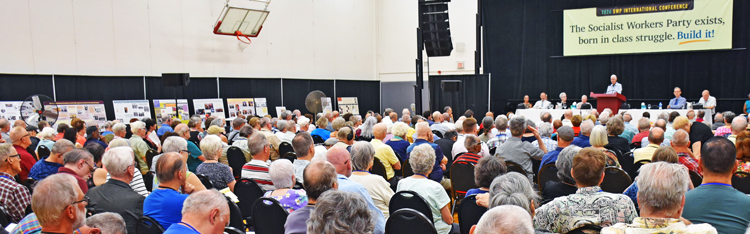
Barnes pointed again to the banner hanging at the front of the hall, as he and others had done throughout the conference: “The Socialist Workers Party exists, born in class struggle. Build it!”
When those 900 young people gathered in July 1960 in Havana’s Blanquita Theater (today the Karl Marx Theater), Barnes said, Che Guevara was in fact using his time at the microphone to explain to them why a proletarian communist party needed to be built in Cuba.
“That’s why I could hear echoes of the article I was reading,” Barnes said. “It helped me see who was right and who was wrong in the debates raging all around me.”
Marxism might be “palatable to many dilettantes and dabblers in radicalism,” the author of the ISR article said, “if it weren’t so insistent on converting its program into an organized working-class political struggle.” Those who broke from the SWP in 1954, the article concluded, did so “over the concept and role of a Leninist party.”
After spending two and a half months in Cuba amid an advancing working-class revolution; hearing and debating about Che’s talk; reading his first article by an SWP leader; and then meeting several party members also in Havana that summer — after all that, Barnes said, “I was well along the way to joining the SWP when I returned to the United States.”
‘Seeds in the wind’
Barnes explained that those who abandoned the SWP in the 1950s and briefly published the American Socialist “used to make fun of the party’s subscription campaigns for the Militant, our SWP election campaigns, and our sales of pamphlets and books to working people on the job and elsewhere.” They made light of the disciplined and systematic way we carry out trade union work alongside other rank-and-file workers and union members, he said.
So do the party’s petty-bourgeois opponents to this day, Barnes added.
“The SWP just tosses seeds into the wind and hopes they’ll fall to the ground and take root somewhere,” our opponents laughed.
At the same time, Barnes added, these currents were — and still are — convinced “that they do know where to find people who are ‘intelligent,’ who are equipped ‘to understand complex questions.’ People who are ‘woke,’ we might add today.”
Where? Barnes asked. “Where do you think? University malls, faculty lounges, urban neighborhoods and better-off suburbs and towns that these colleges and universities often dominate. In the ‘nonprofits,’ ‘NGOs,’ and professional associations of all kinds. In thuggish milieus of Stalinist, ‘antifa,’ and other middle-class groups like the DSA, who change out of their fashionable clothes for a few hours, or troll ‘social media,’ when someone who doesn’t share their ‘progressive’ views needs to be ‘canceled’ or ‘shut down.’”
Yes, in fact, Barnes said, the cadres of the Socialist Workers Party “are advocates of ‘tossing seeds into the wind’” — of reaching out as widely as possible to working people on the job, in their neighborhoods, in cities and small towns, on union picket lines and social and political protests of all kinds.
Barnes said that he learned a lot more about building a party of professional revolutionaries when he returned to Minnesota in fall 1960, during his senior year at Carleton College. Through SWP members he had met in Cuba, he and his friends ended up spending long hours talking with experienced communist workers in the Twin Cities.
As Barnes and others recounted their experiences visiting Cuba, he said, these workers “talked with us about the history of the class struggle in the United States, and how the SWP was responding to U.S. and world politics,” from the Cuban Revolution to the Black struggle and developments in the unions.
Reinforced by what he had learned in Cuba and from reading the International Socialist Review article, Barnes said, he could now understand “why contempt for the party’s own history and communist continuity means you can never be a revolutionary.”
Barnes said he also learned that when the SWP met people like himself and his friends — people who wanted to fight, people who wanted to make a socialist revolution in the United States — then party members devote a lot of time, thought and energy into recruiting them to the SWP.
“Neither your commitment to join the SWP, nor the party’s decision to take you into membership,” Barnes said, “will ever be decided by what social class you were born into. Or by what level of formal education you may have had.”
What’s decisive, Barnes said, “is how much you want to build the revolutionary party that exists.
“How much you want to build the party that over decades has proven by its working-class program, and by its centralized and disciplined activity in the U.S. and world class struggle, that it is capable of forging a leadership of the working class and our allies that can lead tens of millions in a revolutionary struggle for workers power in the United States. A victorious socialist revolution.”
That revolutionary party today is the Socialist Workers Party. Its founding leaders were forged in the programmatic, political and organizational continuity of the early years of the Communist Party in the U.S. and of the Communist International founded by Lenin.
And they organized and worked for more than a decade under the political leadership of Leon Trotsky, who alone among the central leaders of the Bolshevik Party remained true to Lenin’s proletarian internationalist course. Trotsky led SWP leaders in the battle to defend Marxism, and to rebuild a proletarian party and a world communist movement, in face of the Stalinist political counterrevolution at the close of the 1920s.
One thing worth paying attention to in the new 2026 introduction of Trotsky’s In Defense of Marxism, Barnes said, “is its strong reaffirmation of our more-than-century-long conviction that no matter what you may have been doing with your life beforehand, no matter what ‘career path’ may have been open to you, it is never ‘a sacrifice’ to join the revolutionary party.”
To the contrary, Barnes said, “not only are you committing yourself to the most productive and satisfying life anyone can have. Above all, you’re committing yourself to the most vital task facing the working class and all humanity.
“You are taking your place on the front line of the historic battle to take state power out of the hands of the imperialist exploiters, oppressors and war makers. You’re becoming a professional revolutionary in the fight to put an end once and for all to capitalism’s dog-eat-dog social relations and replace them for the first time with truly human relations based on solidarity and social labor,” Barnes said.
“You’re joining in the fight for a socialist world.”