
Washington is ramping up pressure on the Ukrainian government, claiming Kyiv is the chief obstacle to peace, at the same time offering concessions to normalize relations with Moscow, whose murderous invasion of Ukraine has now lasted longer than World War I. While the Russian army is stalled or losing ground on the front line amid heavy casualties, the Vladimir Putin regime has stepped up its aerial bombardment of Ukraine’s cities and power grid as winter approaches.
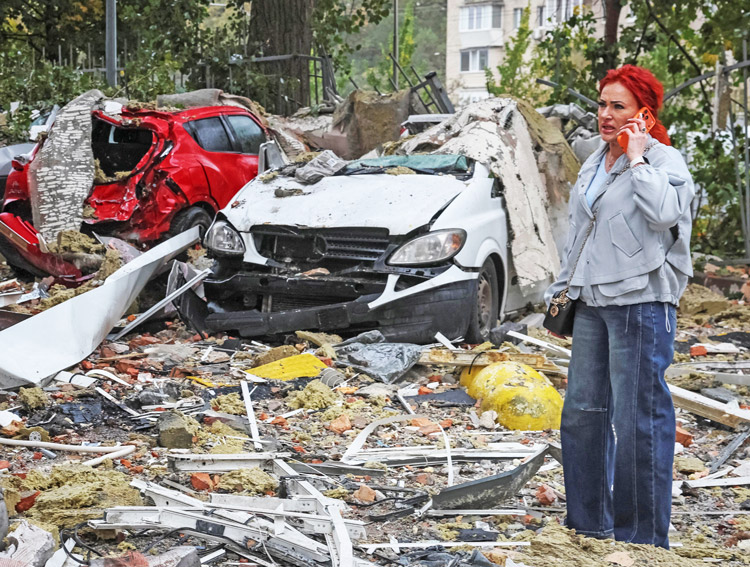
The Kremlin’s target is Ukrainian working people, in workplaces, apartments and on city streets. Civilian casualties are at record levels, with 328 killed and 2,105 injured in September, 85% higher than the same month last year.
President Donald Trump announced he had struck a deal after speaking with Putin by phone Oct. 9. Trump said this deal included lifting restrictions on Russian diesel exports, a move he hopes will stem fuel price rises in the U.S. going into the 2026 elections. He then put on hold new bipartisan U.S. sanctions against Russia and denounced Kyiv’s defensive targeting of Russian oil refineries.
Washington later slowed Ukraine’s access to Elon Musk’s Starlink satellite system, crucial for both its defense and offensive strikes, at the same time delaying shipments of U.S. missiles vital to Kyiv’s efforts to meet escalating Russian attacks on Ukraine’s cities.
In July, Trump had backed Kyiv’s strikes on Russian refining capacity, an attack on both Moscow’s oil supply and an essential source of cash for its war effort. He said it was “an escalation that can help lead to an end” of Moscow’s war. But now he regards Ukrainian President Volodymyr Zelensky as an obstacle to his efforts for new agreements with Moscow to aid the U.S. rulers’ push to defend their place as top dog in the imperialist world “order.”
Displaying imperial contempt for Ukraine’s national sovereignty, Trump said the country needed to get a new president. Seeking to weaken Kyiv’s position, he said Oct. 19 it was “time for somebody else to negotiate on behalf of Ukraine.”
After announcing his new dealings with Moscow, Trump claimed Oct. 11 that both Moscow and Ukraine would observe an “energy ceasefire.” Kyiv paused its strikes on Russian oil refineries for three days. Moscow simply ignored the “agreement,” pounding Ukrainian electrical, oil and gas infrastructure 76 times the following week.
The steps by the White House to develop closer relations with Moscow are “in the national interest of the United States,” Trump said Oct. 16. By this he meant the interests of the billionaire ruling families. As U.S. imperialism’s rivalry with Beijing, its main capitalist competitor, sharpens, a central piece of the U.S. rulers’ global foreign policy is to draw Moscow closer as an ally.
Washington no longer provides financial aid to Ukraine and only supplies weapons paid for by Kyiv and European governments. However, U.S. intelligence and access to Starlink remains critical to the country’s defenses against Moscow’s attacks, and its ability to strike military and infrastructure targets in Russia. The White House deliberately cut this access back as part of applying pressure on Ukraine in its maneuvering.
Despite Moscow’s pounding of Ukraine’s cities and Trump’s reversal on protections, the large majority of Ukrainians favor continuing to fight to defend their national sovereignty.