Today’s largest and fastest growing Ebola outbreak in the Democratic Republic of the Congo reached 9,552 confirmed cases with 4,602 deaths by Oct. 19. This is the most rapid spread of Ebola-caused deaths ever. Washington and other imperialist powers are doing nothing to provide aid and treatment, in sharp contrast to the response of Cuban medical volunteers during the Ebola outbreak in Africa in 2014.
First detected in May, the epidemic has now spread to Uganda and Kenya. Nigeria, the most populous country in Africa, reported its first case Oct. 20. It’s caused by the Bundibugyo strain of Ebola, with no known vaccine or treatment.
“I have never seen [an Ebola epidemic] get this far ahead of us,” Heather Kerr, director of the International Rescue Committee in the Democratic Republic of the Congo, told the New York Times. Most new cases are people not on contact lists used to track potential cases, because lack of serious attention means “deaths are occurring not in treatment centers but in people’s homes and communities.”
The outbreak started in eastern DRC, where the ability to deal with it was severely weakened by 30 years of armed conflicts between government and opposition forces. The United Nations reports 243 acts of violence, threats, or interference affecting aid workers since the beginning of the year.
When Ebola hit a displaced persons camp with a treatment center last month, soldiers came looking for weapons and burned the camp to the ground. Some 19,000 people had to flee, spreading the infection.
Toilers there have a distrust of health workers, international responders and government institutions.
The mortality rate of those infected is averaging 50%. Many who develop Ebola symptoms choose to stay home with their families instead of going to treatment centers where they fear dying alone. Deep cultural and spiritual traditions surround death and burial, which are ignored in treatment centers.
Local healthcare workers have gone unpaid, and since the outbreak began at least 50 have died of Ebola.
The World Health Organization declared the outbreak a public health emergency in June, announcing a $518 million six-month emergency response plan, offering $3.9 million from its contingency fund.
The U.S. government sharply cut funding to humanitarian groups in Africa last year and plans to cut billions of dollars more from global health spending. Other imperialist governments and donors have also tightened their aid.
Washington responded not with aid, but imposed a ban on travel from the Democratic Republic of the Congo by anyone who was in the country over the previous 21 days. The government of Canada followed suit with an entry ban.
In September, Washington convened a meeting of foreign ministers from the Group of 20+. Participants pledged $700 million to fight the epidemic. But this has had little impact.
Big capitalist pharmaceutical companies like Moderna and Serum Institute of India are competing to develop a lucrative vaccine for Bundibugyo. Merck, the maker of the Ervebo vaccine used against the more common Zaire Ebola virus, sent the vaccine for clinical trial in the DRC hoping to show it could be profitable for combating Bundibugyo. And the makers of a number of antiviral drugs are rushing to clinical trials to see if they can be effective.
Cuba barred from fighting Ebola
The most effective response to any Ebola epidemic was shown by Cuban volunteers in the worst outbreak to date, centered in the West African countries of Liberia, Sierra Leone and Guinea from 2014 to 2016. A powerful account of that battle is told in Red Zone: Cuba and the Battle Against Ebola in West Africa by Enrique Ubieta Gómez.
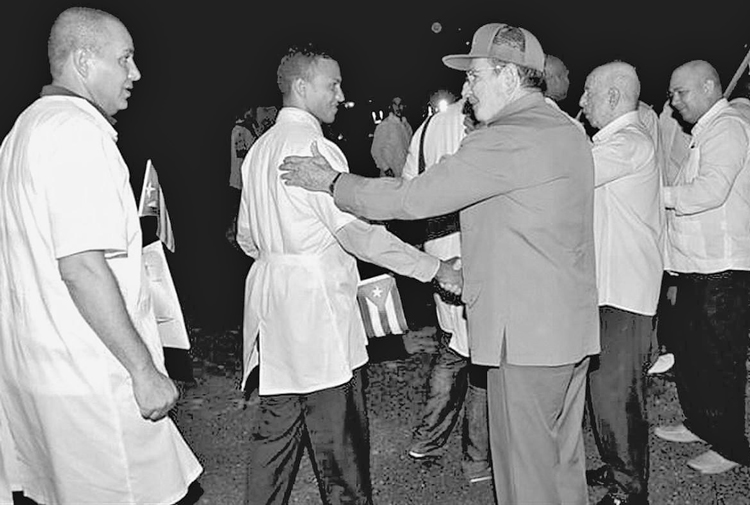
Within three days of the U.N.’s call for assistance in that epidemic, Cuba selected and started training 256 doctors, nurses and healthcare technicians, out of 12,000 who volunteered to join the fight against Ebola. Cuba was the only country to send medical personnel for patient care.
After Cuba responded, governments in Europe increased financial aid and Beijing built another laboratory in Sierra Leone. Washington announced it would send 500 soldiers to Liberia to build a hospital and other facilities.
Rather than treating their Ebola patients as a threat, the Cuban medical workers provided hands-on care to thousands of critically ill people, their families and in communities traumatized by the disease. As people in Sierra Leone got to know the Cubans, suspicion of treatment from “outsiders,” who had no care for the customs there, was gradually overcome.
The human connections made by Cuban healthcare providers made a life or death difference for many struck by the deadly disease and allowed a dignified death for others. When the last member of the medical brigade returned home after eight months, the Ebola epidemic was effectively eradicated.
Ubieta Gómez noted his book is “about the solidarity and internationalism that are at the heart of the Cuban Revolution.” Sending “doctors and nurses to the West African countries struck by the Ebola epidemic continued a tradition spanning more than five decades.” Cuba’s response was a product of the transformation resulting from its socialist revolution.
As part of Washington’s drive today to overturn that revolution, the U.S. rulers slander Cuban medical volunteers around the world and pressure governments who have benefited from Cuba’s medical missions to shut them down. Secretary of State Marco Rubio slanders Cuban doctors serving abroad, claiming they’re “forced labor” and part of a system of “state-sponsored human-trafficking.”
In 2014, upon hearing Cuba would respond to its appeal for help with Ebola, Ernest Bai Koroma, the president of Sierra Leone, told Cuban Ambassador Jorge Fernando Lefebre, “I knew Cuba would not abandon us. You are true to your heritage, to your African roots. That is what Fidel [Castro] has taught you. I knew Cuba would continue to be a friend of Africa. Tell Raúl [Castro], tell the people of Cuba, that we will never forget that.”
The U.S. government is preventing Cuba from responding today and the Congolese people are paying for it with their lives.