

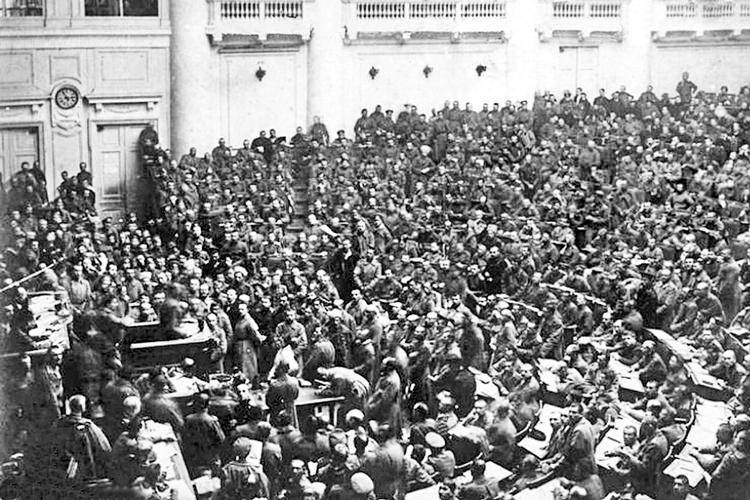
The History of the Russian Revolution by Leon Trotsky is one of Pathfinder’s Books of the Month for October. The excerpt is from the Preface written by Trotsky, a central leader of the revolution and the Bolshevik Party under V.I. Lenin. Written from exile in the early 1930s, Trotsky describes the social, economic and political conditions that fueled the 1917 Russian Revolution. From the February insurrection, where workers and soldiers in Petrograd toppled the czarist monarchy, through eight months of deepening class struggles, Lenin and the Bolsheviks led Russian toilers to take political power. Copyright © 1932 by the University of Michigan. Reprinted by permission of Pathfinder Press.
During the first two months of 1917 Russia was still a Romanov monarchy. Eight months later the Bolsheviks stood at the helm. They were little known to anybody when the year began, and their leaders were still under indictment for state treason when they came to power. You will not find another such sharp turn in history — especially if you remember that it involves a nation of 150 million people. It is clear that the events of 1917, whatever you think of them, deserve study. …
The most indubitable feature of a revolution is the direct interference of the masses in historic events. In ordinary times the state, be it monarchical or democratic, elevates itself above the nation, and history is made by specialists in that line of business — kings, ministers, bureaucrats, parliamentarians, journalists. But at those crucial moments when the old order becomes no longer endurable to the masses, they break over the barriers excluding them from the political arena, sweep aside their traditional representatives, and create by their own interference the initial groundwork for a new régime. Whether this is good or bad we leave to the judgment of moralists. We ourselves will take the facts as they are given by the objective course of development. The history of a revolution is for us first of all a history of the forcible entrance of the masses into the realm of rulership over their own destiny.
In a society that is seized by revolution classes are in conflict. It is perfectly clear, however, that the changes introduced between the beginning and the end of a revolution in the economic bases of the society and its social substratum of classes, are not sufficient to explain the course of the revolution itself, which can overthrow in a short interval age-old institutions, create new ones, and again overthrow them. The dynamic of revolutionary events is directly determined by swift, intense and passionate changes in the psychology of classes which have already formed themselves before the revolution.
The point is that society does not change its institutions as need arises, the way a mechanic changes his instruments. On the contrary, society actually takes the institutions which hang upon it as given once for all. For decades the oppositional criticism is nothing more than a safety valve for mass dissatisfaction, a condition of the stability of the social structure. … Entirely exceptional conditions, independent of the will of persons or parties, are necessary in order to tear off from discontent the fetters of conservatism, and bring the masses to insurrection.
The swift changes of mass views and moods in an epoch of revolution thus derive, not from the flexibility and mobility of man’s mind, but just the opposite, from its deep conservatism. The chronic lag of ideas and relations behind new objective conditions, right up to the moment when the latter crash over people in the form of a catastrophe, is what creates in a period of revolution that leaping movement of ideas and passions which seems to the police mind a mere result of the activities of “demagogues.”
The masses go into a revolution not with a prepared plan of social reconstruction, but with a sharp feeling that they cannot endure the old régime. Only the guiding layers of a class have a political program, and even this still requires the test of events, and the approval of the masses. The fundamental political process of the revolution thus consists in the gradual comprehension by a class of the problems arising from the social crisis — the active orientation of the masses by a method of successive approximations. The different stages of a revolutionary process, certified by a change of parties in which the more extreme always supersedes the less, express the growing pressure to the left of the masses — so long as the swing of the movement does not run into objective obstacles. When it does, there begins a reaction: disappointments of the different layers of the revolutionary class, growth of indifferentism, and therewith a strengthening of the position of the counter-revolutionary forces. Such, at least, is the general outline of the old revolutions.
Only on the basis of a study of political processes in the masses themselves, can we understand the role of parties and leaders, whom we least of all are inclined to ignore. They constitute not an independent, but nevertheless a very important, element in the process. Without a guiding organization the energy of the masses would dissipate like steam not enclosed in a piston-box. But nevertheless what moves things is not the piston or the box, but the steam.
The difficulties which stand in the way of studying the changes of mass consciousness in a revolutionary epoch are quite obvious. The oppressed classes make history in the factories, in the barracks, in the villages, on the streets of the cities. Moreover, they are least of all accustomed to write things down. Periods of high tension in social passions leave little room for contemplation and reflection. … For better or worse, a revolutionary party bases its tactics upon a calculation of the changes of mass consciousness. The historic course of Bolshevism demonstrates that such a calculation, at least in its rough features, can be made. …
However, the processes taking place in the consciousness of the masses are not unrelated and independent. No matter how the idealists and eclectics rage, consciousness is nevertheless determined by conditions. In the historic conditions which formed Russia, her economy, her classes, her State, in the action upon her of other states, we ought to be able to find the premises both of the February revolution and of the October revolution which replaced it.