HUMACAO, Puerto Rico — The fight by fishermen here for a ramp that would make launching and beaching their small fishing boats qualitatively easier, spotlights some of the challenges facing the working class in Puerto Rico. It also provides a good example of the many ways in which Washington’s colonial domination serves the interests of U.S. capital.
Militant correspondents and members of the Socialist Workers Party on Oct. 23 met six members of the Punta Santiago Association of Fishermen on a beach on the outskirts of the town.
Nearby, still lay two of their boats damaged by Hurricane Maria in 2017, as well as a wrecked pier — evidence of the months it took for fishermen to recover from their losses. They were plagued with power outages as well as marine habitats upended by the storm.
“For over 40 years we have been fighting for a boat ramp,” Eddie López, the association’s president, told us. “Senators from all the political parties have come here. They have posed for pictures helping us push the boats into the water by hand. We’ve taken them out in our boats so they can see for themselves how hard it is. They make promises to help, but never resolve anything.”
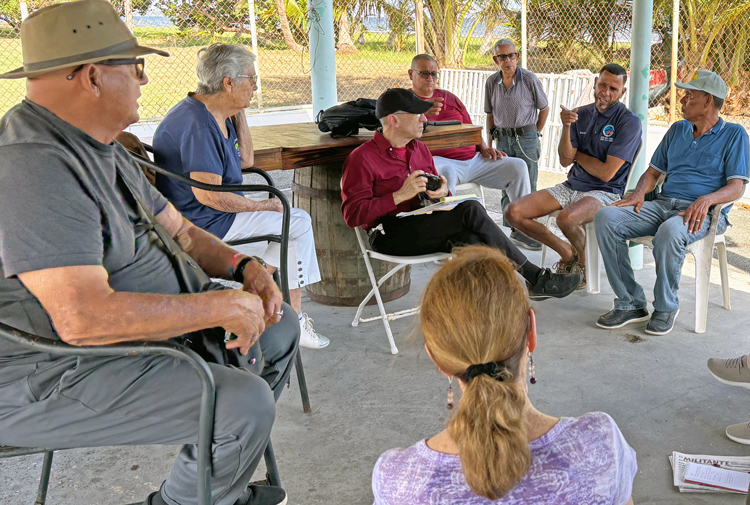
The association has 17 members, López said. There are over 170 similar groups of fishermen in the island’s coastal towns, but no national association. López says that Punta Santiago is the only town without its own boat ramp.
Most of the members own one boat. Instead of paying a wage to the two or three workers they hire, they divide up the catch with them at the end of each day.
Like other small businesses and self-employed workers across the island, the fishermen are being battered by the capitalist economic crisis, made worse by their status as a U.S. colony. When we asked if the price of gas for their boats had increased, they broke into bitter laughter. The price of all their necessities has soared.
Electric rates have skyrocketed, with an 18% increase this month alone, making it nearly twice as expensive as in the continental U.S. Faced with frequent brownouts and blackouts, many of the fishermen have turned to renting solar panel systems. That can cost them between $150 and $320 a month.
“We’re not asking for much,” said fisherwoman Elsie Rodriguez, who still goes out on their boat every Saturday at the age of 81. “We just need a little bit of concrete.” She and her husband, Ángel Luis, also own a store that buys the catch from other fishermen and resells it to the public.
When asked why members of the association don’t organize to build the ramp themselves, Rodríguez shrugs her shoulders. “We can’t get the permits” from the government, she says.
The U.S. overseers and local capitalist governing bodies try to block workers from organizing collectively to solve their problems. They foster dependency on government “aid” and create the illusion workers can’t go around the bureaucratic obstacles, which are compounded by final control in the hands of colonial bodies.
“The only way they will get a ramp is if the U.S. Army Corps of Engineers builds it,” Yamary Morales, a former fisherwoman in nearby Yabucoa, told the Militant the next day.
López showed us newspaper articles from 2012 and 2017 when government officials promised the ramp would soon be built. It never was. He also played a video showing the backbreaking work of pushing their boats from the beach to the sea and back.
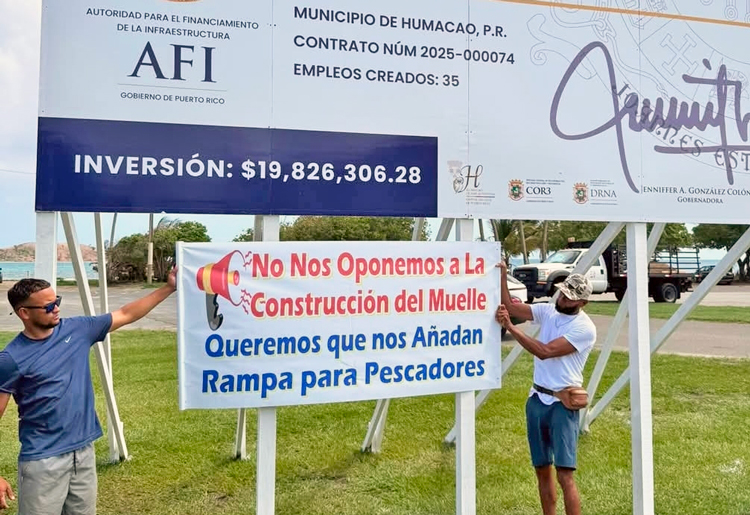
The fishermen are angry that $20 million was approved for construction to replace the pier in Punta Santiago destroyed by the hurricane in 2017 — without including a boat ramp.
“The pier would be good for tourism and the community,” said fisherman Vidal Silva, 62. “But why can’t their plans include a ramp?”
The fishermen said they also face harassment from officers of Puerto Rico’s Department of Natural and Environmental Resources. When he was moving his boat, “one of them told me that my truck was polluting the beach and water,” Luis said.
The new pier is being built mostly with funds from the U.S. Federal Emergency Management Agency. The Puerto Rican government is required to contribute 10%.
But the U.S.-government imposed Fiscal Oversight and Responsibility Board — known by Puerto Ricans as the Junta — has veto power over any expenditure greater than $10 million. The fishermen at first didn’t think the Junta would have a say if the colonial government decided to allocate the funds, but when Rodríguez looked up the regulations as we were talking, she said it seemed the Junta would have final say if it ever reached that point.
Even though most Puerto Ricans are proud of their culture and history, many don’t support independence, fearing the economic consequences.
“If Puerto Rico becomes independent, I’ll take the first plane to the United States,” said López, as discussion turned to the broad economic and social crisis facing working people in Puerto Rico and the U.S. today.
He also reacted strongly when something in the Militant defending the Cuban Revolution caught his eye. “Do you think it’s right people are starving in Cuba, have no electricity, no water, no food, no freedom?” he demanded. “I want the U.S. army to invade Cuba.”
None of the other Puerto Ricans in the group jumped in behind López. To the contrary, they helped bring the discussion back to the conditions they face and the meeting ended on a positive note.
The fishermen are hoping they will get an affirmative answer soon, said López. “Otherwise we may have to organize another protest.”
Róger Calero contributed to this article.