MONTREAL — The Canadian Union of Public Employees “will advocate defiance of any use of Section 107 of the Canada Labour Code to break strikes and supports any union that decides to defy strikebreaking laws,” Mark Hancock, the union’s national president, said at an online program organized by the Canadian Labour Congress Oct. 13. It launched a campaign to defend the right to strike from new attacks by Prime Minister Mark Carney’s government.
Officials from many of Canada’s major unions and some 7,600 unionists and others participated in the phone-in.
“When Ontario Premier Doug Ford tried to take away the right to strike of Ontario education workers” in 2022, Hancock said, “they defied the law with the backing of the whole labor movement. [Ford] folded and had to withdraw the legislation.
“Then Carney tried to do the same thing to the Air Canada flight attendants” in August 2025.
Flight attendants fought the government’s move “with the support of the labor movement and forced Air Canada to accept a groundbreaking contract.” For the first time, workers won the right to be paid for some of the hours they work when loading and unloading passengers. Their victory opened the road to WestJet flight attendants winning a similar contract when they went on strike this August.
Since 2023, Ottawa has used Section 107 — which covers 1.1 million workers under federal jurisdiction — 10 times, ordering postal, rail, port and airline workers back to work.
Bill C-39 targets right to strike
The Liberal Party Carney government is now pushing Parliament to pass Bill C-39. It would give a federal labor minister the power to unilaterally force an end to a strike or lockout and impose binding arbitration if the government declares the action significantly affects the Canadian capitalist economy or causes major disruption.
Carney appealed to Canadian nationalism to try to justify the new law, claiming it’s needed to strengthen Ottawa’s hand in the ongoing trade war with the U.S. rulers.
“If Bill C-39 becomes law, working conditions at Canada Post would become worse, because management would not negotiate knowing that a strike by the union would be outlawed,” Jan Simpson, president of the Canadian Union of Postal Workers, warned at the Oct. 13 meeting. Unions across Canada “have to together mobilize against Bill C-39” and prevent it from becoming law, she said.
The Canadian Labour Congress is calling on Parliament to defeat Bill C-39 and to repeal Section 107 entirely.
However, at the same time the CLC proposes Ottawa establishes an “independent panel of labour relations experts to assess whether a strike has created a genuine national economic emergency.”
This would let the government retain the power to end a strike through a vote in Parliament instead of by a decision of the Canada Industrial Relations Board. CLC President Bea Bruske claims this is needed because “Canada’s unions want a strong economy, reliable supply chains and stable labour relations. We share those goals with the business community.”
“Working people have no common goals or interests with the bosses who exploit us and are attacking our rights,” Philippe Tessier, Communist League candidate in the upcoming federal by-election in Montreal’s Rosemont — La Petite-Patrie constituency, told the Militant. Tessier is a rail worker and member of the Teamsters union.
“Giving Parliament the power to end workers strikes in the name of ‘stable labor relations’ rather than the Industrial Relations Board, changes nothing. It’s still a way for the government to attack the right to strike,” Tessier said. Parliament has passed back-to-work laws 37 times since 1950.
“The unions need to fight against giving Ottawa any power to break workers strikes, however they propose to do it,” he added.
CLC rallies across Canada
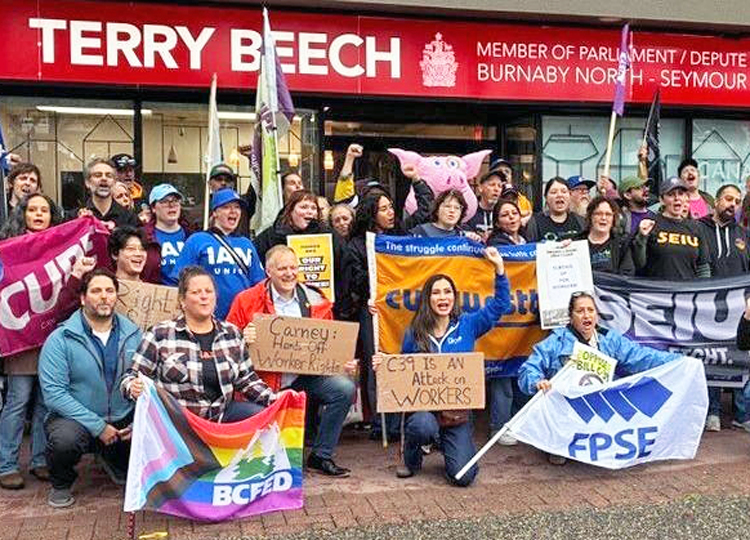
On Oct. 15 the CLC organized rallies against Bill C-39 in 21 cities across Canada, most outside the offices of local Members of Parliament.
Around 100 unionists participated in the Montreal rally at the Guy Favreau federal government building, including members of CUPE, and steel, construction and municipal workers’ unions.
“The right to strike is fundamental. Without it unions can’t fight for better wages or for our rights as workers,” Frederic, a construction electrician, who declined to use his last name, told the Militant at the action.
On Oct. 21 the Public Service Alliance of Canada announced a nationwide strike vote in November among 120,000 federal government workers. The union says the government has made an “insulting wage proposal” — an increase of less than 1% per year. It’s also demanding an end to the union’s right to negotiate job security and to allow bosses to schedule workers at unusual hours with no extra pay.
In 2023 the Public Service Alliance waged a hard fought 12-day strike for wage increases to match inflation.