

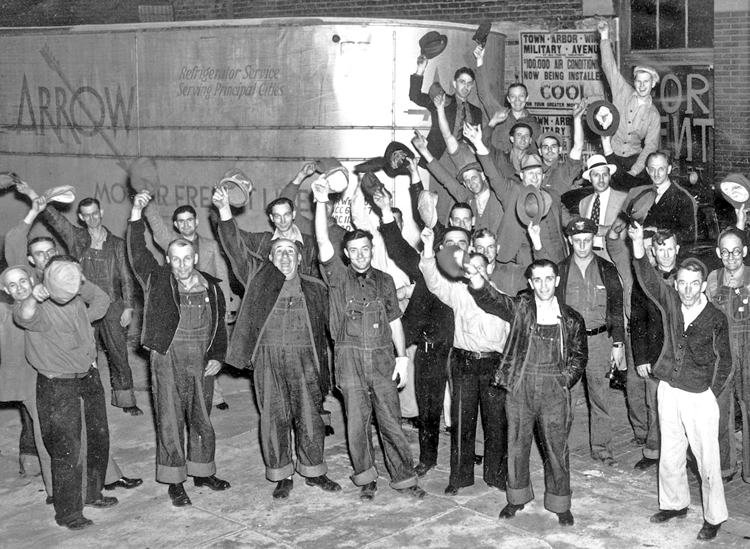
Teamster Power by Farrell Dobbs is one of Pathfinder’s Books of the Month for September. Dobbs tells the story of how members of Teamsters Local 574 in Minneapolis wielded the union power they forged through three victorious 1934 strikes. With class-struggle leadership, the Teamsters extended their union throughout the Midwest, helped organize other unions and the unemployed and advance independent working-class political action. The book is the second of four volumes by Dobbs, a central strike leader who emerged from the ranks to become organizer of the Teamsters’ campaign that unionized a quarter of a million over-the-road truckers. He served as national secretary of the Socialist Workers Party from 1953 to 1972. The excerpt is from the chapter, “A transformed International.” Copyright © 2008 by Pathfinder Press. Reprinted by permission.
I would be assigned the special task of supervising over-the-road organizing in the central states. Agreement was also reached that I should set up my headquarters in Omaha, so as to help the relatively new local unions in that region and to let the bosses know that they would be kept under surveillance. …
Numerous contract violations had been occurring in that region. The operators involved seemed to bank on the union losing the fight in the west, which would have weakened our position. Even if we won, they had come to expect that the agreement would not be tightly enforced. That assumption had arisen due to laxness exhibited by local union officials at a few terminals. … The time had now come, however, for these bosses to learn that they were gravely mistaken. …
[W]e put forward a class-struggle outlook. [Dave] Beck [of Seattle] adhered to the class-collaborationist norms of business unionism. We advocated the industrial form of organization; Beck was essentially a craft unionist. We defended and sought to advance trade union democracy; Beck used bureaucratic methods, ruling those he led with an iron hand.
There was yet another difference, related directly to over-the-road contract policy. We bargained on an area-wide basis to establish uniform wages and conditions for all the workers involved. Beck allowed considerable variation in contract terms, according to each operator’s so-called “ability to pay.”
Despite these conflicting outlooks, we were able to establish practical cooperation in organizing and strike activities. …
So great had the union power become that all this was accomplished without having to take major strike action. Nothing more was required than a few minor skirmishes with random bosses.
An instructive balance sheet could now be drawn.
With Trotskyist militants playing a key leadership role, the policies needed to build a potent International had been demonstrated in living terms. The necessary course had first been put into practice during the 1934 Minneapolis strikes. A means of projecting effective union-building measures onto a larger arena had then been exemplified through the North Central District Drivers Council, as it was initially conceived. Its successes proved the value of broad union cooperation developed with unfettered aims and limitless forms of action.
Examples had also been provided of ways to overcome obstacles created by the [Daniel] Tobin machine. The IBT head had been defeated in his attempt to read the Minneapolis Teamster militants out of the union movement. After that his objections to the NCDDC were sufficiently overcome to enable us to launch the over-the-road campaign.
Still another gain was made later through our perception of changing reality, combined with use of flexible tactics and the ability to maintain the necessary patience. Tobin himself was drawn into support of the eleven-state project.
The latter development had significant effects. Former IBT concepts of maintaining a loose federation of insular baronies were definitively fractured. As a corollary, the old-line craft structure began to crack wide open. The movement was no longer rooted primarily among relatively privileged driving crafts in exclusive sections of the industry. It was beginning to embrace workers in a much broader range of occupations. A modified social composition resulted that implied new class-struggle potential.
Advances in organizational structure were also occurring. New patterns had been set for broader, more sophisticated methods of area-wide cooperation between local unions in pursuit of uniform goals. New examples of leadership guidance had been introduced in shaping the necessary strategy, tactics, and functional norms to achieve union objectives.
In the course of their struggles the workers had acquired increased awareness of their strength as a class. They had grasped the importance of bringing their collective weight to bear against the bosses on the necessary scale. And they had come more and more to identify themselves with militant union policies.
Full use of the Teamster power along the foregoing lines had brought the workers victory in the over-the-road conflict. The dramatic gains registered in that struggle had, in turn, inspired truck drivers generally. As a result the way had been opened for unprecedented union growth in all quarters of the industry.
In fact, new members were already pouring into the International Brotherhood of Teamsters at an accelerated rate. In both 1938 and 1939 it reported the biggest recruitment gains of any national organization in the AFL. By the fall of 1939 this added up to a total membership nearing 500,000, which represented quite a jump for the International from the 1933 figure of about 80,000. The IBT was well on the way to attaining its later standing as the largest single union in the country.