One of Pathfinder’s Books of the Month for September is the Spanish edition of Women in Cuba: The Making of a Revolution Within the Revolution. It is by three leaders of the Federation of Cuban Women, Vilma Espín, Asela de los Santos and Yolanda Ferrer. It tells the story of how Cuban women — workers, peasants, housewives and youth — demanded to be part of the unfolding socialist revolution and how doing so transformed their lives and Cuba’s history. This extract is from the introduction by Mary-Alice Waters, a leader of the Socialist Workers Party and president of Pathfinder Press, who edited the book. Copyright © 2012 by Pathfinder Press. Reprinted by permission.
We had “no preconceived structure or agenda,” Vilma Espín says here. There was “just a desire by women … to participate in a revolutionary process, whose aim was to transform the lives of those who had been exploited and discriminated against and create a better society for all.” And the leadership of the revolution responded.
Espín was a legendary combatant of the July 26 Movement in the Santiago de Cuba underground and the Rebel Army’s Second Front during the revolutionary war and mass popular struggle of the 1950s that brought down the bloody military dictatorship of Fulgencio Batista. Following the January 1, 1959, victory, she became the central leader of the ongoing revolutionary activity that gave birth to the Federation of Cuban Women (FMC), serving as its president until her death in 2007. …
Addressing a leadership meeting of the Federation of Cuban Women in December 1966, Cuban prime minister Fidel Castro called attention to the antiwoman prejudices that prevailed in prerevolutionary Cuba, as throughout class societies the world over. “Prejudices that have existed, not just for decades or centuries,” Castro said, “but for millennia.” …
Under capitalism, he went on, the big majority of women are “doubly exploited or doubly humiliated.” …
There are two sectors in this country, two components of society that, aside from economic reasons, have had other motives for sympathizing with and feeling enthusiasm for the revolution: the black population of Cuba and the country’s women.
The political clarity and decisive leadership given the fight for women’s equality by Fidel Castro, the central leader of the Cuban Revolution for more than half a century, is one of the truest measures of the working-class character of that revolution and the caliber of its leadership. It has been so from the earliest days of the fight against the Batista dictatorship. That same clarity and decisiveness has been a guarantee of the revolutionary alliance of workers and farmers in Cuba over those decades.
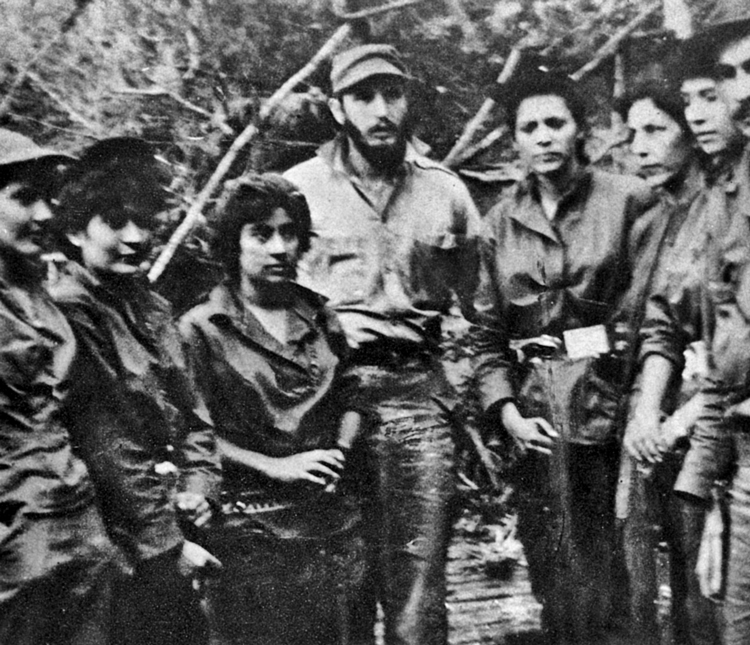
At every point in the struggle, women were part of the vanguard and its leadership. Women such as Haydée Santamaría and Melba Hernández, who joined the assault on the Moncada military garrison in Santiago de Cuba on July 26, 1953. Women like Celia Sánchez, the principal organizer of the July 26 Movement in Manzanillo, the first woman to join the Rebel Army as a combatant, and a member of its general staff. Women like Vilma Espín, whose story you will read in the pages to follow.
The Cuban Revolution is distinguished from all previous revolutions in the history of the modern working-class movement, among other things, by the number of women who were central to its day-to-day leadership.
Moreover, the speed of women’s economic and social advances in the thirty years between 1960 and 1990 — advances measured by education, employment, infant and maternal mortality rates, and other gauges — allowed Cuban women to conquer a degree of equality that it took women in the United States and other industrialized capitalist countries more than a century and a half to achieve.
But none of this was inevitable.
“One of the ways our revolution will be judged in coming years,” Fidel Castro told the Second Congress of the FMC in 1974, “is how we have resolved the problems facing women in our society and our country.”
Without the clear course charted by Fidel as well as other central leaders — including Abel Santamaría, Frank País, and Raúl Castro, all of whom readers come to know better in the pages of this book — the record of Cuba’s revolutionary struggle would have been far less exemplary. …
The political determination of Fidel Castro to challenge the antiwoman prejudices held by some who were among the best cadres of the movement was demonstrated by the fight he waged in 1958 to organize the Mariana Grajales Women’s Platoon of the Rebel Army — something Espín points to as “an extraordinary moment in the history of women’s participation in the revolution.”
“Some of our comrades were still very machista,” Fidel [said]. …
Some of the men asked “How can you give those rifles to those women when we are unarmed?”
That reaction really made me mad. So I told one of them: “I’ll tell you why we’re going to give those rifles to those women: because they’re better soldiers than you.” I didn’t say another word. …
“What was our objective?” Fidel asked.
First, we believed in women’s capacity, women’s courage, their capacity to fight; and second, we knew that such a precedent would have enormous importance in the future, when the moment came to raise the question of equality in our society.