Moscow’s murderous war on the Ukrainian people has deliberately targeted working people in urban and rural areas, killing thousands. Members of Ukraine’s trade unions make up a significant part of the volunteer military forces on the front lines. At the same time, they’re keeping industry running to produce the resources and infrastructure Ukraine needs to defend itself.
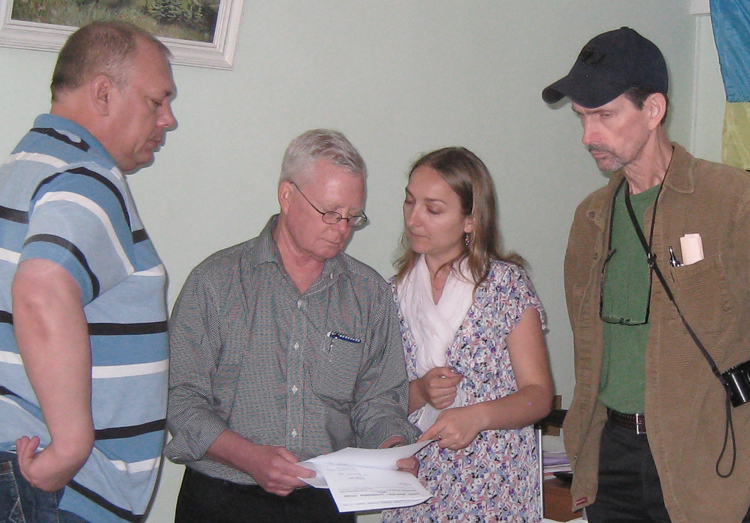
Andriy Khyzhniy, head of a rail section of the Trade Union of Railway and Transport Construction Workers of Ukraine (TURU), and Kateryna Izmailova, chair of TURU’s Youth Council, described this in a June interview by Sacha Ismail and Chris Ford from the Ukraine Solidarity Campaign in the U.K.
The group also reported on remarks made by Vyascheslav Grigorievich Fedorenko, a section president in the Free Trade Union of Railway Workers of Ukraine at the Kryvyi Rih depot, delivered at a labor conference in Kyiv the same month.
They talked about what rail union members are carrying out under war conditions and, at the same time, the challenges posed by anti-union measures being pursued by Ukraine’s capitalist government.
“The area my trade union organization covers is near the front line. It includes two big railway hubs that are under Russian occupation,” said Khyzhniy. His union section has lost “thousands of members. That includes many who still work on the railway, but have been forced to migrate to other regions, and are now in other sections of the union.”
“The role Ukraine’s railways have played since the full-scale invasion is huge,” he said. Rail workers evacuate people “from front-line regions, and in very harsh conditions,” doubling the number of passengers normally carried. They transport military equipment, soldiers, “and even prisoners of war for exchange.” The work of the railways is closely integrated with Ukraine’s military mobilization.
“That is only possible because workers are very committed to protecting their country, and so ready to take on such a massive workload.”
He said they have to pay close attention to safety questions “to check for threats of attacks, for damage to systems and equipment, for mines, for signs of sabotage and terrorist activity.” He pointed out that in “parts of Ukraine nurseries and schools are closed, and so workers have to bring their children to work with them.”
“It isn’t possible to leave their workstation to go to the shelters” when Russian attacks rain down, Fedorenko said at the Kyiv conference. “The bombs and drones prevent workers from sleeping at night.”
“Most locomotives date from the 1950s and present safety risks for railway workers, users and the general public,” he said.
Fedorenko said some 10% of rail workers are on the front lines and that the unions work hard to provide them with needed supplies, like “medicines, bulletproof vests and binoculars.”
Up to late June, 23 rail workers had been killed at work and 600 had died on the front or in bombardment of Ukraine’s cities, Fedorenko said. But the rail bosses “refuse to pay the compensation linked to deaths, passing the responsibility onto the deceased workers!”
Bosses use war to attack unions
The Ukrainian government is taking advantage of the war by “taking measures that adversely affect our terms and conditions,” Khyzhniy said in the interview. For example, Kyiv has tossed aside the 40-hour workweek workers won and imposed a 60-hour workweek. And under the government’s war measures, strikes and protests are considered illegal.
Khyzhniy said that support from trade unions in other countries has been “invaluable.” Rail workers have received food, medicine, emergency supplies and protective equipment.
“Since the start of 2025, there have been over 20,000 missile and drone strikes” by Moscow, he said. “It shows that Putin is not currently interested in peace. Railway workers need peace, but we reject the interpretation of ‘peace’ that would see the occupation of Ukraine, depriving us of our national independence.
“Appeasement of the dictator who is the aggressor means the preparation of future wars, including against other countries in Europe,” he said.