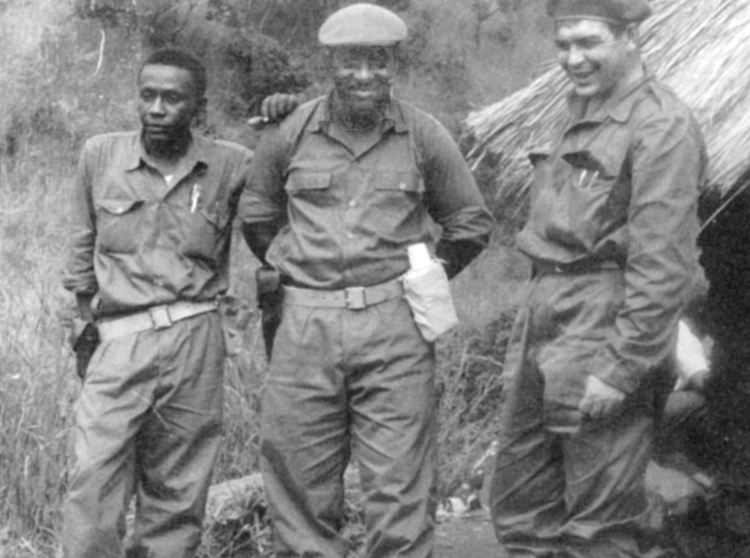
From the Escambray to the Congo: In the Whirlwind of the Cuban Revolution by Víctor Dreke is one of Pathfinder’s Books of the Month for September. Since the 1950s Dreke has been a leading participant in Cuba’s revolutionary movement — beginning as a high school activist; as a fighter in the battles to defeat U.S.-backed dictator Fulgencio Batista; and as an internationalist combatant with Che Guevara in the Congo, and in Guinea-Bissau. He gives a firsthand account of the early years of the Cuban Revolution, when the actions of thousands of men and women changed the course of history and themselves. This excerpt is from the introduction by Mary-Alice Waters, a leader of the Socialist Workers Party and president of Pathfinder Press. Copyright © 2002 by Pathfinder Press. Reprinted by permission.
“When I was young, my father used to tell me, ‘Don’t get involved in anything,’” Víctor Dreke recalls.
“My father wasn’t for Batista, he was against Batista. But he didn’t believe in anyone. ‘Don’t join anything,’ he’d say. ‘Things will always stay the same. One side wins now, the other side wins later, and the ones with money will always be in power. Study and get an education and don’t mess with strikes or any of that. It won’t get you anywhere. Besides, that stuff’s not for blacks.’
“That was my father’s way of looking at things. And I think this was how many blacks in Cuba looked at things. Until the victory of the revolution.
“Fortunately, I didn’t listen.” …
Rebel-minded young people the world over will find it easy to identify with Víctor Dreke and the way he responded to conditions around him. He tells how he and thousands of men and women like him — workers, farmers, students, shopkeepers and street vendors, most still in their teens and early twenties — simply began fighting for a more just world following the March 10, 1952, military coup that installed the U.S.-backed dictatorship of Fulgencio Batista.
Batista’s regime quickly became one of the most brutal tyrannies Latin America had yet seen. “We were ready to die” to bring down Batista, Dreke says, “but we didn’t know the first thing about revolution.”
In his account of how easy it became after the 1959 victory of the Cuban Revolution to “take down the rope” that for decades had segregated blacks from whites at dances in the town squares, yet how enormous was the battle to transform the social relations underlying this and all the other “ropes” — inherited from colonialism, capitalism, and Yankee domination — Dreke captures the historical challenge of our epoch. At the heart of this book lies the willingness, determination, and creative joy with which Cuba’s working people have defended their revolutionary course since 1959 when confronted by the imperialist empire to the north, a power whose vital interests the world over are threatened by the outreaching dynamic and ongoing example of the new class order in Cuba
As the Batista dictatorship crumbled on January 1, 1959, in face of a rising tide of mass popular resistance and the military advances of the small Rebel Army commanded by Fidel Castro, the U.S. government accelerated efforts to defend the property and privileges of Cuba’s ruling class along with the vast landed estates and industrial monopolies held by American corporations and wealthy families. To Washington’s amazement, the young revolutionary government could neither be intimidated nor bought off. Every act of Yankee aggression was met by growing millions of determined toilers of city and countryside who swelled the ranks of the revolution and pushed it forward, transforming themselves in the process.
The first free territory of the Americas was born.
Decades later, Washington can still neither forgive nor forget. It continues to turn every effort to destroy the living example of Cuba’s workers and farmers. It looks for every opportunity to punish them for the audacity of having thrown off the imperialist boot and making a socialist revolution on Washington’s doorstep. For the audacity of neither bowing to the empire nor accepting its rules and definitions.
On July 26, 1953, when 160 mostly young, determined opponents of the Batista dictatorship simultaneously attacked the Moncada garrison in Santiago de Cuba and the Carlos Manuel de Céspedes garrison in nearby Bayamo, they were, like Víctor Dreke, still far from being the conscious communists they became in the course of struggles to come. “We learned Marxism from books, but above all we learned it from life,” Cuban President Fidel Castro said twelve years later at a mass rally in Santa Clara.
What were we on July 26? he asked. “Among the books they seized from us after the attack on the Moncada barracks were books of Martí and Lenin,” Castro noted, but he and his compañeros were not Marxists or Leninists. “We still had much to learn, much to understand. We understood some of the essential principles of Marxism, the reality of class society divided into exploited and exploiters. We understood the role of the masses in history. But we had not yet deepened our consciousness and our revolutionary education enough to understand, in all its profundity and magnitude, the phenomenon of imperialism. … That we learned about in our own flesh.”
Through Dreke’s eyes and experiences we see the history shaping class battles unfold. Following the lines of his story, we come to understand how millions like him were transformed from inexperienced if unflinchingly courageous revolutionary youth into seasoned proletarian leaders of a people who have proven themselves capable of defying the demands and multifaceted aggressions of the Yankee rulers for nearly half a century.
And we see both the shape and the scope of the revolutionary class battles still to come across the Americas and around the globe.