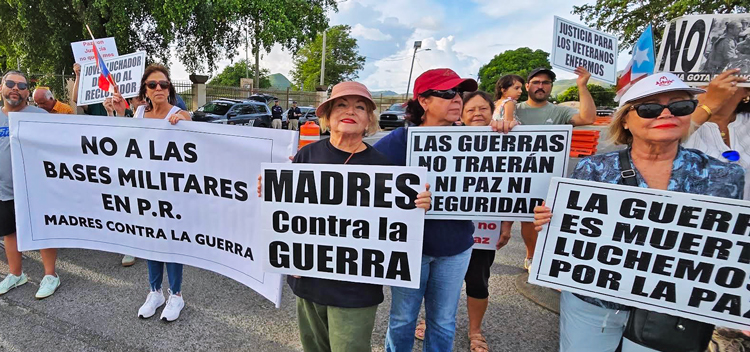
As part of its broader military buildup across Latin America and the Caribbean, Washington has rapidly expanded U.S. aerial and naval operations in Puerto Rico, provoking widespread concern and indignation among working people there. Many oppose the U.S. rulers once again using their colony of Puerto Rico as a base for military aggression against sister nations in the region.
“We categorically condemn the continued illegal military buildup, aggression and military presence in the archipelago of Puerto Rico,” the Frente Independentista Boricua (Boricua Independence Front), a group in New York, said in a recent statement. As well as military escalation “with the intent of regime change and exploitation of Latin American natural resources.”
Since August, the U.S. Marines and naval forces have carried out amphibious landing exercises. They are transporting and installing equipment at the recently reactivated Roosevelt Roads Naval Station in Ceiba. The Pentagon has moved helicopters, fighter jets, surveillance and transport aircraft, as well as drones, to military and civilian airports across the island.
Residents and authorities in the town of Aguadilla told the press they see U.S. MQ-9 Reaper drones taking off day and night, some armed with Hellfire missiles. They are used for surveillance and strikes alongside naval and fighter jets obliterating boats and people the Donald Trump administration claims are carrying drugs.
“Let it not be said that there is one Puerto Rican who is complicit in invading a sister Latin American nation,” said Sonia Santiago of Mothers Against War. The group has been holding demonstrations at Camp Santiago in Salinas, where U.S. Marines are training. Their next action is planned for Dec. 13 at 4 p.m. at the entrance to the Roosevelt Roads Naval Station.
U.S. aims to renew use of Vieques
Residents of Vieques, a small island 7 miles off the mainland, are particularly outraged the Pentagon is considering renewed use of the shuttered U.S. Navy bombing range there. Washington was forced to close the base in 2003 under pressure of broadly supported mass protests. U.S. officials also said they plan to dispose of unexploded ordnance from the live munitions used during the current drills in Salinas.
“From the Navy you could expect anything,” Ismael Guadalupe told Telemundo reporter Glorinel Soto. Guadalupe was a leader of the movement that forced the U.S. Navy out of Vieques.
For more than 60 years, the Navy used big parts of La Isla Nena, as Puerto Ricans call Vieques, for bombing practice and storage of ammunition. There is still hundreds of thousands of unexploded ordnance spread around the area.
“All they left was illnesses,” Luis Ortíz, a local fisherman, told Telemundo, referring to the high cancer rates and other health problems plaguing Vieques residents from exposure to depleted uranium and a host of toxic heavy metals leaching poisons into coastal areas and waters. Residents and fishermen have demanded the U.S. decontaminate the area and return all these lands into Puerto Rican hands.
Residents and their supporters have vowed to oppose the use of their island for military purposes again, threatening the lives and livelihoods of the Puerto Rican people.