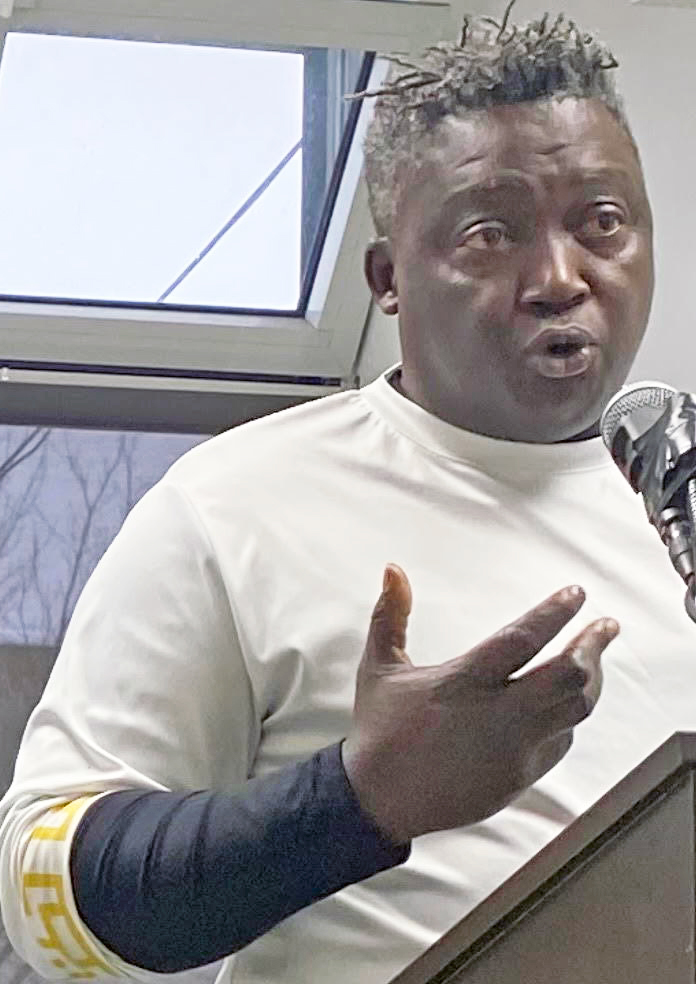
MONTREAL — A well-attended Militant Labor Forum here Nov. 30 focused on Cuba’s historic role in the yearslong struggle that brought down the hated apartheid regime in South Africa. The panelists were Mayuka Abdullai, a cleaner at Montreal airport, originally from Ghana; Fatimata Ouattara, a physiotherapist originally from Burkina Faso; and Philippe Tessier, a rail worker and Teamsters union member, speaking for the Communist League.
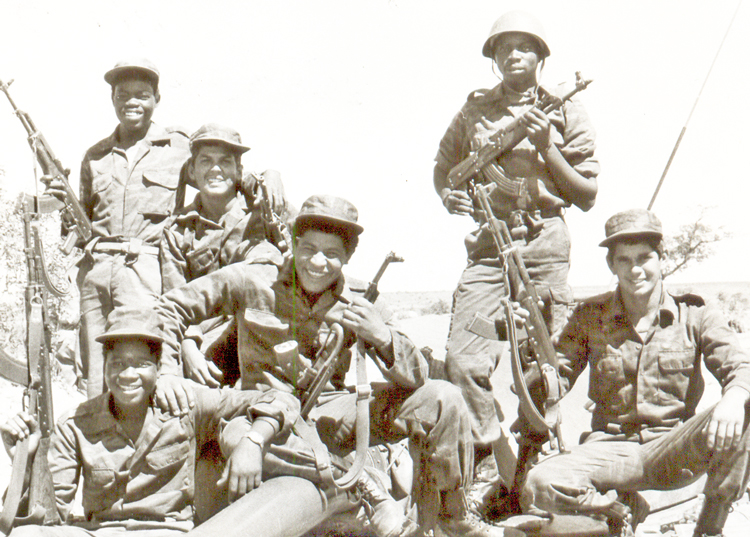
The meeting marked the 50th anniversary of Operation Carlota, when the revolutionary Cuban government organized to send what became 425,000 volunteers. They served in Angola from 1975 to 1991 in the historic battle against repeated invasions by the white supremacist regime in South Africa.
The struggle culminated in 1988 when Cuban and Angolan forces decisively defeated the South African army at Cuito Cuanavale. “Following this defeat,” Tessier told the 36 people at the meeting, “Pretoria was forced to sit down at the negotiating table, abandon its invasion and grant independence to Namibia. Less than two years later Nelson Mandela won his freedom after 27 years in prison.”
Mandela went to Cuba in 1991 to thank the Cubans for their contribution. “The Cuban internationalists have made a contribution to African independence, freedom, and justice, unparalleled for its principled and selfless character,” he said.
Abdullai spoke about the scope and importance of Cuba’s internationalist solidarity throughout Africa. “Cuba has been in most African countries. They help and leave without taking anything from us. They don’t care about our gold or diamonds,” he said. “So many doctors came from Cuba when we were facing malaria and other sicknesses.”
He said he learned about the Militant when supporters of the weekly working-class newspaper knocked on his door. He thanked the paper for its coverage of the struggles of working people around the world.
Ouattara explained that it is impossible to understand Thomas Sankara, the leader of the 1983-87 revolution in Burkina Faso, without also talking about Cuba, a decisive ally there and in many other African struggles.
Sankara and Burkinabe revolution
“Burkinabe foreign policy under Sankara” — standing side-by-side with Cuba — “was part of the international struggle against oppression, in particular against apartheid,” she said.
Ouattara described how under Sankara’s leadership special attention was taken to educate the Burkinabe people about apartheid in South Africa. For example, video presentations on the struggle there were presented all over the country, including in the smallest villages.
“The Canadian government opposed the Cuban internationalist mission,” Tessier said. “A few months after the beginning of the 1975 war in Angola, Pierre Trudeau’s Liberal government moved to prevent Cuban planes from using the Gander airport in Newfoundland to refuel on the way to Angola and put additional pressure on the Cuban government to stop its support.” For over a decade Ottawa suspended all financial aid to Cuba.
Sankara was assassinated by counterrevolutionaries in 1987, Ouattara said, and “all his works were destroyed, wiped out or deformed. But since 2022, the popular progressive revolution under the leadership of Captain Ibrahim Traoré has again given to our people a part of its dignity. For the first time in a long time, a national policy is in continuity with the work of Sankara.”
In the discussion, Tessier expressed a different view of the military regime that seized power in Burkina Faso. “Traoré leads the ruling army’s efforts to stabilize capitalist rule,” he said. “While Sankara was for utilizing the French language, imposed on them by French imperialism, to make connections with the rest of the world, Traoré is opposed. Traoré is for the jailing of people who are gay. There is not the same continuity.”
Steve Penner, from the Communist League, spoke in the discussion. “Like other great revolutionary and communist leaders, such as V.I. Lenin and Leon Trotsky, who led the Russian Revolution in 1917, and Fidel Castro and Che Guevara, who led the 1959 Cuban Revolution, Sankara understood there is no other way to overcome the exploitation and oppression we face other than through the organization, mobilization and education of working people. There is no leader anywhere in Africa today with that perspective.”
Soulèye Ndiaye, originally from Senegal, said he thought the panelists had done a remarkable job in explaining what is happening in Africa and the rest of the world, and he wants to know more. He subscribed to the Militant and got Thomas Sankara Speaks and Malcolm X, Black Liberation, and the Road to Workers Power, both in French.
Idrissa Diallo from Guinea said, “We see Cuba as an African country because of its support for our struggles.”
Tessier wrapped up the meeting, saying, “Yesterday many of us here participated in the massive labor-sponsored march against the attacks the Quebec government is waging against the unions, doctors and immigrants.
“Struggles such as this, like Cuba’s revolution and its inspiring mission in Angola, show that with a proletarian leadership workers and farmers have the capacity to unite and fight against the world capitalist system. To organize a mass struggle to take political power to end racism and all other forms of oppression and stop the march of imperialism toward war, that’s what the Communist League seeks to join in doing.”