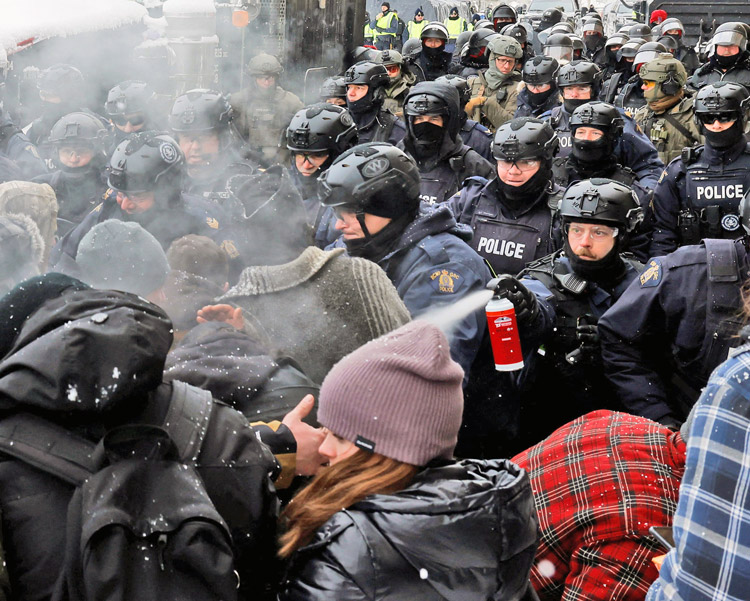
MONTREAL — In an important and hard-fought victory for working people and defenders of political rights, Canada’s Federal Court of Appeal ruled Jan. 16 that the Liberal government of Prime Minister Justin Trudeau’s use of the draconian Emergencies Act to deploy 3,000 heavily armed police to crush the trucker-led Freedom Convoy in 2022 was illegal.
Hundreds of truckers, their families and supporters from across the country had set up camp, many with their big rigs, for three weeks in downtown Ottawa, Canada’s capital. They were peacefully protesting job-threatening COVID mandates and other anti-democratic moves by the government.
The panel of three judges concluded unanimously that a federal court was correct two years ago in ruling the government’s use of the Emergencies Act violated the Charter of Rights and Freedoms, freedom of expression and protection against unreasonable search or seizure.
It also upheld the ruling that the blockades may have been “disruptive,” but “they fell well short of a threat to national security,” as the government fraudulently claimed.
Trudeau had cited a “threat to the national security of Canada” to invoke the act, giving the government extraordinary powers, including to prohibit citizens from assembling in public and to freeze the bank accounts of a number of Freedom Convoy participants.
Current Liberal Prime Minister Mark Carney had joined Trudeau in denouncing the truckers before the Emergencies Act was invoked, telling the Globe and Mail that the Freedom Convoy was “seditious” and calling on Ottawa to take police action to end it.
Police arrested hundreds of the truckers and their supporters, with many, including central leaders of the convoy, charged with the crime of “mischief,” which can carry a sentence of up to 10 years in prison. It was the biggest act of police repression in modern Canadian history.
Convoy leaders trucker Chris Barber and Tamara Lich, who were targeted by Ottawa for their leadership roles, were convicted of “mischief” and sentenced to a year or more of house arrest, followed by months of 10 p.m. to 5 a.m. stay-at-home curfews. The charges were based entirely on what they had said on social media and in emails, that is for their words and ideas, not anything they did. Lich and Barber are appealing both their convictions and sentences.
Hanging over Barber’s head throughout the trial has been the prosecution’s stated intention to seize his tractor-trailer, claiming it was “offense related property.” This was quashed by an Ontario judge Dec. 19.
After the government invoked the Emergencies Act, the 180,000-member Ontario Public Service Employees Union spoke out, explaining such laws are a threat to working people and their unions. “Historically, the labor movement has often been the target of legislation aimed at suppressing anti-government dissent, including times when workers have demanded better living conditions through strike actions.”
“The Federal Court of Appeal has delivered a historic victory for the rule of law,” the Canadian Civil Liberties Association said in a Jan. 16 media release after the court decision.
Ottawa has until mid-March to appeal the court’s ruling to the Supreme Court.
The fight continues
Since its attack on the truckers, Ottawa has introduced a series of proposed laws attacking a wide range of democratic freedoms, including an Online Harms Act and “hate speech” criminal code amendments. These laws have been widely condemned by civil libertarian organizations as attacks on the right to free speech and association.
“These court victories reflect the broad opposition among working people to Ottawa’s use of the Emergencies Act against the truckers,” Joe Young, the Communist League candidate in next October’s Quebec provincial election, told the Militant. “After the assault on the truckers, the government has moved to block the right to strike of rail, port, postal and airline workers.
“Canada’s capitalist rulers are driving to restrict the political space we need to organize, fight back and chart a course through our unions to defend working people on a line of march toward replacing capitalist rule with a workers government.
“Defending Tamara Lich and Chris Barber, fighting for the repeal of the Emergencies Act, and opposing Ottawa’s new attacks on democratic freedoms are important steps along this line of march,” Young said.