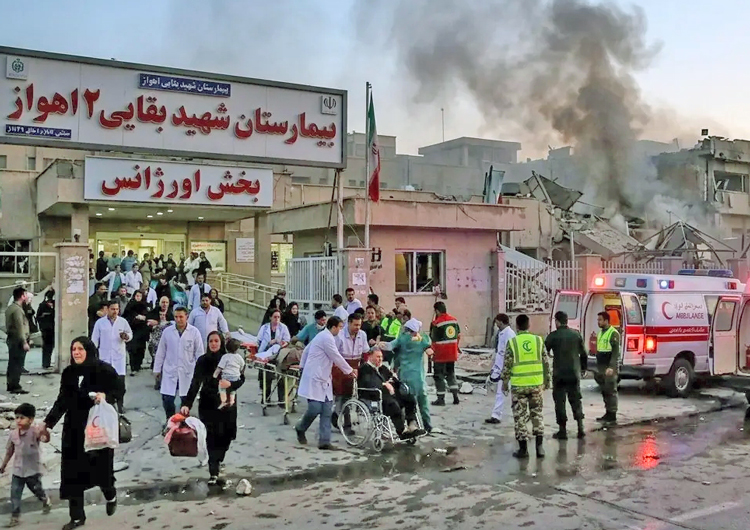
Washington’s war on Iran, along with deepening assaults on living standards and repression at the hands of the reactionary capitalist regime in Tehran are deepening the crisis working people face there. U.S. airstrikes not only target Tehran’s military facilities, they have also destroyed fishing boats, water desalination plants and bridges.
The Wall Street Journal tried to argue July 13 the renewed U.S. war has unleashed “a wave of nationalist fervor.” While the editors admit that “dissatisfaction with the regime still runs deep,” it claims nationalist sentiment makes “compromising with the U.S. difficult.”
But in fact, numerous articles in Iran’s own pro-government news media show opposition to the regime is deepening, as the rulers try to force working people to pay the cost of its military adventures.
“Gambling with Their Lives for 20 Million Tomans a Month: The Story of Fishermen’s Empty Tables Under Missile Fire” is the headline on a July 22 article by the government-funded Iranian Labour News Agency (ILNA).
Working people who had been “coping with chronic water shortages, electricity outages and wages below the poverty line, while keeping the country’s ports and refineries operating, were not suddenly thrust into hardship by war,” the article notes. “Their lives were already a daily struggle for survival” long before “the first missile.”
Fishermen who worked for themselves faced rising fuel costs and frequent government denials of fishing licenses. Those working for capitalist fishing companies found that bosses took two-thirds of the profit, then divided up what’s left among each of the crew members.
‘More dangerous than missiles’
A U.S. airstrike on a dock in Bandar Abbas, used by both civilians and the Iranian Navy, killed two fishermen.
When asked why they continue going out to sea, fishermen told ILNA, “Not working is more dangerous than missiles. Hunger is more dangerous. Keeping our boat at the dock is more dangerous.”
An ILNA article headlined “The Hardships of Chabahar Municipal Workers During the Missile Bombardments” July 21 notes that contract workers on the “front lines” of “clearing debris” from the destruction caused by Washington’s attacks “are not only denied even the most basic hazard pay, but continue to struggle with overdue wages, lack of job security, and interrupted insurance coverage.”
“War strikes cities and regions whose people — especially the working class — had already spent years struggling with unemployment, job insecurity, social inequality, wage suppression, and shortages of water and electricity.” It’s even worse, ILNA says, in Iran’s most “deprived regions,” including Chabahar “in the long-neglected province of Sistan-Baluchistan.”
Many of the municipal workers in Chabahar are contract workers. “We don’t have days off. We’re always on duty and on the front lines. Job security? We don’t have any — we’re tied to contractors,” said contract worker Ahmad. “All we’re asking is that they pay our overtime and benefits on time.”
Class inequality laid bare
“Officials and managers at the municipality are doing very well. They get everything,” Ahmad said. “Each of them own several houses. The people at the top have everything. But when it comes to us, they say there’s no money.”
“In Chabahar,” ILNA concludes, “class inequality is laid bare.”
ILNA leaves out one important fact. Most people in Chabahar are Baluchis. Like Kurds, Arabs and other oppressed nationalities, Baluchis face systematic discrimination from the regime and savage repression when they resist. Fearing the growing opposition to its rule, the regime has stepped up executions over the last year. This falls hardest on Baluchis, Kurds and Arabs who are disproportionately put to death.
The anger described openly in the pro-regime press is the tip of the iceberg. Retirees in at least seven cities took to the streets July 19 to demand a raise in pensions to keep up with inflation.
In Rasht the retirees also demanded an end to the death penalty and freedom for imprisoned teachers. Workers from the Chouka wood and paper plant in Pareh Sar joined that action. They’ve been fighting for back pay and the reinstatement of 25 fired workers.
That same day, workers at the Tabriz Machine Manufacturing foundry division went on strike over two months of unpaid wages. They joined a retirees’ protest in Tabriz.
In Shush retirees chanted “Inflation, high prices — no to war and destruction,” and “You who claim justice — how long will you keep lying to the people?”