(first of two articles)
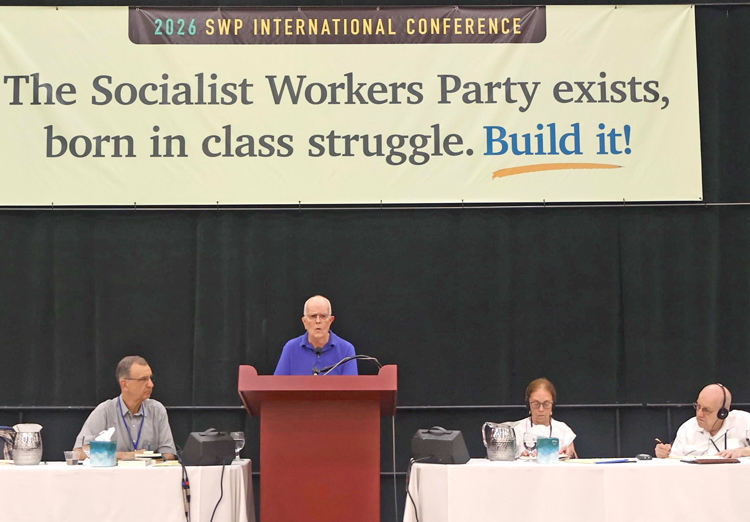
OBERLIN, Ohio — “The Socialist Workers Party exists, born in class struggle. Build it!” That was the banner displayed above the speakers platform at the party’s 2026 International Conference held here June 11-14.
The banner is bold, correct, as well as timely, said SWP National Secretary Jack Barnes in his opening political report. At best, however, no single banner can do more than affirm the revolutionary working-class character of such a party, Barnes added, not spell it out in more detail and full color
Socialist Workers
Party 2026 Conference
“That’s the job we’re here to work on together during the conference,” Barnes said. “Above all, of course, everything depends on what we keep on doing to build the party.” What we do here at the conference, he said, will build toward the party’s December constitutional convention in New York City. That’s where, incorporating experience from the U.S. and world politics between then and now, we’ll “ratify, correct and add to our political line and course” and elect the party’s National Committee.
The SWP is a Marxist party, in both program and social composition, Barnes said. We’re a party “born in class struggle,” as the banner says, along the road to the revolutionary victory of workers power. That line of march shapes our political life, milieu, organizational norms and weekly rhythm of activity.
That same political yardstick was central to the two other main conference talks: “Defending Cuba, Defending Cuba’s Socialist Revolution,” presented by Mary-Alice Waters, and “Iran, Israel and the United States in the Imperialist Epoch: Two Wars in One,” by Steve Clark. All three presentations addressed the economic and social crises and breakdowns facing the U.S. capitalist rulers today, including their mounting wars, war threats and other military clashes.
Washington is fighting to defend its dominance as the world’s weakened but far and away single strongest economic and military power, in face of sharpening rivalry among the imperialist and other major exploiting classes and nation states. They are battling among themselves to divide and redivide control over markets, access to natural resources and low-wage labor, as well as control of economically and militarily strategic global choke points.
The conference was marked by the increased resistance in the working class and labor movement to the employers’ intensifying exploitation, as well as other social and political struggles.
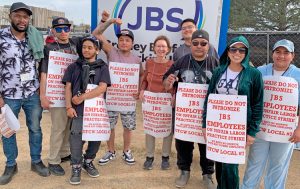
Thousands of union meatpackers of many national origins in Greeley, Colorado, had just fought and won gains in their four-week strike against JBS Foods. Labor battles by packinghouse workers, sugar warehousers, nurses, and hotel workers are spreading, as are protests by immigrant workers, their families and supporters in the unions and elsewhere. And there is a step up in actions against the U.S. government’s tightening oil blockade and other draconian assaults on Cuba’s sovereignty with the aim of crushing the single revolutionary outpost in the Americas and trying to divide the Cuban leadership.
The SWP’s international gathering drew 300 people from the U.S., as well as Australia, Canada, the U.K., France, Greece and New Zealand. There were three days of sessions attended by all conference participants, numerous classes and wide-ranging informal discussions.
The event culminated the last day with summaries by the three plenary session speakers, as well as a rally that night with talks by participants in various social and political fights centered on the work of Socialist Workers Party and Communist League candidates for public office.
These discussions were enhanced by political and photographic panel displays along one entire side of the conference hall, as well as crowded literature tables. A summer fund appeal raised more than $48,000.
Build party, not create it
Here in the United States, the bastion of world imperialism, “we don’t have to create the revolutionary party,” Barnes said. “It exists.”
Vanguard workers parties can grow with stunning speed amid deepgoing revolutionary events, he added.
In fact, that’s a feature of the epoch we’re living in, the epoch of imperialism, which is also the epoch of proletarian revolution. That has been shown in life by the two great socialist revolutions of the 20th century. The first was the Bolshevik Party-led revolution of October 1917 in Russia, under the leadership of V.I. Lenin. The second was Cuba’s socialist revolution at the beginning of the 1960s, led by Fidel Castro and the movement of workers, rural toilers and students he politically organized and guided to victory — the Rebel Army and July 26 Movement.
“But neither the SWP nor any other party can rest on the laurels of what’s been accomplished in the past,” Barnes emphasized. “We keep on building the party through our involvement in the class struggle and mass work of all kinds.”
“Our communist program is stronger than ever.”
—Jack Barnes
Socialist Workers Party election campaigns are today, as for many decades, the most important single way we organize to get out the word about the party, Barnes said. When our candidates speak out or issue a statement — against Washington’s unconscionable oil blockade of Cuba; the war of imperialist plunder in Iran; demanding amnesty for immigrant workers; against Jew-hating violence — those declarations speak not just for the party. We’re also speaking and acting on behalf of the class interests of the entire working class and exploited, as well as their solidarity and unity in action.
It’s not the party’s size right now that’s decisive, Barnes said. Size is largely determined by today’s conditions in the U.S. and world class struggle, as well as the class-collaborationist leadership of the labor movement. Those factors are largely beyond anyone’s control. As they have throughout the history of capitalism, those factors will unforeseeably but inevitably change with eruptions of working-class resistance, anti-imperialist struggles and new advances of the world socialist revolution.
The SWP today, Barnes said, is proletarian in our program, our class composition and our norms and habits of political conduct. “Our communist program is stronger than ever,” he said.
“We remain true to that party,” Barnes said. “We keep our eyes focused on the only class and class institutions through which a vanguard can organize and lead millions in a successful revolutionary struggle for workers power.”
In Defense of Marxism
An essential guide to building the party, Barnes said, are the political and organizational lessons to be studied in the book In Defense of Marxism by communist leader Leon Trotsky. On the eve of the June socialist conference, a new edition of that work, first published in 1942, had just come off the presses. From that time to today, it has been and remains a programmatic foundation of the Socialist Workers Party and our international movement.
In Defense of Marxism is the record of Trotsky’s close collaboration with the SWP leadership in 1939-40 during the last months of his life, as he led a watershed political struggle for the communist future of the international movement he had founded. At stake, in Trotsky’s words, was “nothing more or less than an attempt to reject, disqualify and overthrow the theoretical foundations, the political principles, and organizational methods of our movement.”
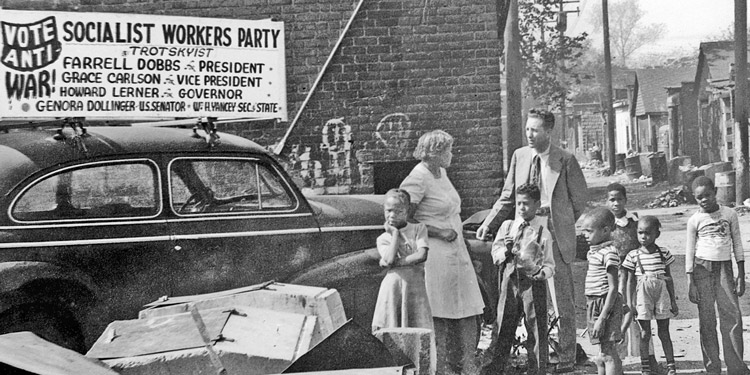
As the U.S. rulers drove to ensure their supremacy by entering the second imperialist world slaughter already raging in Europe, a minority in the party’s National Committee began to buckle under patriotic war pressures. Trotsky’s articles and letters from that fight, Barnes emphasized, serve as a fundamental programmatic and political guide for today. The new edition’s 2026 introduction is being used by the SWP in politically preparing its upcoming December 2026 convention.
Reading and discussing this 2026 edition of In Defense of Marxism, including its new introduction, dispel a common misconception about Trotsky’s place in the modern communist movement. It rebuts the false notion that whatever his reputation as a skilled writer and “theoretician,” he always came up short on matters of organization, working-class activity and discipline. This falsification is peddled, among others, by Stalinists and other middle-class radicals, in order to demean and discredit both Trotsky and the Bolshevik-forged world movement he led.
But this book shows that nothing could be further from the truth, Barnes said. From 1917 when he was won by Lenin to the Bolshevik Party, no one had internalized more deeply than Trotsky what Lenin taught and carried out in action about the inseparable interconnection of proletarian politics and proletarian organization, of word and deed.
In fact, at a crucial turning point in the 1939-40 struggle in the SWP, Trotsky pointed to the “lack of understanding of revolutionary centralism and hostility toward it” as a “typical” character trait of followers of any nonproletarian, petty-bourgeois tendency.
What’s more, Trotsky insisted, the political and programmatic questions at issue in the struggle — unconditional opposition to imperialist war, defense of the Soviet workers state, Marxism’s materialist method — could not be understood or acted on in a party “inundated by nonproletarian elements.” The task, Trotsky wrote, is “to orient” the party “toward the factories, the strikes, the unions.”
That’s the road, Trotsky said, to forging a cadre “of proletarian revolutionists capable of understanding what the party is, what loyalty to the banner means, and what revolutionary discipline signifies.”
Barnes noted that several SWP branches across the U.S. and Communist Leagues in other countries have already begun weekly membership classes to discuss In Defense of Marxism, and that it had been integrated into conference classes. Participants purchased more than 200 copies of the new edition.
Barnes also underlined the importance of the upcoming new edition of James P. Cannon’s The Struggle for a Proletarian Party, also with a 2026 introduction. Cannon, a founding leader in Lenin’s time of the communist movement in the U.S. and of the Communist International, was the SWP’s national secretary at the time of the 1939-40 dispute. The book contains the pamphlet of the same name that Cannon wrote on the eve of the April 1940 convention that voted to reject the minority’s proposed course and affirm the party’s proletarian orientation. It also contains Cannon’s letters to Trotsky and to other SWP leaders.
At the successful conclusion of that political struggle, Trotsky wrote party leader Farrell Dobbs that Cannon’s pamphlet was a much needed handbook by “a genuine workers leader. If the discussion had not produced more than this document, it would be justified.”
No one on either side of that fight, of course, questioned that Trotsky had led the fight in the SWP around both the programmatic and organizational questions at stake. But by studying Cannon’s book along with Trotsky’s, Barnes said, readers come to see how Trotsky “led the leaders of the SWP, who were among the finest organizers the communist movement has ever produced anywhere in the world.”
Even before waging that momentous battle, Barnes said, Trotsky had already consciously recognized the SWP and its tested proletarian leadership — Cannon, Dobbs, and others — as a party that could take the lead worldwide in keeping aloft the flag unfurled by Lenin more than a quarter century earlier.
A movement not a doctrine
“What are the foundations of Marxism?” Barnes asked. That needs to be understood as we build a proletarian party “capable of organizing and leading the struggle for workers power.”
Barnes focused on three central pillars.
One is overcoming the misunderstanding that communism is “a set of ideas.” That was first clarified in 1847 when the young Karl Marx and Frederick Engels were recruited to the world’s first communist party by a number of revolutionary-minded workers in Europe. Those veteran cadres asked Marx and Engels to draft a program for the new organization, the Communist League, which was founded at the end of that year.
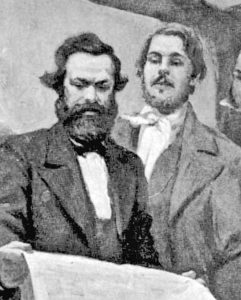
As they were working on the draft, a radical middle-class democrat named Karl Heinzen wrote several public attacks on communists, portraying them as doctrinaire sectarians who were dividing the political struggle for democratic freedoms and a republic in Germany and elsewhere in Europe.
Engels replied to these falsifications in an October 1847 article. Heinzen “imagines communism is a certain doctrine which proceeds from a definite theoretical principle … and draws further conclusions from that,” he wrote.
Heinzen “is very much mistaken,” Engels replied. “Communism is not a doctrine but a movement. It proceeds not from principles but from facts. … Communism, insofar as it is a theory, is the theoretical expression of the position of the proletariat in this [class] struggle and the theoretical summation of the conditions for the liberation of the proletariat.”
Later in 1847 Marx and Engels incorporated this cornerstone of our movement into the program that was adopted by the new organization. “That document has become well known since then as the Communist Manifesto,” Barnes added.
In short, he said, “communists never start from ideas we think we somehow ‘discovered.’ We start from facts learned from struggles by the working class here and the world over. And then we generalize and adjust those lessons over time.
“That’s how our program grows and changes.”
Transforming class relations
Only such an understanding of our Marxist program, Barnes said, is consistent with our materialist understanding of history — whether natural history or human history.
Marxists have no “blueprint” of either the class struggle in our times or of a future communist society, Barnes said. Instead, we have “a working-class program and strategy for the transformation of material reality. A program and strategy for the revolutionary transformation of the exploitative class relations in capitalist society. Through these struggles, the working class and other toilers transform our class consciousness and ourselves.
“To understand the method of Marxism, don’t start with dialectics,” Barnes advised. “Start with material reality, start with materialism.”
In that regard, Barnes urged conference participants to make more use of the book published a few years ago, Labor, Nature, and the Evolution of Humanity by Engels, Marx, George Novack and Mary-Alice Waters. It helps explain to fellow workers what the subtitle of that book calls “The Long View of History.” So do titles on the origins of women’s oppression and fight for their emancipation by Evelyn Reed, Waters, and others — books such as Cosmetics, Fashion, and the Exploitation of Women and Problems of Women’s Liberation.
That’s where working people can learn that capitalism’s dog-eat-dog system of wage exploitation and oppression is not eternal, Barnes said. And how those degrading relations among human beings can be combated through solidarity and struggle and ended once and for all.
That’s where transformation — dialectics — comes in most strongly. Where revolutionary activity and change come in.
Professional revolutionaries
A second pillar of Marxism, Barnes told conference participants, is that a revolutionary proletarian party must be what Lenin called “a party of professional revolutionaries.”
That’s “one of the most intentionally and willfully ‘misunderstood’ political contributions by Lenin,” Barnes added. “Not that there’s anything difficult about what Lenin wrote. It’s just that the bourgeois class enemies of the working-class movement and the Stalinists and other class-collaborationist misleaders both have a stake in distorting Lenin.”
One such “misunderstanding” is that Lenin thought that workers in the party need to be led by a university-educated elite of “professionals,” who volunteer in their spare time to do so. Bourgeois anti-communists love to promote this falsification, hoping to portray communists as “hypocrites.” But it’s also convenient for so-called intellectuals who fancy themselves “political leaders” of the working class.
A professional revolutionary is also not the same thing as a party member chosen to shoulder a necessary full-time staff assignment — for a leadership committee, for a newsweekly, for a publishing house, for a party election campaign, or so on. Members of a party staff are a relatively small minority of the professional revolutionaries who make up a proletarian party.
There may be no better place to start in finding out what a professional revolutionary is than a couple of sentences on party membership at the opening of the SWP constitution. Membership, the constitution says, is open to anyone “who accepts the program of the party,” “agrees to submit to its discipline and engage actively in its work” and “belong[s] to a duly constituted branch of the party.”
The SWP, Barnes said, is made up of members with different origins and backgrounds who organize our lives and energies to building a proletarian party. Our purpose — again in the words of the party constitution — is “to establish a workers and farmers government, which will abolish capitalism in the United States and join in the worldwide struggle for socialism.”
In everything we do, “this party-building effort involves revolutionary workers teaching each other and learning from each other,” Barnes said. “We take the time to train each other to be professional in all kinds of skills and working-class attitudes.
“We’re professional in how we organize and fight alongside other workers in industry and the trade unions, whether on the job or on a picket line. In how we write and produce a weekly workers paper, and how we organize together to promote it and sell it. In how we self-finance a workers party,” Barnes said.
“We’re professional in how we organize SWP election campaigns, efforts to overcome undemocratic barriers imposed by both capitalist parties to gaining ballot status, and how we present ourselves as candidates. And much, much more.”
None of this is new, Barnes repeated. It’s what Lenin explained in his 1902 book, What Is To Be Done? It’s the party’s “duty to assist every capable worker to become a professional agitator, organizer, propagandist, literature distributor, etc., etc.,” Lenin said.
The “worker revolutionary,” the Bolshevik leader insisted, must “become a professional revolutionary.”
The third pillar, Barnes said, is Lenin’s recognition that by the closing decade of the 19th century, a historic new epoch of world capitalism had opened.
Imperialism
What Lenin called the imperialist epoch had its base in a handful of powerful nation states, above all the United Kingdom, Germany, France and the United States, as well as Russia, Japan, and a number of others in Europe, North America and the Pacific.

These imperialist powers had come to dominate and divide among themselves the exploitation of the labor and natural wealth of the entire earth, Barnes said. Lenin explained this development in his 1916 work, Imperialism, the Highest Stage of Capitalism. As this small book shows, Lenin wrote, “capitalism has now singled out a handful … of exceptionally rich and powerful states which plunder the whole world simply by ‘clipping coupons.’”
And nothing fundamental has changed this exploitative world order in the subsequent 110 years. “Until the working classes and their allies in that handful of imperialist countries have won state power from those capitalist ruling classes,” Barnes said, “history and the international class struggle will be dominated by sharp rivalry among them to redivide spheres of plunder and profits among themselves — from tariff and other conflicts over markets, to bloody military adventures and world wars.”
Imperialism is not, Barnes said, “a policy preferred by finance capital, subject to bourgeois ‘reform.’ It must be overthrown in revolutionary class struggle.”
(Continued next week)