1,000s attend events in Cuba to back its nat’l sovereignty
HAVANA — Thousands of people across Cuba paid tribute to the revolution’s central leader, Fidel Castro, Aug. 13 on the 100th anniversary of his birth. Here in the capital, the centenary was marked in neighborhoods all over the city.
The main event, held at the Karl Marx Theater, was the closing session of an international symposium “Fidel: Legacy and Future.” Among those attending were historic leader Raúl Castro, President Miguel Díaz-Canel, government ministers, army generals and Communist Party leaders. The 1,500 participants in the symposium included 1,000 international participants from 63 countries. For the closing session they were joined by delegations from Cuban workplaces and mass organizations.
Speakers during the conference countered the campaign of slanders by capitalist politicians and media in the U.S. and internationally. One example was the Wall Street Journal article “Cuba throws a birthday bash for Fidel as his legacy lies in ruins.” Speaking at the opening session of the event Díaz-Canel told the conference how Cuba’s “economic collapse” referred to by the Journal resulted from over six decades of Washington’s attempts to overturn the revolution through its unbroken political and economic war.
That war has sharply intensified over recent months, with the imposition of a total oil blockade and other sanctions accompanied by a shrill propaganda campaign asserting Cuba is a threat to U.S. national security. The State Department issued a 100-page report last month, “Cuba: The Capital of 21st Century Communism,” claiming that Cuba is bent, under Fidel Castro’s lingering influence, on “conquering the neighboring United States.” It also names dozens of U.S. organizations as dangerous Cuban agents.
The Washington-led drive to suffocate Cuba has resulted in extreme shortages of running water, electricity and transportation that have fueled rampant inflation. The consequences include a doubling of the infant mortality rate.
Many speakers pointed to the fact that the Cuban Revolution is a threat to the United States — not a military threat, but the threat of its example.
Before the revolution, President Díaz-Canel reminded the conference, over half the Cuban population “lived in shacks, barracks, and slums without even the most basic living conditions, and with no access to electricity at all.” Nearly 40% of the population was illiterate. Today, Cuba enjoys one of the highest literacy rates in the world.
Program ‘flowed from real needs’
The program that Fidel Castro led through the revolutionary struggle — land reform, labor rights, an end to anti-black discrimination, women’s equality and other measures to advance the interests of workers and peasants — wasn’t “a doctrine imported from some manual,” Díaz-Canel said. It flowed from the real needs and aspirations of working people, who were mobilized and led to carry it out.
Fidel Castro belongs not just to Cuba but “to all those who fight for a better world,” he said, a sentiment repeated by many speakers.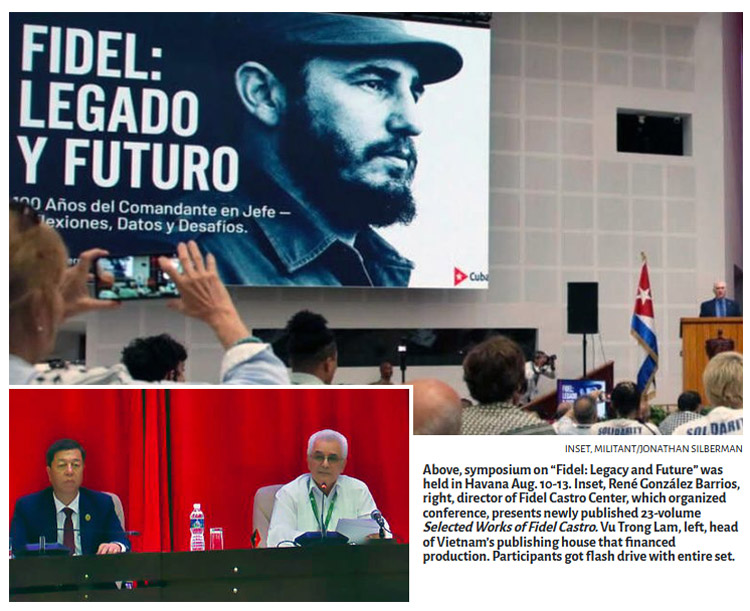
Tjitunga Elijah Ngurare, prime minister of Namibia, and Nikosazana Dlamini Zuma, former foreign minister of South Africa, spoke of Cuba’s immense contribution to liberation struggles in Africa. “I wouldn’t be standing here if it weren’t for Fidel, for Cuba,” said Dlamini Zuma. Hundreds of thousands of Cuban volunteers fought in Angola over 16 years to push back repeated invasions by the apartheid regime in South Africa, culminating in its defeat in 1988.
“Cuba didn’t go away,” she added. When one of the largest epidemics yet of Ebola was spreading in West Africa in 2014, Cuba sent doctors who turned the tide in the fight against its spread. “We owe a big debt to the Cubans. We have to act against the blockade.”
Among the international participants were many who had organized protests in their own countries against the attacks on Cuba’s sovereignty as well as other working-class struggles. Joel Cruz, a teacher from Monterrey, Mexico, reported he had raised money to bring medicines, solar panels and other aid to Cuba. Ignacio Bardesio, a carpenter and union member from Uruguay, told the Militant construction workers there had just won a reduction of the workweek from 44 to 40 hours.
Speakers at some 300 panel discussions included Osnay Miguel Colina, secretary general of the Cuban trade union federation, the CTC; Félix Duarte Ortega, president of the National Association of Small Farmers; and Federation of Cuban Women President Teresa Amarelle. Duarte described how the U.S. blockade of fuel, fertilizer, pesticides and other inputs has devastated food production and distribution.
Labor leader Colina highlighted the blows dealt to industrial and agricultural production and the efforts being made by workers to keep factories running, which is at the heart of the way out of the crisis and defending workers’ interests.
Other panels were held on education and health; “Fidel and religion”; the struggle for women’s emancipation; the “war of the entire people” advanced by Castro that is at the center of the country’s military defense; art; sports; and more. The Cuban Institute for Friendship with the Peoples held daily workshops to promote the revolution’s defense.
‘Our principles are not negotiable’
Cuba is in favor of talks with Washington, but “doesn’t negotiate our principles,” said Elier Ramírez, vice-director of the Communist Party’s ideological department. Facing threats and pressure from Washington, “we did not give up our aid to the defense of Angola,” he said, “nor our support for Puerto Rico’s independence.”
The Cuban government played an instrumental role in securing the release in 1978-79 of the five Puerto Rican nationalists who had spent a quarter century in U.S. prisons, noted Juan Camacho, one of 30 delegates who came from Puerto Rico who are active in the Cuba solidarity committee there.
At a special session, a newly published 23-volume Selected Works of Fidel Castro was presented by René González Barrios, director of the Fidel Castro Center, which organized the symposium. González Barrios was flanked by Ramírez and Vu Trong Lam, director of Vietnam’s national publishing house, which financed publication of 3,000 copies. A digital version was provided on a flash drive to all symposium participants
In his opening speech, Díaz-Canel said Fidel Castro taught that “yes, imperialism is powerful” but “history is on the side of the people. … We’re committed to resist the imperialist blockade however many years are necessary. … Cuba won’t sell out, won’t surrender, won’t go down on its knees.”
Greetings were sent to the event from Russian President Vladimir Putin and Chinese President Xi Jinping. Platform speakers included leaders of the Communist parties of Spain, Portugal, Chile, Turkey, Vietnam and Laos.
International Book Fair
The 34th Havana International Book Fair, originally scheduled for February, had been postponed by the impact of Washington’s economic war. A scaled-down fair was organized to coincide with the symposium, and the two events intertwined in book presentations at venues across the city.
“Holding this fair, amidst the conditions the island is experiencing, is a clear demonstration of the country’s unwavering commitment to culture,” said Juan Rodríguez, president of the Cuban Book Institute.
Making it more accessible to people in the capital, the fair was held at the recently established “Cultural Station” in central Havana, and at the Fidel Castro Center itself. Stands included Cuban national and regional publishing houses responsible for 1,400 new titles. Due to shortages of paper and ink, a big majority of new titles have been published as e-books.
The book fair honored writer Marilyn Bobes and historian José Bell Lara, editor of a multivolume Documents of the Cuban Revolution who was awarded the national social sciences prize. Pedro Pablo Rodríguez of the José Martí Studies center received a prize for his lifelong work on Cuba’s national hero.
Russia, the country of honor, had a large stand presenting 1,500 titles. The Russian delegation included writers, translators and artists.
Following the Havana leg, the book fair will travel to each provincial capital, ending in Santiago de Cuba in the far east of the country on Sept. 6.
Jonathan Silberman and Claudia Kaiser-Lenoir contributed to this article.