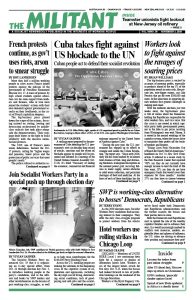
“We are moving forward with the solutions we’ve decided on. Without resources it’s a long, hard road, but we’re alive and we’re slowly making progress — with our people,” Vicente de la O Levy, Cuba’s minister of energy and mines, told Reuters Oct. 9. (A more complete version of the interview was posted on YouTube by the Cuban News Agency.)
He described the brutal effects of the U.S. rulers’ oil blockade and sanctions imposed on the Cuban economy and people, and responded to Washington’s latest round of threats of attack.
In early October, U.S. authorities announced the Coast Guard had intercepted a loaded oil tanker they claimed was bound for Cuba.
“We can assure you that there was no contract of any kind with Enetec S.A.,” said de la O Levy, “No Cuban state-owned company has managed to secure a fuel contract, whether for small or large quantities.” This is nothing more than an effort by Washington to put additional pressure on the Cuban government, and to show the world how difficult it is to get fuel to Cuba, he said.
The oil blockade imposed by the Donald Trump administration in January has succeeded in preventing any fuel deliveries to the Cuban government, crippling the country’s industry, transportation and basic services. Washington has allowed some U.S. fuel exporters to ship gasoline and diesel to the island’s private sector.
The U.S. media speaks of “millions of gallons” of imported fuel coming to the private sector, said de la O Levy, but these are small quantities compared to the country’s needs. “We continue suffering blackouts. We lack fuel to transport medicine, raw materials for production, irrigation, virtually everything.”
The U.S. ban also applies to liquified gas sold in small cylinders for cooking, which a large percentage of Cuba’s people depend on. “This is another concrete example of how the blockade directly attacks the people,” he said.
New gov’t steps ease scarcities
As part of steps recently rolled out by the Cuban leadership, private businesses and individuals are now allowed to import and resell fuel, lubricants and other products. They are also able to lease state-run facilities to sell these products. Up to now, much of the imported fuel brought to Cuba has been sold chaotically from people’s apartments and private convenience stores. Prices have ranged from $19 to $38 a gallon, which gets added on top of the cost of everything, from produce at the market to taxi fares.
Now farm cooperatives, made up of individual private farmers, are pooling their resources to import U.S. fuel directly, not through middlemen sprouting up across the island in search of profits.
Some cooperative members “bought 1,500 liters, and some 200,” Pablo Pérez Guzmán, president of the Frank País Cooperative in Artemisa province, told the local newspaper. “We didn’t get it to resell it, but for the producers directly.” Farmers will pay $2.40 a liter, instead of the $7 demanded by private sellers.
The cooperative also allocated 20 to 50 liters for some farmers who couldn’t afford to pay. “It’s not possible to supply everyone, but even so, collectively we have planted more than 50% of our land in order to bring food to the people,” said Pérez.
US goal: crush the Cuban people
The U.S. government’s sanctions are intended “to break the Cuban government and people,” said the energy minister. They tell us “we must privatize CUPET” — the state-owned oil and gas company — and that we “must privatize tourism, the entire Cuban economy; that there must be ‘free’ elections, that there must be this, and there must be that.”
The U.S. rulers’ aggression didn’t start with Donald Trump’s executive order, he said. It began on Jan. 1, 1959, with the triumph of the Cuban Revolution. And it has continued for over six decades, under Republican and Democratic administrations alike.
“Are they going to lift the blockade if we privatize CUPET? Are they going to end the pressure? We’re not infants to believe that,” he said. “Their intention is to break the Cuban people, and the Cuban people have decided that is not going to happen.”
Asked by Reuters about the slight improvement seen in the energy supply since the end of the summer, de la O Levy attributed it to maintenance done on power plants, the installation of 144 solar farms and countless numbers of solar panels installed on the roofs of homes and institutions.
As part of this effort, priority has been given to providing electricity to schools, health clinics, maternity homes and elderly centers, he said. All of Cuba’s polyclinics now have a basic solar unit that provides enough energy for minimal light, ventilation and keeping medications refrigerated.
He said 44 electric charging stations have been installed around the country. More than 1 million electric scooters and tricycles, many of them providing public transportation, are circulating. “It’s a bare-bones means of transportation, not the big air-conditioned buses with comfortable seats we used to have, and they can’t cover long routes. But we are moving,” said de la O Levy. “That’s what this siege has imposed on us, but we’re coming out of it.”